
Elasticity And Surface Tension Manufacturer, Suppliers and Exporter in India
Lab Exports is leading Elasticity And Surface Tension Manufacturer,and supplier and Exporter in India, These Physics Lab items measure how solids stretch and twist and how liquids behave at their surface and in slow flow. Senior school and degree classes use them for Young's modulus, spring constant, modulus of rigidity and Poisson's ratio. Capillary, Quincke, Searle and bubble pressure apparatus cover surface tension, and Stokes and Searle apparatus cover viscosity.The elasticity, surface tension and viscosity items
Every item links to its page with a specification table and house code.
| Measurement | Items |
|---|---|
| Stretching of wires and springs | Young's Modulus Apparatus (Searle's Pattern); Young's Modulus Apparatus (Vernier Type); Young's Modulus Apparatus; Steel Wire (100gm); Hooke's Law Apparatus |
| Rigidity and Poisson's ratio | Rigidity Apparatus (Searle's Pattern); Poisson's Ratio of Rubber Apparatus |
| Surface tension | Capillary Tube Clamp; Rising Table with Capillary Tube Clamp; Quincke's Surface Tension Apparatus; Searle's Surface Tension Balance; Surface Tension Apparatus |
| Viscosity | Viscosity Apparatus Stokes Method; Viscometer Searle's Pattern |
Buying notes for elasticity and liquid apparatus
- Check the syllabus level first. Senior school lists keep to Young's modulus, the spring constant, capillary rise and Stokes' method.
- Decide how extension is read. The Searle's pattern restores a spirit level with a micrometer reading to 0.01 mm. The vernier type reads to 0.1 mm against a 10 cm brass scale.
- List the separate parts and consumables. Slotted weights are not included with the Searle's pattern Young's modulus apparatus. Test wire and loading masses are separate for the Young's Modulus Apparatus, and lead shot is not included with the Stokes apparatus.
- Plan capillary sets as a group. The rising table and the capillary tube clamp are separate items, or can come as one capillary rise set. Quincke's apparatus comes without mercury.
- Check the Stokes tube. The Viscosity Apparatus Stokes Method comes with six steel balls and two rubber bands as index marks. Its one-metre borosilicate tube is clamped upright over a heavy cast iron base.
Class 11 and degree practicals with these items
Young's modulus of a wire is found by loading it in steps and reading the extension against a reference wire, using a length of Steel Wire (100gm). The force constant of a helical spring comes from a load against extension graph on the Hooke's Law Apparatus.
Degree classes time the swinging and twisting of two suspended rods on the Rigidity Apparatus (Searle's Pattern). One wire then gives Young's modulus, the modulus of rigidity and Poisson's ratio.
Surface tension of water is found by capillary rise with a travelling microscope, using the Capillary Tube Clamp. Adding detergent shows the rise falling. The surface tension of mercury comes from Quincke's drop method, and the coefficient of viscosity of glycerine comes from the terminal velocity of a falling steel ball.
Frequently Asked Questions
What is Searle's apparatus used for?
It measures the Young's modulus of a wire. A test wire and a reference wire hang side by side, so temperature changes and any sag of the support affect both equally. The Searle's pattern reads extension with a spirit level and micrometer; the vernier type reads it on a vernier scale.
How to choose capillary tube size?
Choose clear glass tubes with a narrow, even bore, open at both ends. A very fine bore is hard to measure, and a wide bore gives too small a rise. A set of several bores lets students check that rise times radius stays nearly constant. The capillary tube clamp in this range holds four glass tubes of 0.40 to 1.00 mm bore.
Why is the free surface of water concave but that of mercury convex?
The angle of contact decides the shape. Water is attracted to glass more strongly than to itself, so its contact angle is acute and the surface dips in the middle. Mercury holds together more strongly than it clings to glass, so its contact angle is obtuse and the surface bulges upwards.
Are critical velocity and terminal velocity the same?
No. Critical velocity is the speed of flow up to which a liquid flows smoothly in layers; above it the flow becomes turbulent. Terminal velocity is the constant speed a body settles at when falling through a fluid, once drag and upthrust balance its weight.
What is surface tension?
Surface tension is the property that makes the free surface of a liquid act like a stretched elastic skin, pulling it towards the smallest possible area. It is measured as the force acting per unit length along a line drawn in the surface.
To enquire, email [email protected] with the house codes and quantities of the items you need. Tender buyers can also see the Tenders and OEM page.
Last updated: 24 November 2026
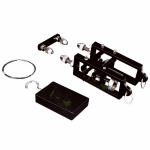
Young's Modulus Apparatus (Searle's Pattern)
Product Code : EL-EAST-10411
Searle's pattern Young's modulus apparatus: two brass frames with self-centering chucks, spirit level link and micrometer reading to 1/100 mm.
Note:
View Details
Young's Modulus Apparatus (Vernier Type)
Product Code : EL-EAST-10412
Vernier type Young's modulus apparatus with 10 cm brass scale and sliding vernier reading to 0.1 mm, in a case with two matched steel wires, ceiling attachment and weight.
Note:
View Details
Hooke's Law Apparatus
Product Code : EL-EAST-10413
Hooke's law apparatus with 30 cm mirror scale, spring, pointer and slotted weights with hanger on a stand; a 12 cm aluminium-scale version is also available.
Note:
View Details
Rigidity Apparatus (Searle's Pattern)
Product Code : EL-EAST-10414
Searle's pattern apparatus with two 30 cm brass rods joined by a 30 cm test wire, for finding the modulus of rigidity and Young's modulus of wires.
Note:
View Details
Poisson's Ratio of Rubber Apparatus
Product Code : EL-EAST-10415
Poisson's ratio apparatus with a cycle rubber tube about one metre long, fitted with a small pointer and mounted on a heavy cast iron stand.
Note:
View Details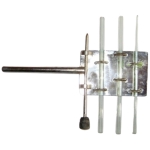
Capillary Tube Clamp
Product Code : EL-EAST-10416
Metal frame clamp holding four 10 cm capillary tubes of different internal diameters, with a 9 mm rod for mounting in a laboratory stand.
Note:
View Details
Rising Table with Capillary Tube Clamp
Product Code : EL-EAST-10417
Adjustable rising table with a 4 inch cast aluminium top, rising to 12 inches, paired with a capillary tube clamp for surface tension experiments.
Note:
View Details
Quincke's Surface Tension Apparatus
Product Code : EL-EAST-10418
Quincke's apparatus with a circular metallic plate, three levelling screws and a sensitive spirit level, for the surface tension of mercury.
Note:
View Details
Searle's Surface Tension Balance
Product Code : EL-EAST-10419
Searle's balance measuring the surface tension of soap film or transparent liquids by beam deflection on a stretched wire, on a tripod stand.
Note:
View Details
Surface Tension Apparatus
Product Code : EL-EAST-10420
Surface tension apparatus with manometer and capillary tube on a wooden stand, and a wide-mouth reagent bottle with dropping funnel in a two-holed cork.
Note:
View Details
Viscosity Apparatus Stokes Method
Product Code : EL-EAST-10421
Stokes' method viscosity apparatus: 1 m borosilicate glass tube held vertically on a heavy cast iron base, with six steel balls and two index bands.
Note:
View Details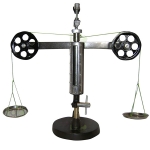
Viscometer Searle's Pattern
Product Code : EL-EAST-10422
Searle's pattern viscometer with height-clampable outer cylinder and mm-graduated inner cylinder, complete with scale pans and releasing pin.
Note:
View Details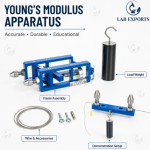
Young’s Modulus Apparatus
Product Code : SCL-EAST-11178
Young's modulus apparatus with experimental frame, wire holder and clamping assembly and a load weight with hook, for tensile extension tests.
Note:
View Details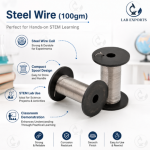
Steel Wire (100gm)
Product Code : SCL-EAST-11219
Steel wire in a nominal 100 gm pack, cut to length as needed for elasticity experiments, suspensions and model-making in the physics lab.
Note:
View Details