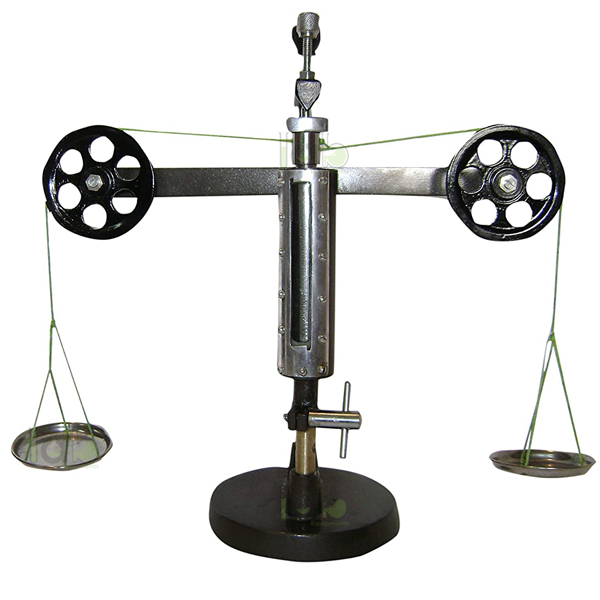
Young's Modulus Apparatus (Searle's Pattern)
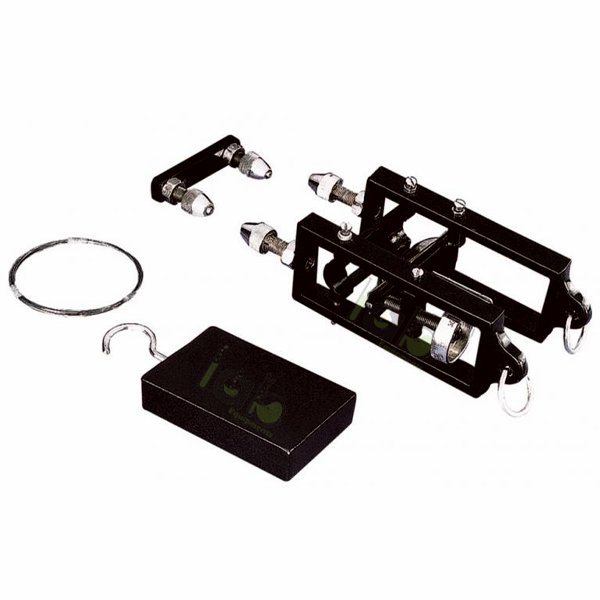
Product Code : EL-EAST-10411
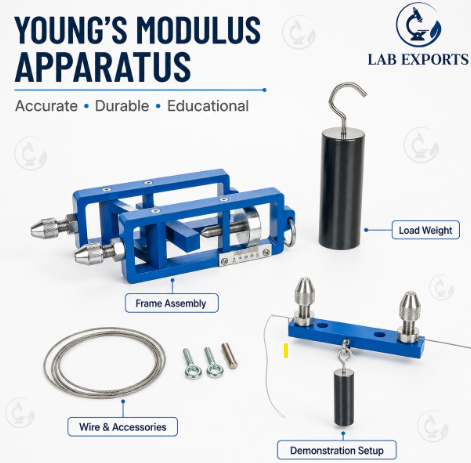
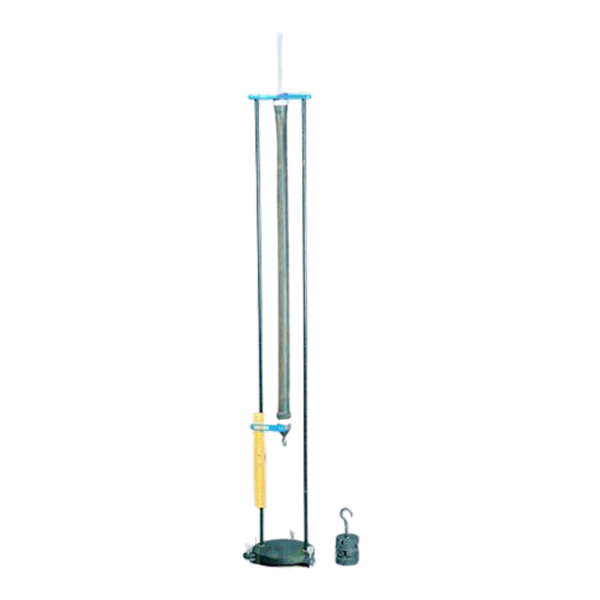
This Searle's pattern apparatus finds the Young's modulus of a wire from how far it stretches under load. Two brass frames with self-centering chucks are joined by a pivoted link that carries a sensitive spirit level. A micrometer head reading to 1/100 mm measures the extension. It comes in a case with a ceiling bracket and a constant weight.
Specifications of the Searle's apparatus
| Component | Specification |
|---|---|
| Method | Searle's pattern |
| Frames | Two, brass, with self-centering chucks |
| Level indicator | Sensitive spirit level on a pivoted link |
| Extension measurement | Micrometer head reading to 1/100 mm (0.01 mm) |
| Supplied with | Ceiling bracket and constant weight, in a case |
| Slotted weights | Not included |
| House code | EL-EAST-10411 |
| Manufacturer | Lab Exports, Delhi |
Experiments with the Searle's apparatus
Two wires hang side by side from the ceiling bracket. The reference wire carries the constant weight, and the test wire carries the load. As the test wire stretches, its frame drops and the spirit level tilts. Turning the micrometer until the bubble is central again gives the extension.
- Young's modulus of a steel wire. Use a length of steel wire as the test wire and measure its diameter with a screw gauge. Then Y = MgL/(πr2l). Here M is the load in kg and g the acceleration due to gravity. L is the length of the wire, r its radius (half the diameter) and l the extension.
- Load against extension graph. Load the test wire in equal steps with a slotted mass hanger and plot load against extension. A straight line shows that Hooke's law holds. Its slope gives M/l for the formula.
- Comparing two metals. Repeat the experiment with brass wire in place of steel, for both the test wire and the reference wire. For wires of the same length and diameter under the same load, the metal with the lower Young's modulus stretches more.
How to take the readings
- Hang both wires from the ceiling bracket and fit the frames. Load each wire enough to make it straight.
- Measure the length L of the test wire, and its diameter at several points along it.
- Turn the micrometer until the bubble is central, and note this zero reading.
- Add weights in equal steps. Relevel the bubble and record the micrometer reading after each step.
- Remove the weights in the same steps, reading each time, and take the mean extension for each load.
Documentation and supply
Most Lab Exports products carry a one-year manufacturer warranty.
Lab Exports manufactures the Searle's pattern Young's modulus apparatus at its works in Laxmi Nagar, Delhi, and supplies it to schools, colleges and universities in India and 60+ countries, handling the export documents for each shipment. More about the company is on the About Lab Exports page.
Frequently Asked Questions
Why does Searle's method use two wires?
The second wire is a reference. If the support sags under the load, or the room temperature changes, both wires move by the same amount. The spirit level only tilts when the test wire stretches more than the reference wire, so those errors cancel.
Why must the diameter of the wire be measured so carefully?
The radius appears squared in the formula, so the percentage error in the diameter is doubled in Y. Take readings at several points along the wire, in two directions at right angles, and use the mean.
Why are readings taken while unloading as well as loading?
If the unloading readings match the loading ones, the wire has stayed within its elastic limit. Any small lag in the wire shows up as a difference between the two sets. Taking the mean of the two readings for each load reduces that error.
Why is a small load kept on the wire before the zero reading?
A wire usually has kinks and bends. A small starting load pulls it straight, so the extensions you record are true stretching and not straightening. For the same reason, the constant weight keeps the reference wire taut throughout.
Does Young's modulus change if a longer or thicker wire of the same metal is used?
No. Young's modulus is a property of the material. A longer wire stretches more and a thicker wire stretches less under the same load. The ratio of stress to strain stays the same.
Are slotted weights included?
No. The apparatus comes in a case with a ceiling bracket and a constant weight, and slotted weights are not included. A slotted mass hanger with its weights can be ordered with it to load the test wire.
Other apparatus for elasticity practicals
- Young's Modulus Apparatus (Vernier Type)
- Hooke's Law Apparatus
- Rigidity Apparatus (Searle's Pattern)
- Poisson's Ratio of Rubber Apparatus
More apparatus is in the Elasticity and Surface Tension section of the Physics Lab range.
To enquire, email [email protected] with the house code EL-EAST-10411 and the quantity, or use the Add To Cart button on this page. Tender buyers can also see the Tenders and OEM page.
Last updated: 19 November 2026