Surface Tension Apparatus
Product Code : EL-EAST-10420
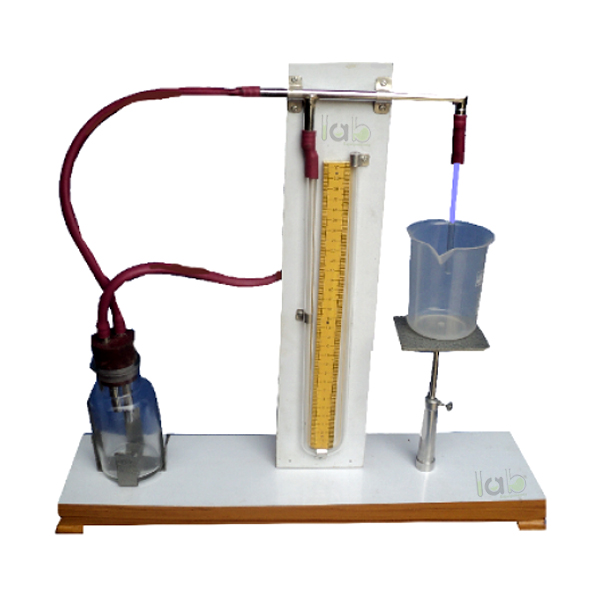
This apparatus finds the surface tension of a liquid by the maximum bubble pressure method, also called Jaeger's method. A U-tube manometer filled with coloured water and a capillary tube of 0.60 mm bore are mounted on a wooden stand. A wide-mouth reagent bottle, closed by a two-holed cork with a dropping funnel, supplies the air pressure. No aspirator is included.
Specifications of the bubble pressure apparatus
| Component | Specification |
|---|---|
| Method | Maximum bubble pressure (Jaeger's method) |
| Stand | Wooden, with the manometer and capillary tube mounted on it |
| Manometer | U-tube with 200 mm limbs, filled with coloured water of known density; the reference limb is open to the air |
| Manometer scale | 0 to 100 mm water head, read as the difference between the limbs, in 1 mm divisions |
| Capillary tube | Square-cut tip, 0.60 mm internal diameter |
| Air reservoir | Wide-mouth reagent bottle |
| Bottle fitting | Two-holed cork: a dropping funnel in one hole, and an outlet tube opening into the air space of the bottle in the other |
| Connections | A tee and flexible tubing join the outlet tube to the manometer and to the capillary tube |
| Test-liquid beaker | 100 ml low-form glass beaker, a separate item |
| Aspirator | Not included |
| House code | EL-EAST-10420 |
| Manufacturer | Lab Exports, Delhi |
Experiments by Jaeger's method
Water dripping slowly from the funnel into the closed bottle displaces air and raises the pressure inside. That air passes out through the outlet tube and a tee to the manometer and to the capillary tube. The tip of the capillary dips into the test liquid in a 100 ml beaker. Every joint must be airtight, because the pressures measured are small. A bubble grows slowly at the tip. The pressure inside it is greatest when the bubble is a hemisphere with the same radius r as the capillary bore.
At that moment the manometer reading balances the depth of liquid above the tip plus the excess pressure 2T/r. So T = (rg/2)(Hρm - hρ). Here H is the manometer difference just before the bubble breaks away, and ρm is the density of the coloured water in the manometer. h is the depth of the tip, ρ the density of the test liquid and g the acceleration due to gravity.
- Water at one depth. The capillary has a 0.60 mm bore. Check it at the tip with a travelling microscope and take r as half of it. Dip the tip to a measured depth h and let the funnel drip slowly. Read both menisci of the manometer and note the highest H for several bubbles. Use the mean H in the formula.
- Changing the depth of the tip. Repeat at several depths h. H rises as the tip goes deeper, but each pair of readings should give nearly the same T. This checks the correction for the depth of the tip.
- Cross-check by capillary rise. Measure T for the same sample of water by the capillary rise method, with the beaker raised on a rising table with capillary tube clamp. The two methods rest on different readings, so close agreement checks both.
Frequently Asked Questions
How does Jaeger's method determine surface tension?
Jaeger's method measures the greatest air pressure needed to push a bubble out of a capillary tip dipped in the liquid. At that moment the bubble is a hemisphere of the capillary radius r, with an excess pressure of 2T/r. The manometer reading, less the depth of liquid above the tip, gives the surface tension T.
Why is the capillary tube dipped to different depths?
Repeating at several depths checks the depth correction. The manometer must also balance the liquid above the tip, so the manometer difference H rises as the tip goes deeper. Each depth should still give nearly the same T, and the mean of several depths is more reliable than one reading.
How does the radius of the capillary affect the bubble pressure?
A narrower capillary needs a higher pressure to release a bubble. The excess pressure at release is 2T/r, so it varies inversely with the radius r. That is why the 0.60 mm bore of the tip is checked carefully, for example with a travelling microscope.
Why must the bubbles form slowly?
Slow bubbling lets the manometer follow the pressure, so the highest reading just before each bubble breaks away can be read. If the water runs in fast, bubbles leave before the reading settles and H comes out wrong. The dropping funnel lets you set a slow drip into the bottle.
Why is the pressure inside a bubble greater than outside?
A curved liquid surface under tension pushes inward, so the pressure on its concave side is higher. A bubble of radius r inside a liquid has one surface, and its excess pressure is 2T/r, where T is the surface tension. A soap bubble in air has two surfaces, so its excess pressure is 4T/r.
More apparatus for surface tension practicals
More apparatus is in the Elasticity and Surface Tension section of the Physics Lab range.
To enquire, email [email protected] with the house code EL-EAST-10420 and the quantity, or use the Add To Cart button on this page.
Last updated: 23 November 2026