Poisson's Ratio of Rubber Apparatus
Product Code : EL-EAST-10415
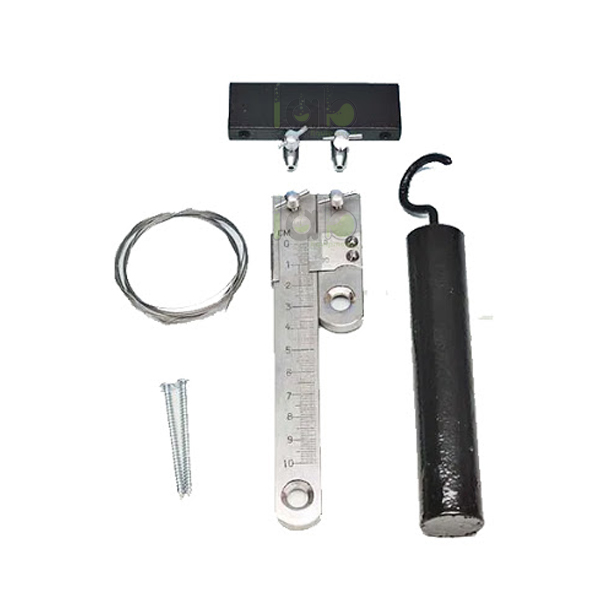
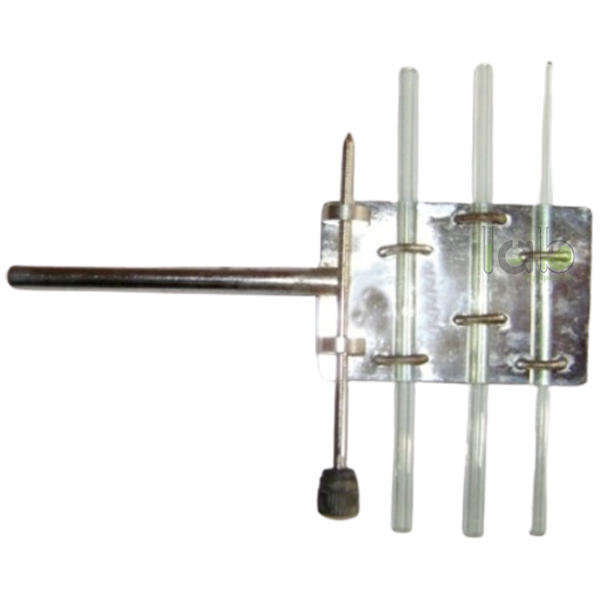
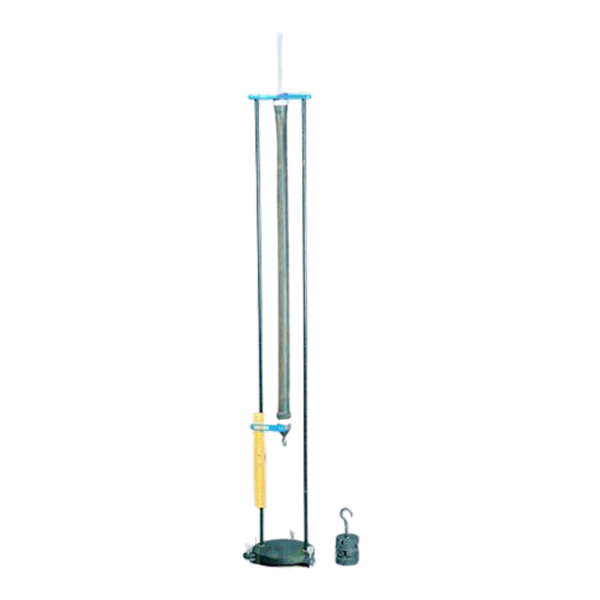
This apparatus is used to find Poisson's ratio for rubber, the ratio of sideways contraction to lengthwise extension when it is stretched. It has a cycle rubber tube about one metre long, fitted with a small pointer and mounted on a heavy cast iron stand. A solid bung seals the lower end, and a retaining sleeve there carries the hanger hook.
Specifications of the Poisson's ratio apparatus
| Component | Specification |
|---|---|
| Tube | Cycle rubber tube, about 1 metre long |
| Indicator | Small pointer on the tube |
| Stand | Heavy cast iron |
| Lower end | Sealed with a solid bung |
| Load fitting | Retaining sleeve over the lower end of the tube, carrying the hanger hook |
| Principle | Lateral contraction against longitudinal extension |
| Extras for the volume method | Slotted weights, a weight hanger and a burette: ask for them in the enquiry if needed |
| House code | EL-EAST-10415 |
| Manufacturer | Lab Exports, Delhi |
Finding Poisson's ratio of rubber
Poisson's ratio σ is the lateral strain divided by the longitudinal strain. A stretched rubber tube gets longer and narrower at the same time, and the small pointer shows how far it has stretched.
- Volume method with a burette. Clamp the tube vertically on the cast iron stand, with the bung in its lower end, and fill it with water. Fit a burette at the top, held in a burette clamp. Hang a slotted mass hanger on the hook of the retaining sleeve and add masses in equal steps. The sleeve passes the load to the tube itself, so it does not rest on the grip of the wet bung alone. For each load, note the increase in length dL from the pointer and the change in volume dV from the water level in the burette.
- Working out the ratio. Read the internal diameter D of the tube at its end with the inside jaws of a vernier caliper. The internal cross-sectional area is then A = πD2/4. Plot dV against dL and take the slope dV/dL. Then σ = (1/2)(1 − (1/A)(dV/dL)).
- Comparing with the expected value. Rubber changes its volume very little when stretched, so the result should come out close to 0.5. Most metals give a value of about 0.3, which shows how differently the two kinds of material behave.
Frequently Asked Questions
What is Poisson's ratio for rubber?
It is close to 0.5, the upper limit for an ordinary material. Rubber keeps nearly the same volume when it is stretched, so its sideways contraction almost makes up for the gain in length.
How is Poisson's ratio calculated, and does it have a unit?
It is the lateral strain divided by the longitudinal strain. The lateral strain is the change in diameter over the diameter, and the longitudinal strain is the change in length over the length. Both are ratios of lengths, so Poisson's ratio has no unit.
What are the limits of Poisson's ratio?
In theory it lies between −1 and 0.5 for a material that behaves the same in every direction. Nearly all real materials fall between 0 and 0.5. A value above 0.5 would mean the volume shrinks on stretching, which ordinary materials do not do.
Why must there be no air bubbles in the water inside the tube?
An air bubble is squeezed or expands as the load changes. The water level in the burette then moves for that reason as well, and dV no longer shows only the change in the inside volume of the tube.
Why should the hanger be still when a reading is taken?
A swinging or bouncing load keeps changing the stretch, so neither the pointer nor the water level settles. Wait until the hanger is still, then read the pointer and the burette together.
More apparatus for measuring elastic properties
- Rigidity Apparatus (Searle's Pattern)
- Young's Modulus Apparatus (Vernier Type)
- Hooke's Law Apparatus
More apparatus is in the Elasticity and Surface Tension section of the Physics Lab range.
To enquire, email [email protected] with the house code EL-EAST-10415 and the quantity, or use the Add To Cart button on this page.
Last updated: 23 November 2026