Viscometer Searle's Pattern
Product Code : EL-EAST-10422
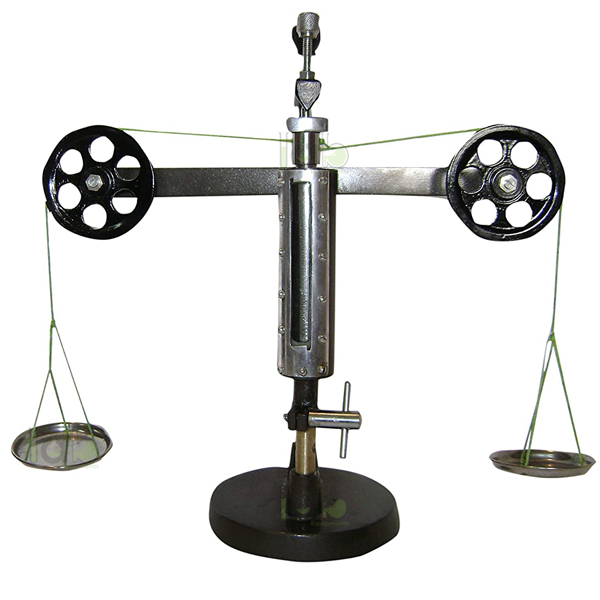
This rotating cylinder viscometer, Searle's pattern, measures the coefficient of viscosity of very viscous liquids. An inner cylinder of 20.0 mm radius turns inside an outer cylinder of 22.0 mm internal radius, with the liquid in the 2.0 mm gap. Weights in two scale pans pull cords round a drum on the axle. A releasing pin holds the cylinder until each run starts.
Specifications of the Searle's viscometer
| Component | Specification |
|---|---|
| Pattern | Searle's, rotating inner cylinder |
| Inner cylinder | 20.0 mm radius, graduated in mm, with a transparent cover over the reading slot |
| Outer cylinder | 22.0 mm internal radius, can be clamped at any desired height |
| Radial gap | 2.0 mm |
| Immersed length | 50 mm; other lengths by clamping the outer cylinder at another height |
| Drive | Two cords over opposite low-friction pulleys pull tangentially on a coaxial drum, 40.0 mm effective diameter at the cord centreline |
| Supplied with | Two scale pans and a releasing pin |
| Slotted masses | Calibrated, a separate accessory, supplied in equal pairs |
| Suited to | Very viscous liquids |
| House code | EL-EAST-10422 |
| Manufacturer | Lab Exports, Delhi |
Viscosity measurements with the rotating cylinder
Each pan hangs on a cord that passes over a pulley and pulls on the drum, and both pulls turn the drum the same way. With a total mass m in each pan, the driving couple is about 2mgr. Here r is the drum radius, half the 40.0 mm diameter, and g is the acceleration due to gravity. The liquid resists by viscous drag, and the cylinder soon turns at a steady angular speed ω. Let a be the radius of the inner cylinder (20.0 mm), b the inner radius of the outer cylinder (22.0 mm) and l the immersed length. The viscous couple is then G = 4πηlωa2b2/(b2 - a2), where η is the coefficient of viscosity. At steady speed G equals the driving couple, less the losses in the bearings and pulleys.
- Single-load run on glycerine or a heavy oil. Check the radii a and b with a vernier caliper, since the actual values enter the result directly. Place one mass of an equal pair of slotted masses in each scale pan. Withdraw the releasing pin, wait for a steady speed, then time a set number of turns with a stop clock.
- Speed against load. Repeat with several loads and plot the load against the steady angular speed. The points should lie on a straight line, and its slope is used in place of a single reading.
- Removing the end effect. The ends of the inner cylinder add an unknown extra drag. Clamp the outer cylinder at a new height, read the new immersed length on the mm scale and repeat. Taking the difference between the two results cancels the end effect.
Running the viscometer
- Fill the outer cylinder with the liquid and clamp it so the inner cylinder is immersed to a known depth.
- Load the scale pans equally while the releasing pin holds the inner cylinder still.
- Withdraw the pin and let the speed become steady before you start timing.
- After each run, engage the releasing pin again before you change the load or the immersed length.
Frequently Asked Questions
What is the working principle of a rotating cylinder viscometer?
It measures the couple needed to keep one cylinder turning steadily inside another, with the liquid filling the gap. At a steady speed, the driving couple from the weights equals the viscous couple of the liquid. The coefficient of viscosity then follows from that couple, the steady angular speed and the cylinder dimensions.
Why is the rotating cylinder method preferred for highly viscous liquids?
It gives a steady rotation that is easy to time, where a falling ball would move too slowly for convenient timing. The viscous drag acts over the whole immersed surface of the inner cylinder. The load in the scale pans can be changed to suit the liquid.
How does the gap between the two cylinders affect the measurement?
A narrower gap gives a larger viscous couple at the same speed, so a given load turns the cylinder more slowly. On this viscometer the gap is 2.0 mm, so b2 - a2 is small, and small errors in the radii cause large errors in η. The cylinders must also be coaxial so that the gap is even all round.
What are the main sources of error in the rotating cylinder experiment?
The chief ones are the extra drag at the ends of the inner cylinder and timing before the speed is steady. A change in liquid temperature during the runs matters too. Friction in the bearings and pulleys uses up part of the driving couple. Repeating with two immersed lengths removes the end effect.
What other methods are used to measure viscosity?
Two common ones are the falling ball (Stokes) method and the capillary flow (Poiseuille) method. The first times a ball falling at its terminal velocity through the liquid. The second measures the rate of flow through a narrow tube and suits less viscous liquids such as water. The rotating cylinder method on this page suits very viscous liquids.
Other apparatus for properties of liquids
More apparatus is in the Elasticity and Surface Tension section of the Physics Lab range.
To enquire, email [email protected] with the house code EL-EAST-10422 and the quantity, or use the Add To Cart button on this page.
Last updated: 23 November 2026