
Magnetism Manufacturer, Suppliers and Exporter in India
Lab Exports is leading Magnetism Manufacturer,and supplier and Exporter in India This part of the Physics Lab range holds permanent magnets and electromagnetism apparatus for school and college classes. Permanent magnets come as bars, cylinders, horseshoes and U shapes in chrome steel or alnico, alongside ferrite, neodymium and ceramic pieces. Electromagnets, Fleming rule apparatus, a motor model, a demountable transformer, a magnetic needle and a tangent galvanometer cover current and magnetism.Magnets and electromagnetism items by group
Each item below opens its own page with its details and house code.
| Group | Items |
|---|---|
| Bar and cylindrical magnets | Bar Magnet Pair Chrome Steel; Alnico Bar Magnet Pair; Bar Magnet - Superior; Cylindrical Bar Magnet, Pair, Chrome Steel; Alnico Cylindrical Magnet Pair |
| Horseshoe and U-shaped magnets | Horseshoe Magnet Chrome Steel; Alnico Horseshoe Magnet; Horseshoe Magnet; U-Shaped Magnet, Chrome Steel; Alnico U-Shaped Magnet |
| Ferrite, neodymium, ceramic and ring magnets | Ferrite Discs; Ferrite Rings; Neodymium Discs; Neodymium Cylinder; Neodymium Block; Magnadur Magnets (Rectangular Magnet); Floating Ring Magnet Apparatus |
| Electromagnets, motor and induction | Electromagnet; Electromagnet "U" Shape; Fleming's Left Hand Rule; Fleming's Right Hand Rule; Electric Motor Model; Induced Current Apparatus; Demountable Transformer |
| Needle and field instruments | Magnetic Needle on Stand; Tangent Galvanometer |
Picking magnet materials and shapes for a class set
- Match the material to the task. Alnico bar and horseshoe magnets give clear poles at the ends for field plotting. Ferrite pieces suit general bench work, and the much stronger neodymium shapes suit teacher demonstrations.
- Plan for handling. Ferrite and neodymium magnets are hard but brittle and can chip if dropped or allowed to snap together. Alnico is tougher to break but loses strength more easily if knocked or stored badly.
- Choose shapes by experiment. Bar magnets suit field lines and pole tests, while horseshoe and U shapes concentrate the field between facing poles. Floating ring magnets show repulsion, as on the Floating Ring Magnet Apparatus.
- Ask about keepers and storage. Store pairs with unlike poles side by side and keepers across the ends.
- Check the electrical side of electromagnetism items, so the cells or supply can be planned with them.
Magnetism practicals in the syllabus
Younger classes test attraction and repulsion between poles and find which materials a magnet picks up. A freely pivoted Magnetic Needle on Stand shows the directive property, settling along the north-south line. Field lines are traced around a bar magnet with a small compass, dot by dot, on a fixed sheet of paper.
For electromagnetism, students pass a current through a coil on a soft iron core and see it attract iron only while the current flows. The Fleming's Left Hand Rule apparatus links field, current and force, which is the action inside the Electric Motor Model. Moving a magnet into a coil induces a current, the effect the Induced Current Apparatus is used to show.
Senior classes assemble coils on a core with the Demountable Transformer to compare turns and voltages. The Tangent Galvanometer finds a current from how far a needle at the coil centre turns against the earth's horizontal field.
Frequently Asked Questions
What are the different types of magnets with their definitions?
There are three types. A permanent magnet keeps its magnetism once magnetised; ferrite, alnico and neodymium are common materials. A temporary magnet, such as soft iron, is magnetic only while in another field. An electromagnet is a coil on a soft iron core that is magnetic only while current flows.
Are neodymium magnets stronger than alnico?
Yes, neodymium magnets are far stronger for their size. Alnico has moderate strength and is tough, but loses magnetism more easily if dropped or kept without a keeper. Neodymium is brittle and can pinch fingers or chip when two pieces snap together, so it suits teacher-led demonstrations.
What is the proper way to store a bar magnet?
Store bar magnets in pairs, side by side with unlike poles together and a wooden strip between them. Place soft iron keepers across both ends to close the magnetic circuit. Keep the set in a dry drawer, away from heat, iron filings and electronic equipment.
How to trace the magnetic field lines around a bar magnet using a compass needle?
Fix the magnet on paper and draw its outline. Put a small compass near the north pole and mark a dot at each end of the needle. Move the compass so its tail sits on the last dot, mark again, and repeat. Join the dots, and keep iron objects away throughout.
When to use Fleming's LHR and RHR?
Use the left-hand rule for motors: it gives the direction of the force on a current-carrying conductor in a magnetic field. Use the right-hand rule for generators: it gives the direction of the current induced when a conductor moves through a field.
To enquire, email [email protected] with the house codes and quantities of the items you need. Tender buyers can also see the Tenders and OEM page.
Last updated: 24 November 2026

Neodymium Block
Product Code : EL-M-10309
Polish-coated neodymium rare-earth block magnet with flat faces, strong for its size, for generator models and uniform-gap experiments.
Note:
View Details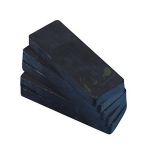
Magnadur Magnets (Rectangular Magnet)
Product Code : EL-M-10310
Flat rectangular Magnadur ceramic magnets with natural finish and high field strength, in seven sizes from 10 x 10 x 6 mm to 45 x 20 x 6 mm.
Note:
View Details
Neodymium Cylinder
Product Code : EL-M-10308
Polish-coated neodymium rare-earth cylinder magnet in four sizes up to 10 x 40 mm, for induction and Lenz's law experiments.
Note:
View Details
Neodymium Discs
Product Code : EL-M-10307
Polish-coated neodymium rare-earth disc magnets, very strong for their size, in seven sizes from 5 x 2 mm to 24 x 10 mm.
Note:
View Details
Alnico Bar Magnet Pair
Product Code : EL-M-10298
Pair of strong Alnico bar magnets with marked north pole and keepers, offered in 12 sizes from 50 x 10 x 6 mm to 150 x 15 x 10 mm.
Note:
View Details
Cylindrical Bar Magnet, Pair, Chrome Steel
Product Code : EL-M-10299
Pair of red-and-blue painted chrome steel cylindrical bar magnets, 10 mm diameter, in lengths from 50 to 250 mm, supplied with keepers.
Note:
View Details
Alnico Cylindrical Magnet Pair
Product Code : EL-M-10300
Pair of strong Alnico cylindrical magnets, 10 mm diameter, in 50, 75, 100 or 150 mm lengths, supplied with keepers.
Note:
View Details
Horseshoe Magnet Chrome Steel
Product Code : EL-M-10301
Red-painted chrome steel horseshoe magnet with keeper, in ten sizes from 50 to 200 mm long and 5 or 10 mm thick.
Note:
View Details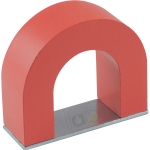
Alnico Horseshoe Magnet
Product Code : EL-M-10302
Red-painted Alnico horseshoe magnet with keeper for strong, lasting field demonstrations, in 50, 75 and 100 mm lengths.
Note:
View Details
U-Shaped Magnet, Chrome Steel
Product Code : EL-M-10303
Chrome steel U-shaped magnet with marked north pole and keeper, 75, 100 or 150 mm long in a 15 x 6 or 15 x 8 mm section.
Note:
View Details
Alnico U-Shaped Magnet
Product Code : EL-M-10304
Strong Alnico U-shaped magnet with an 18 mm centre gap and keeper, in 50, 75, 100 and 150 mm lengths with an 11 x 8 mm section.
Note:
View Details
Ferrite Discs
Product Code : EL-M-10305
Ferrite ceramic disc magnets with high coercivity, in six sizes from 15 x 3 mm to 35 x 8 mm, for low-cost classroom magnetism sets.
Note:
View Details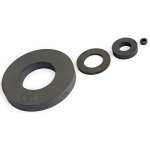
Ferrite Rings
Product Code : EL-M-10306
Ferrite ceramic ring magnets in five sizes from 18 x 6 mm to 36 x 8 mm, for floating-ring repulsion and basic magnetism experiments.
Note:
View Details
Bar Magnet Pair Chrome Steel
Product Code : EL-M-10297
Pair of chrome steel bar magnets, 75 x 12 x 5 mm, painted red and blue for pole identification and supplied with keepers.
Note:
View Details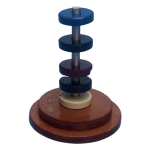
Floating Ring Magnet Apparatus
Product Code : EL-M-10311
Five ceramic ring magnets, 32 mm external diameter, on a wooden rod and base 150 mm high, showing like-pole repulsion as floating rings.
Note:
View Details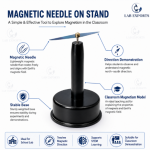
Magnetic Needle on Stand
Product Code : SCL-M-11100
Magnetised 100 mm carbon steel needle on a low-friction brass pivot and non-magnetic stand, for field direction and Oersted experiments.
Note:
View Details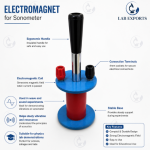
Electromagnet
Product Code : SCL-M-11183
U-shaped soft iron core electromagnet with insulated copper coils, 4 mm terminals, 4-6 V DC operation and a hooked soft iron armature.
Note:
View Details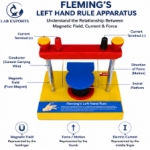
Fleming’s Left Hand Rule
Product Code : SCL-M-11198
Teaching model of Fleming's left hand rule showing the field, current and force directions of the motor effect.
Note:
View Details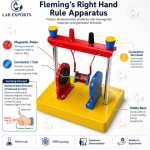
Fleming’s Right Hand Rule
Product Code : SCL-M-11199
Induction apparatus with a moving copper conductor, U-shaped permanent magnet and centre-zero indicator for Fleming's right hand rule.
Note:
View Details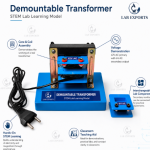
Demountable Transformer
Product Code : SCL-M-11210
Teaching transformer with a demountable core and coils of 2400 turns (220 V), 130 turns (12 V) and 65 turns (6 V) for turns-ratio experiments.
Note:
View Details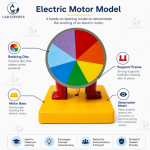
Electric Motor Model
Product Code : SCL-M-11214
Open-frame DC electric motor model, 3-6 V, with soft iron armature, split-ring commutator, adjustable brushes and permanent or electromagnet field.
Note:
View Details
Electromagnet “U” Shape
Product Code : SCL-M-11228
U-shaped core electromagnet for demonstrating the magnetic effect of current, pole formation and switchable attraction.
Note:
View Details
Horseshoe Magnet
Product Code : SCL-M-11245
U-shaped horseshoe permanent magnet for pole identification, material testing and field-direction activities in school science.
Note:
View Details
Bar Magnet – Superior
Product Code : SCL-M-11248
Straight permanent bar magnet with poles near the ends, for polarity, attraction, repulsion and field-mapping activities.
Note:
View Details
Tangent Galvanometer
Product Code : SCL-M-11272
Circular current-carrying coil with a compass needle and angular scale at its centre, used to verify the tangent law and measure current.
Note:
View Details
Induced Current Apparatus
Product Code : SCL-M-11342
Teaching apparatus for electromagnetic induction: moving a magnet relative to a coil produces an induced current, used for Faraday's and Lenz's laws.
Note:
View Details