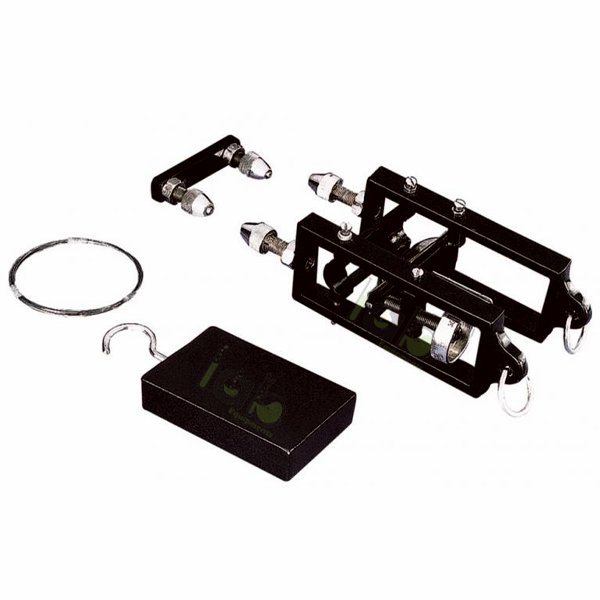
Hooke's Law Apparatus
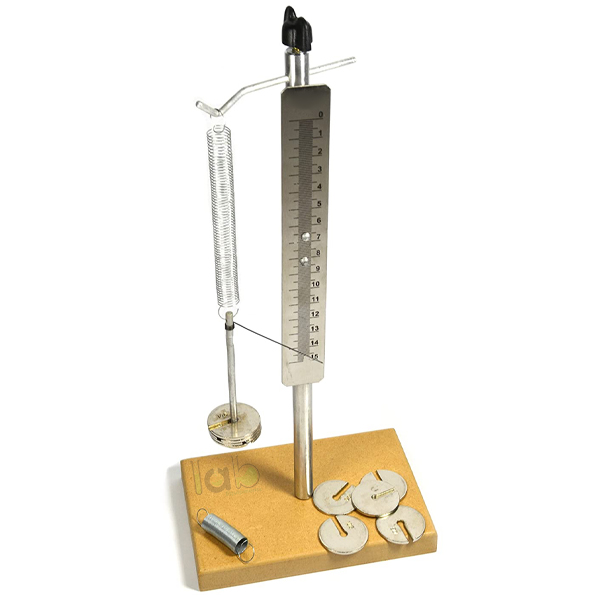
Product Code : EL-EAST-10413
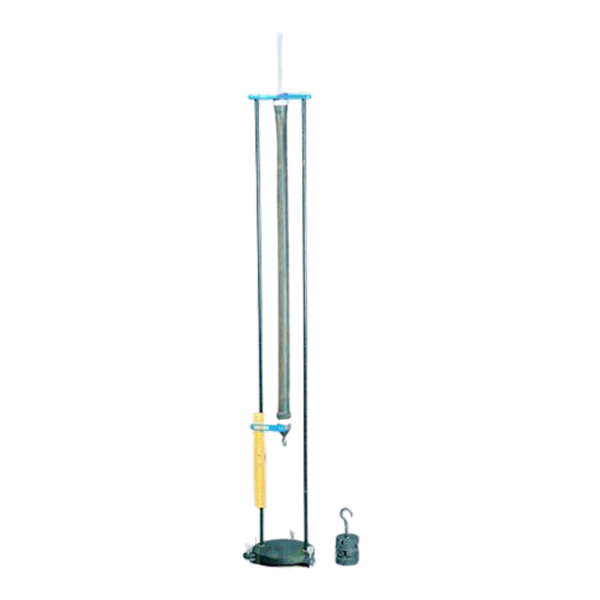
This apparatus shows that the stretch of a spring is proportional to the load on it, and gives the spring constant. The standard version has a 30 cm mirror scale and a spring of about 20 N/m with a pointer, all on a stand. A 50 g hanger and four 50 g slotted discs come with it. A version with a 12 cm aluminium scale on a metallic stand is also available.
Specifications of the Hooke's law apparatus
| Component | Specification |
|---|---|
| Scale (standard version) | 30 cm mirror scale |
| Spring | Spring constant about 20 N/m, fitted with a pointer |
| Slotted weights (standard version) | One 50 g hanger and four 50 g slotted discs |
| Working load | Up to 250 g including the hanger, about 2.45 N, for about 123 mm extension |
| Mounting (standard version) | On a stand |
| Alternative version | 12 cm aluminium scale, spring and slotted weight hanger (without weights), on a metallic stand |
| Principle | Hooke's law, force against extension |
| House code | EL-EAST-10413 |
| Manufacturer | Lab Exports, Delhi |
Experiments with the spring and mirror scale
Hooke's law says that, within the elastic limit, the extension x of a spring is proportional to the force F stretching it, so F = kx. Here k is the spring constant in newtons per metre (N/m).
- Spring constant from a force-extension graph. Add the four 50 g discs to the hanger one at a time and read the pointer after each. The force is mg, where m is the mass on the hanger in kg and g is the acceleration due to gravity. Plot force against extension, and the slope of the straight line is k. The 12 cm version has a hanger but no weights, so take masses from a slotted mass hanger set.
- Spring constant from oscillations. Pull the loaded hanger down a little and let it go, so it moves up and down. Time several complete oscillations with an analog stop clock and divide by their number to get the period T. Then k = 4π2m/T2, where m is now the whole mass on the spring, hanger included. Keep the spring vertical and the swings small. The mass of the spring itself adds a small error, so compare this k with the value from the graph.
Reading the pointer against the mirror scale
- Stand the apparatus on a level bench and let the spring hang freely with the pointer and hanger attached.
- Move your eye until the pointer hides its own image in the mirror. Your line of sight is then square to the scale, so there is no parallax error.
- Note the reading with the empty hanger, then add the 50 g discs one at a time and read again once the pointer is at rest.
- Take the weights off in the same steps and read again. The spring should come back to its first reading.
Frequently Asked Questions
What precautions should be taken in a Hooke's law experiment?
Hang the spring vertically from a rigid support and add the weights gently. Wait for the pointer to stop before reading, and keep the pointer in line with its image. Keep the total load within 250 g, hanger included.
What is the unit of the spring constant?
The SI unit is the newton per metre (N/m). The spring constant k is the force per unit extension, found as force divided by extension. A stiffer spring has a larger k and stretches less under the same load. The spring in this apparatus is about 20 N/m.
What are the limitations of Hooke's law?
It holds only up to the elastic limit, or more strictly the limit of proportionality. Beyond that the force-extension graph curves, and the spring may not return to its first length. Some materials, such as rubber, do not follow it closely even at small loads.
On what does the period of a loaded spring depend?
It depends on the mass hung on the spring and on the spring constant, since T = 2π√(m/k). A heavier load gives a longer period and a stiffer spring a shorter one. While the swings stay small, the period does not depend on their size.
Which version comes with slotted weights?
The standard version with the 30 cm mirror scale has a 50 g hanger and four 50 g slotted discs, 250 g in all. The 12 cm aluminium-scale version has a slotted weight hanger only, without discs, on a metallic stand.
Other apparatus for Hooke's law practicals
- K Constant Spring
- ESAL Spring Balance
- Slotted Mass Hanger, 1kg
- Young's Modulus Apparatus (Vernier Type)
More apparatus is in the Elasticity and Surface Tension section of the Physics Lab range.
To enquire, email [email protected] with the house code EL-EAST-10413 and the quantity, or use the Add To Cart button on this page. Tender buyers can also see the Tenders and OEM page.
Last updated: 23 November 2026