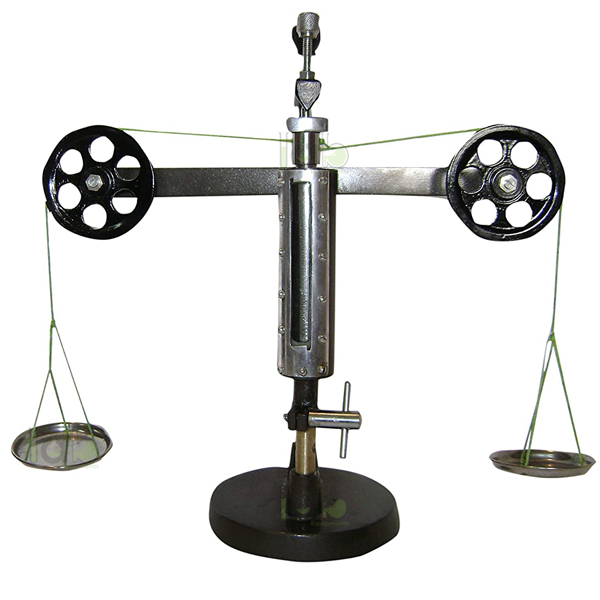
Searle's Surface Tension Balance
Product Code : EL-EAST-10419
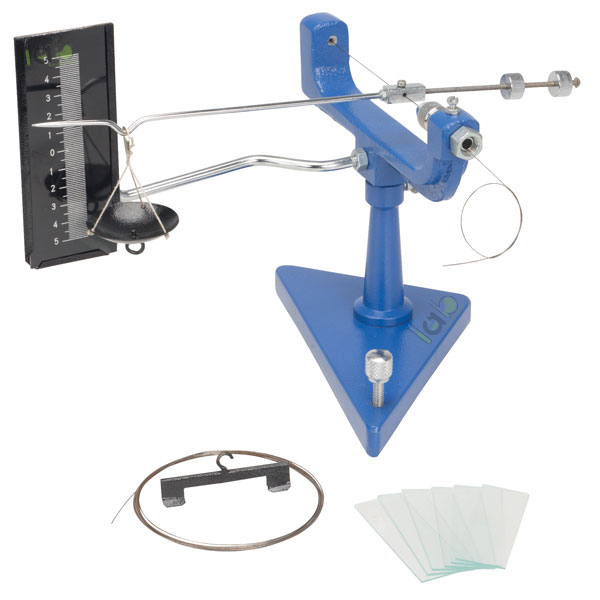
This Searle's balance finds the surface tension of a soap film or a liquid by the torsion method. A light beam is carried on a stretched wire, and the pull of the liquid surface twists the wire. A pointer on the beam reads that pull on a 0 to 10 mN scale. The balance stands on a tripod with a levelling screw.
Specifications of the surface tension balance
| Component | Specification |
|---|---|
| Method | Torsion balance: deflection of a beam carried on a stretched wire |
| Readout | Lightweight pointer on the beam over a fixed scale, 0 to 10 mN, in 0.1 mN divisions |
| Soap-film frame | Detachable rectangular wire frame, 30 mm straight wetted span |
| Plate | Flat and removable, a separate attachment for liquid surfaces |
| Calibration masses | 10, 20, 50, 100, 200 and 500 mg, with tweezers |
| Stand | Tripod, with levelling screw |
| Suitable for | Soap films and transparent liquids; coloured or opaque liquids too, when the point of detachment can be seen and wetting is repeatable |
| House code | EL-EAST-10419 |
| Manufacturer | Lab Exports, Delhi |
Measurements with the torsion balance
The wire frame, or the separate plate, hangs from one end of the beam. A soap film on the frame pulls it down with a force F = 2TL. Here T is the surface tension and L is the 30 mm wetted span of the frame. The factor 2 counts the two surfaces of the film. With the plate in a liquid, the pull depends on the wetted perimeter of the plate and the angle of contact. The force twists the wire, and the beam turns through an angle proportional to the force.
- Calibrating the beam. With the tweezers, hang the calibration masses one at a time at the point where the frame or plate hangs. A 10 mg mass gives a force of about 0.098 mN. Plot the weight mg, where m is the known mass, against the pointer reading. The slope of this line is the real force sensitivity, used to correct later readings.
- Surface tension of a soap film. Check the 30 mm span L of the frame with a vernier caliper. Form a soap film on the frame and read the extra force it causes on the scale. Correct it with the calibration to get F, then T = F/(2L).
- Comparing with capillary rise. Find T for water with the balance, then find it again by capillary rise using a rising table with capillary tube clamp and a travelling microscope. The balance measures a force directly, while capillary rise depends on a height and a bore radius.
Setting up and taking a reading
- Stand the tripod on a firm bench and level it with the levelling screw.
- Hang the 10 to 500 mg masses in turn with the tweezers and note the pointer reading for each.
- Bring the liquid surface, or the soap film, into contact with the frame or plate hung from the beam.
- Read the force on the mN scale, correct it with the calibration, and work out T.
Documentation and supply
Most Lab Exports products carry a one-year manufacturer warranty.
Lab Exports manufactures the Searle's surface tension balance at its works in Laxmi Nagar, Delhi, and supplies it to schools, colleges and universities in India and 60+ countries, handling the export documents for each shipment. More about the company is on the About Lab Exports page.
Frequently Asked Questions
What does Searle's surface tension balance measure?
It measures the surface tension of a soap film or a liquid. Transparent liquids are usual, and coloured or opaque ones also work when detachment can be seen and wetting is repeatable. The surface pulls on the wire frame or plate hung from the beam, and the pointer shows that pull as a force F. For the frame, T = F/(2L), where L is its 30 mm span.
How does a torsion balance work?
A force at one end of a light beam twists the stretched wire that carries the beam. The twisted wire resists, and the beam turns through an angle proportional to the force. On this balance a pointer on the beam moves over a 0 to 10 mN scale, and the 10 to 500 mg masses check that scale.
What instruments are used to measure surface tension?
Force balances, such as this torsion balance, measure the pull of the surface on a plate, frame or ring. Other lab apparatus uses the rise of liquid in a capillary tube, the pressure needed to blow a bubble, or the shape of a large drop.
What determines the surface tension of a liquid?
Surface tension comes from the cohesive forces between molecules of the liquid. Molecules at the surface are pulled inward, so the surface behaves like a stretched skin. Its value depends on the liquid itself, on dissolved substances such as soap, and on temperature.
Apparatus for drop, bubble and capillary methods
More apparatus is in the Elasticity and Surface Tension section of the Physics Lab range.
To enquire, email [email protected] with the house code EL-EAST-10419 and the quantity, or use the Add To Cart button on this page.
Last updated: 23 November 2026