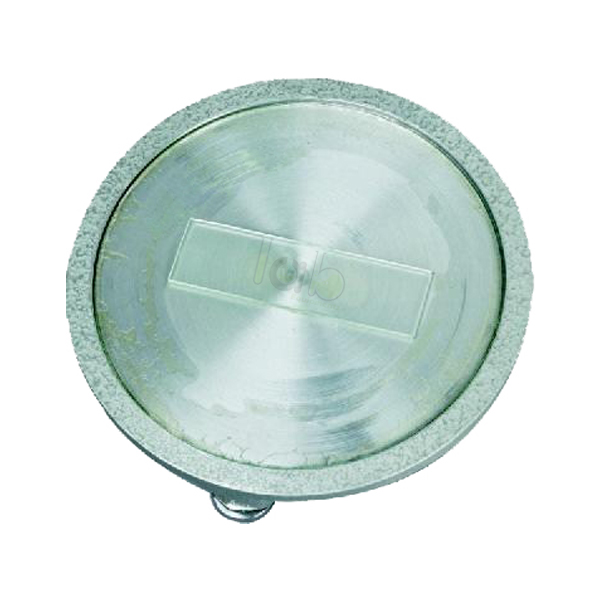
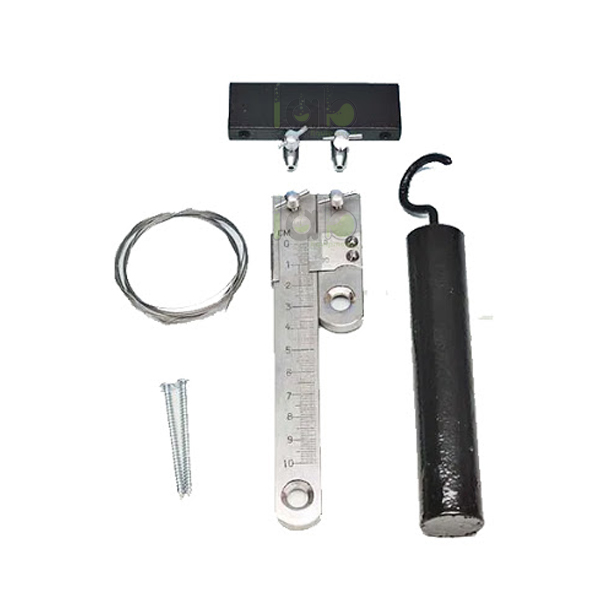
Young’s Modulus Apparatus
Product Code : SCL-EAST-11178
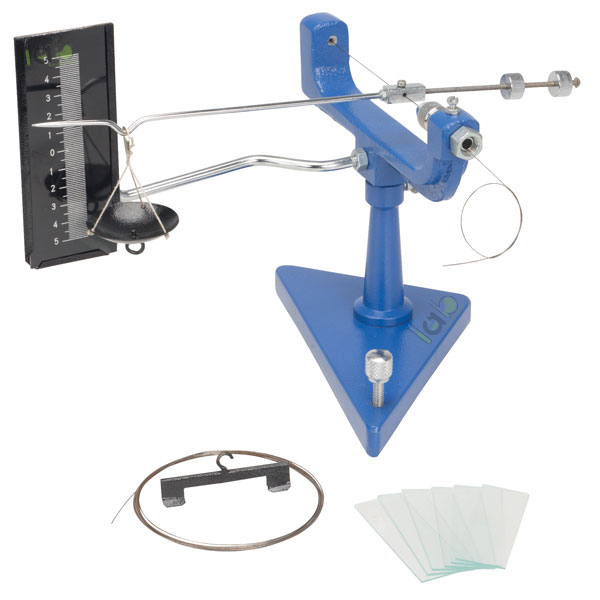
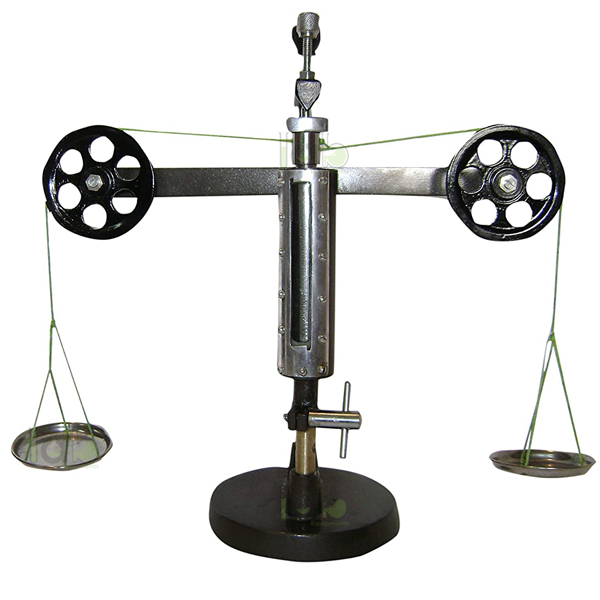
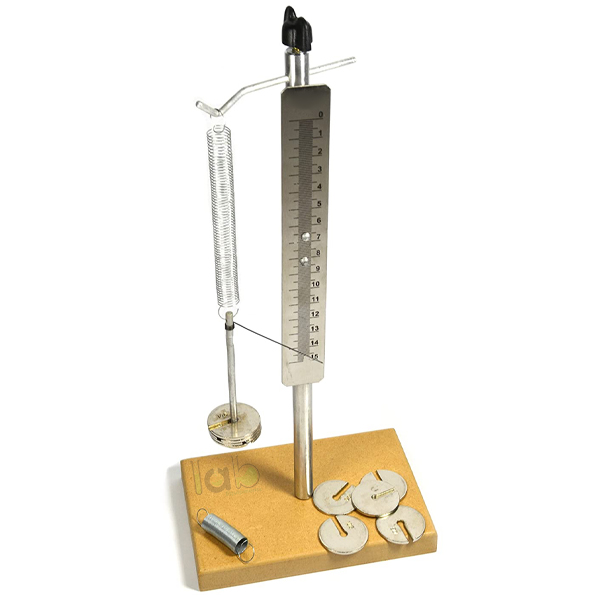
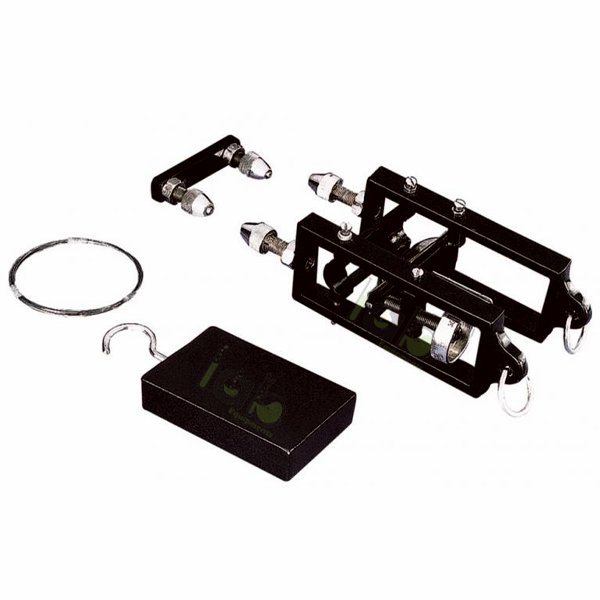
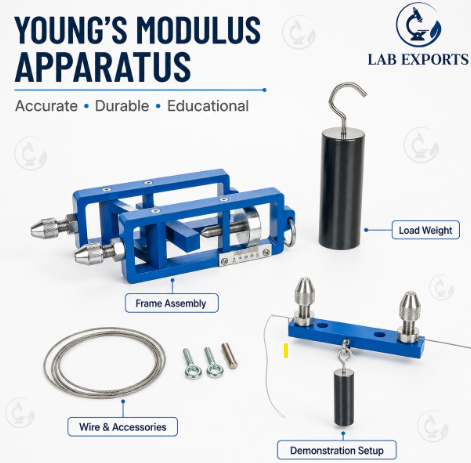
A test wire held in this frame is stretched by a tensile load added in steps, and its extension gives the Young's modulus of the wire. It is made up of an experimental frame, a wire holder and clamping assembly, and a load weight with a suspension hook. Adjustment and fastening accessories are included for setting it up. The extension is read on a vernier or a micrometer, by version.
Specifications of the Young's modulus frame
| Component | Specification |
|---|---|
| Measures | Young's modulus of a test wire |
| Principle | Extension of a wire under an applied tensile load |
| Frame | Experimental frame assembly |
| Wire mounting | Wire holder and clamping assembly |
| Load | Load weight with suspension hook |
| Also supplied | Adjustment and fastening accessories |
| Extension reading | By version: vernier with 0.1 mm divisions, or micrometer with 0.01 mm divisions |
| Sold separately | Test wire and slotted loading masses |
| House code | SCL-EAST-11178 |
| Manufacturer | Lab Exports, Delhi |
Tensile tests on a wire with this frame
A force F on a wire of cross-section A gives a stress F/A. An extension l of an original length L gives a strain l/L. Within the elastic limit the two are proportional, and their ratio is Young's modulus Y. For a load of mass M on a wire of radius r, Y = MgL/(πr2l), where g is the acceleration due to gravity.
- Fitting a test wire. The test wire is a separate item. Cut a length of steel wire free of kinks and clamp it in the wire holder. Hang the load weight on the suspension hook to pull it straight. Measure L, then find the mean diameter from screw gauge readings taken along the wire, and halve it to get r.
- Extension in equal load steps. Note the starting reading. One division is 0.1 mm on the vernier version and 0.01 mm on the micrometer version. Add masses in equal steps from a separate set, for example a 1 kg slotted mass hanger, and record the reading after each one. Take the extension l for each load and work out Y.
Points to watch while loading
- Add each mass gently, without letting the hook drop or swing, so the wire is not jerked.
- After the last step, unload one step at a time and take each reading again. Readings that do not repeat show the load went past the elastic limit, and a fresh wire is needed.
- Keep the wire straight and clear of the frame, so that it stretches freely along its length.
Frequently Asked Questions
How do you find the Young's modulus of a wire by experiment?
Clamp the wire in the holder, straighten it with the load weight, and measure its length L and radius r. Add loads in equal steps and note the extension l after each one. Then Y = MgL/(πr2l), where M is the added mass and g is the acceleration due to gravity.
What does the slope of a load-extension graph give?
With load on the vertical axis and extension on the horizontal axis, the slope is the force per unit extension, F/l. Young's modulus is then the slope × L/A, where A = πr2 is the cross-section of the wire. A stress-strain graph gives Y directly as its slope, within the elastic limit.
What is Hooke's law, and how is it related to Young's modulus?
Hooke's law states that stress is proportional to strain, as long as the elastic limit is not passed. For a stretched wire the constant of proportionality is Young's modulus. On this apparatus, equal load steps should therefore give equal extensions as long as the law holds.
What is the difference between stress, strain and Young's modulus?
Stress is the force per unit cross-sectional area, F/A, measured in pascals. Strain is the extension divided by the original length, l/L, and has no unit. Young's modulus is the ratio of stress to strain, so it also has the unit of pascal.
What is Young's modulus also called?
It is also called the modulus of elasticity or the elastic modulus. Strictly, it is one of several elastic moduli. It covers stretching or compressing along the length, while the shear and bulk moduli cover changes of shape and of volume.
Apparatus for other elastic constants
- Rigidity Apparatus (Searle's Pattern)
- Poisson's Ratio of Rubber Apparatus
- Torsion Apparatus Searle's Type
- Torsion Pendulum
More apparatus is in the Elasticity and Surface Tension section of the Physics Lab range.
To enquire, email [email protected] with the house code SCL-EAST-11178 and the quantity, or use the Add To Cart button on this page. Tender buyers can also see the Tenders and OEM page.
Last updated: 23 November 2026