Capillary Tube Clamp
Product Code : EL-EAST-10416
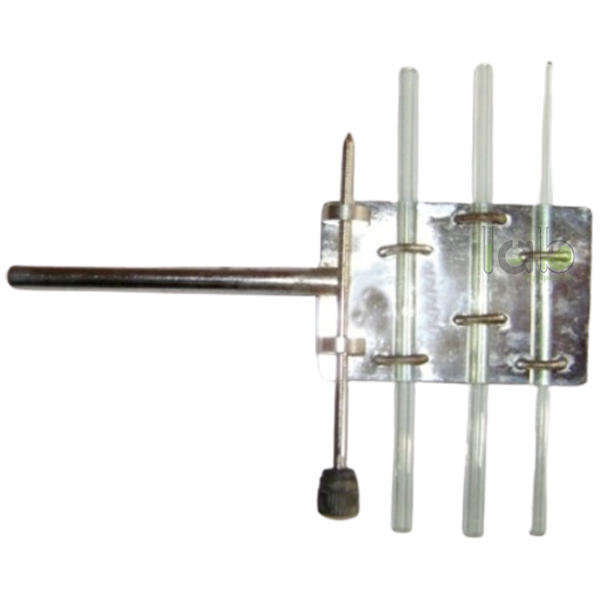
This clamp holds four glass capillary tubes side by side, with internal diameters of 0.40, 0.60, 0.80 and 1.00 mm. The rise of a liquid in each bore can then be compared at once. Each tube is 10 cm long. Small metal brackets hold the tubes on a metal frame, and a 9 mm rod mounts the clamp in a laboratory stand.
Specifications of the capillary tube clamp
| Component | Specification |
|---|---|
| Capillary tubes | Four, glass |
| Internal diameters | 0.40, 0.60, 0.80 and 1.00 mm |
| Tube length | 10 cm (100 mm) |
| Frame | Metal, with small metal brackets holding the tubes |
| Mounting rod | 9 mm, attached to the metal plate |
| House code | EL-EAST-10416 |
| Manufacturer | Lab Exports, Delhi |
Capillary rise practicals with four bores
Water climbs a clean glass capillary until surface tension balances the weight of the raised column. For water in clean glass the angle of contact is close to zero, so T = rhρg/2. Here T is the surface tension and r the internal radius of the tube. h is the height of the column above the outside surface, ρ is the density of the liquid and g is the acceleration due to gravity.
- Surface tension of water. Fix the 9 mm rod in a bosshead on a stand so that the tubes hang vertically. Bring a beaker of water up to the tubes on a rising table and let the columns settle. For each tube, read the bottom of the meniscus and the outside water surface with a travelling microscope, and take the difference as h.
- Rise against bore. The 0.40 mm tube shows the tallest column and the 1.00 mm tube the shortest. Measure the internal radius of every tube and work out r × h for all four. The four products should be nearly equal, which is a good check on the readings.
- Effect of a detergent. Repeat with water that has a little detergent stirred in. All four columns stand lower, because the detergent lowers the surface tension of the water.
Frequently Asked Questions
Why does water rise highest in the narrowest tube?
The rise is inversely proportional to the internal radius. The upward pull of surface tension acts round the rim of the meniscus, which grows with r. The weight to be held up grows with r squared, so a narrow bore supports a taller column.
What forces make a liquid rise in a capillary tube?
Adhesion between water and glass is stronger than the cohesion within the water, so the water wets the glass and curves up at the wall. Surface tension along that curved edge then pulls the column up until its weight balances the pull.
What is the SI unit of surface tension?
It is measured in newtons per metre (N/m) in SI units. Surface tension can also be stated as surface energy per unit area, in joules per square metre, which is the same unit expressed another way.
Why must the capillary tubes be free from grease?
Grease raises the angle of contact between water and glass, so the water no longer wets the bore fully and the column rises less. The formula assumes an angle close to zero. Clean and rinse the tubes and let them dry before use.
How is the internal radius of each capillary found?
The nominal bores are 0.40, 0.60, 0.80 and 1.00 mm, but read each one with a travelling microscope focused on the end of the tube. Measure the bore twice, at right angles, and take half the mean. Since T is directly proportional to r, any error in r passes straight into the result.
Other surface tension apparatus
More apparatus is in the Elasticity and Surface Tension section of the Physics Lab range.
To enquire, email [email protected] with the house code EL-EAST-10416 and the quantity, or use the Add To Cart button on this page. Tender buyers can also see the Tenders and OEM page.
Last updated: 23 November 2026