Rigidity Apparatus (Searle's Pattern)

Product Code : EL-EAST-10414
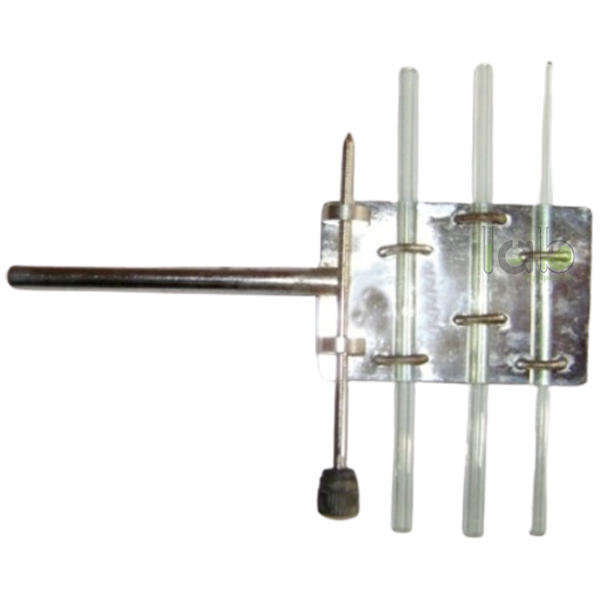
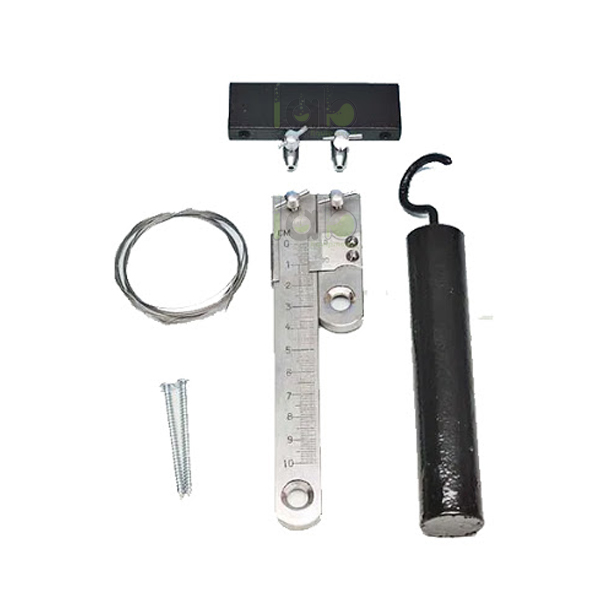
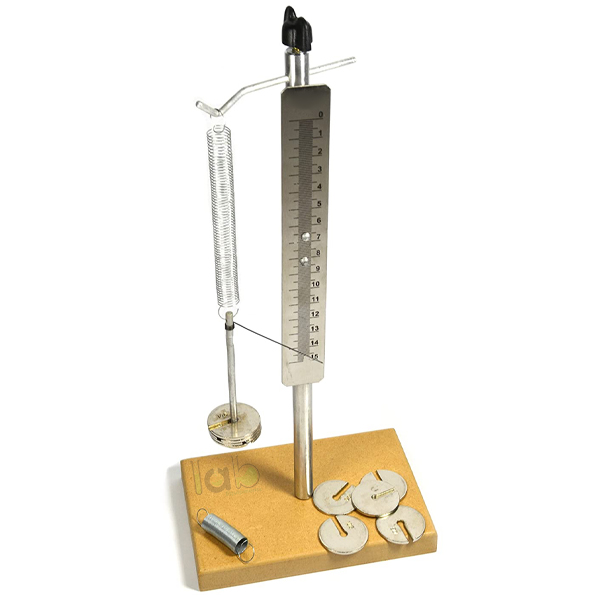
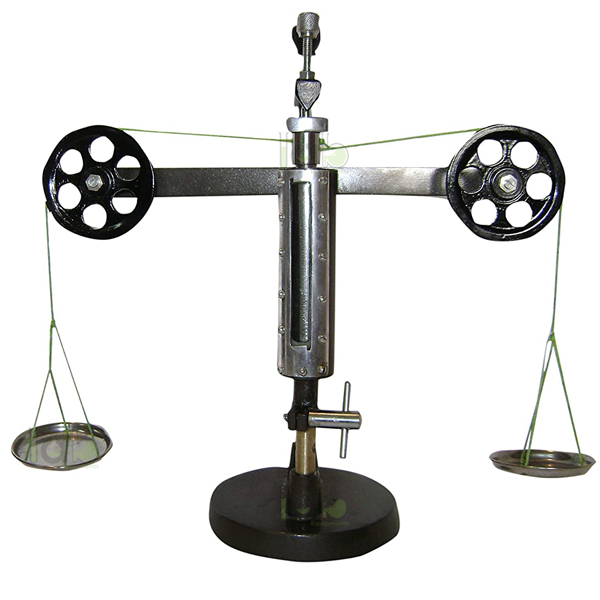
This Searle's pattern apparatus finds both the Young's modulus and the modulus of rigidity of a wire by timing oscillations. A 30 cm test wire joins the mid-points of two brass rods, each about 30 cm long, which hang from hooks. Three test wires of steel, brass and copper, each 1.0 mm in nominal diameter, are supplied with connecting screws.
Specifications of the Searle's rigidity apparatus
| Component | Specification |
|---|---|
| Method | Searle's pattern |
| Test wires | Three: steel, brass and copper, each about 30 cm long and 1.0 mm nominal diameter |
| Brass rods | Two, about 30 cm long, suspended from hooks |
| Wire fixing | Connecting screws at the mid-points of the rods |
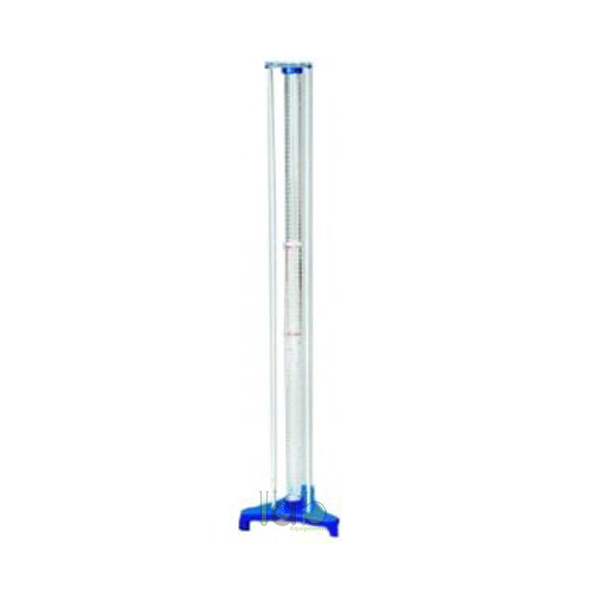
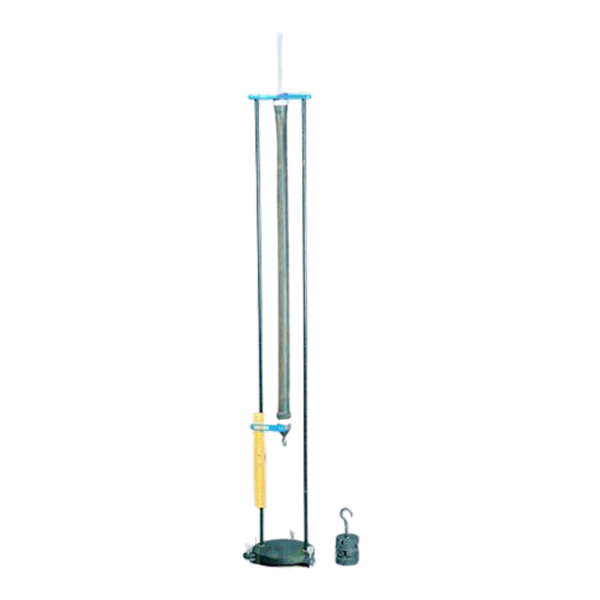
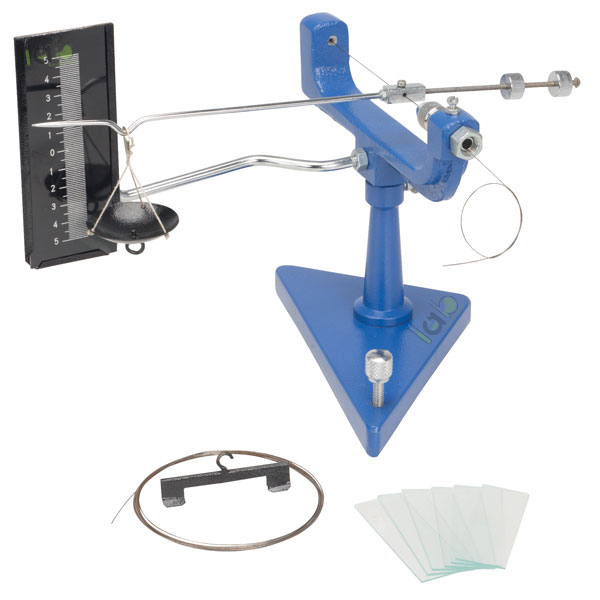
| Separate dynamical accessory | Graduated iron bar, 16 inches (406.4 mm) long and 1 inch (25.4 mm) across the section, with a 15-0-15 cm scale for the position of a movable thumb-screw weight |
| House code | EL-EAST-10414 |
| Manufacturer | Lab Exports, Delhi |
Measurements by Searle's dynamical method
The test wire is screwed to the mid-points of the two rods. Two kinds of oscillation are timed with an analog stop clock, and the radius r of the wire is found from screw gauge readings taken along its length. Weigh one rod on a physical balance to get its mass M, and measure its length b. For a thin rod, the moment of inertia about a vertical axis through its centre is I = Mb2/12. L is the length of the test wire between the screws.
- Young's modulus from the swinging period. Hang the rods level from their hooks. Draw their free ends together through a small distance and release them, so they swing in a horizontal plane and bend the wire. Time 20 oscillations to find the period T1. Then Y = 8πIL/(r4T12).
- Modulus of rigidity from the torsion period. Clamp one rod rigidly so the wire hangs vertically with the other rod at its lower end. Turn the lower rod slightly and let it go, so it twists the wire like a torsion pendulum. Time 20 oscillations to get T2. Then n = 8πIL/(r4T22).
- Poisson's ratio from the two periods. For the same wire, σ = T22/(2T12) − 1, so I, L and r are not needed for this result. Repeat all three results with the steel, brass and copper wires and compare the three metals.
Frequently Asked Questions
What is the difference between Young's modulus and the modulus of rigidity?
Young's modulus is longitudinal stress divided by longitudinal strain, for stretching. The modulus of rigidity is shear stress divided by shear strain, for a change of shape such as a twist. On this apparatus the first comes from bending the wire and the second from twisting it.
How does this apparatus give Poisson's ratio?
It comes from the two timed periods. Poisson's ratio equals Y/(2n) minus one, and with the formulas above this becomes T22/(2T12) − 1. The moment of inertia and the wire dimensions cancel, so only the two periods need to be accurate.
Why does a small error in the wire radius matter so much here?
The radius appears as r4 in both formulas, so any percentage error in r is multiplied by four in Y and in n. The wires are only 1.0 mm in nominal diameter. Read the screw gauge at several places along each wire, with two readings at right angles at each place. Also measure the free length between the screws.
Why is the wire fixed at the mid-points of the rods?
Each rod then turns about a vertical axis through its own centre, which is the axis used for I = Mb2/12. The rods also hang balanced from their hooks, so the swinging and twisting motions stay even and the periods are easy to time.
How many test wires come with it, and what is the graduated iron bar?
Three test wires come with it: steel, brass and copper, each about 30 cm long and 1.0 mm in nominal diameter, with connecting screws. The graduated iron bar is a separate dynamical accessory. It is 406.4 mm long and 25.4 mm across, with a 15-0-15 cm scale for its thumb-screw weight.
Other apparatus for elastic moduli practicals
- Torsion Apparatus Searle's Type
- Torsion Pendulum
- Maxwell Vibration Needle
- Young's Modulus Apparatus (Searle's Pattern)
More apparatus is in the Elasticity and Surface Tension section of the Physics Lab range.
To enquire, email [email protected] with the house code EL-EAST-10414 and the quantity, or use the Add To Cart button on this page. Tender buyers can also see the Tenders and OEM page.
Last updated: 23 November 2026