Viscosity Apparatus Stokes Method
Product Code : EL-EAST-10421
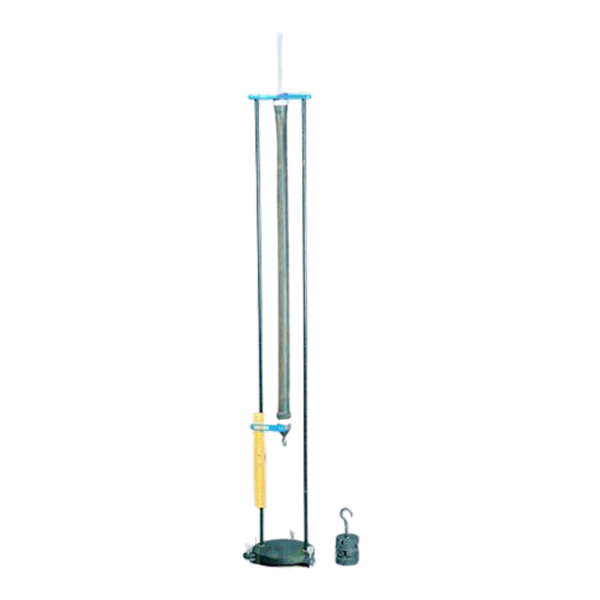
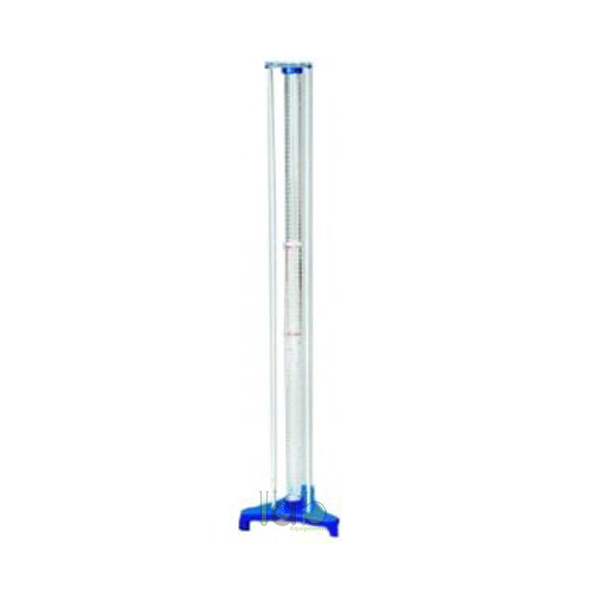
This falling ball apparatus finds the coefficient of viscosity of a liquid by Stokes' method. Steel balls are timed as they fall at a steady terminal velocity through the liquid. A one-metre borosilicate glass tube with a 50 mm bore is held vertically between two upright bars on a heavy cast iron base. Six steel balls, 1.0 to 4.0 mm in diameter, are supplied.
Specifications of the Stokes' method apparatus
| Component | Specification |
|---|---|
| Tube | Borosilicate glass, 1 metre long, 50 mm clear bore |
| Base | Heavy cast iron, with two upright bars and clamps to hold the tube vertical |
| Lower end of tube | Closed by a rubber cork without holes |
| Steel balls | Six, of 1.0, 1.5, 2.0, 2.5, 3.0 and 4.0 mm diameter |
| Index marks | Two rubber bands |
| Lead shot | Not included |
| House code | EL-EAST-10421 |
| Manufacturer | Lab Exports, Delhi |
Falling ball practicals with this apparatus
A ball dropped into a viscous liquid speeds up at first. Soon the viscous drag and the upthrust together balance its weight, and it falls at a steady terminal velocity v. Stokes' law gives the drag as F = 6πηrv, where η is the coefficient of viscosity. Balancing the forces gives η = 2r2(ρ - σ)g/(9v). Here r is the radius of the ball (half its diameter), ρ the density of steel, σ the density of the liquid and g the acceleration due to gravity.
- Viscosity of glycerine. Measure the diameter of each ball with a screw gauge. Drop a ball along the axis of the tube and time it between the two rubber bands with a stop clock. The distance between the bands divided by the time gives v.
- Terminal velocity against radius. Time all six balls and plot v against r2. The plotted points should form a straight line through the origin, as the formula predicts. Work out η from the slope of the line rather than from a single ball.
- Checking that the ball has reached terminal velocity. Set a third mark halfway between the bands with a strip of tape, or move one band. If the ball takes the same time over each half, it was already falling steadily when timing began.
Preparing the tube
- Close the lower end of the tube with the rubber cork and clamp it vertically between the upright bars.
- Fill the tube with the test liquid, such as glycerine, and let any air bubbles rise out.
- Place the two rubber bands a measured distance apart on the lower half of the tube, well below the surface.
- Wet each ball with the liquid before dropping it, so that it does not carry air down with it.
Frequently Asked Questions
What is terminal velocity, and how is it reached?
Terminal velocity is the steady speed a falling ball keeps once it stops speeding up. As the ball gains speed, the viscous drag on it grows. When drag plus upthrust equal the weight of the ball, the net force is zero and it falls at a constant speed v.
Why is the ball allowed to fall some distance before timing starts?
The ball must reach terminal velocity before it is timed. Near the surface it is still speeding up, so a time taken there gives too low a speed and too high a viscosity. Place the upper rubber band well below the liquid surface.
Why should the ball fall along the centre of the tube?
A ball falling close to the wall is slowed by the wall, so it falls more slowly than Stokes' law predicts. Drop each ball gently along the axis of the tube. In this 50 mm tube the 4.0 mm ball has a ball-to-bore ratio of 0.08. The smaller balls feel even less wall effect.
How does the viscosity of glycerine change with temperature?
It falls sharply as the temperature rises, so the balls fall faster in warm glycerine. Note the temperature of the liquid with each set of readings, and give the coefficient of viscosity for that temperature.
Why does a steel ball fall faster in water than in glycerine?
Water has a far lower viscosity than glycerine, so drag and upthrust balance the weight of the ball only at a much higher speed. In water the ball falls too fast for Stokes' law to hold or for timing by hand, so a viscous liquid such as glycerine is used.
Other items for viscosity practicals
- Viscometer Searle's Pattern
- Vernier Caliper IME Type, to check the inside diameter of the tube
More apparatus is in the Elasticity and Surface Tension section of the Physics Lab range.
To enquire, email [email protected] with the house code EL-EAST-10421 and the quantity, or use the Add To Cart button on this page.
Last updated: 23 November 2026