Rising Table with Capillary Tube Clamp

Product Code : EL-EAST-10417
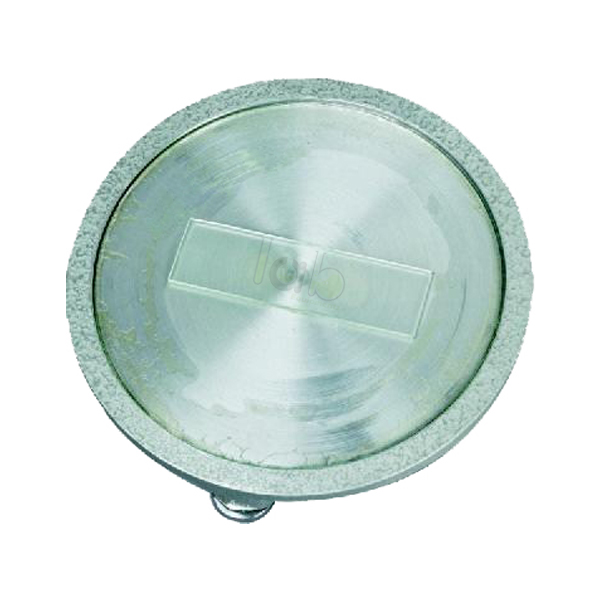
This rising table lifts a beaker of liquid up to a fixed capillary tube and lowers it again without moving the tube. The table top is cast aluminium, about 102 mm (4 inches) across, on an adjustable stand that rises to about 305 mm (12 inches). It comes alone, with the capillary tube clamp as a separate item, or as a complete capillary rise set.
Specifications of the rising table
| Component | Specification |
|---|---|
| Table top | Cast aluminium, about 102 mm (4 inches) in diameter |
| Maximum height | About 305 mm (12 inches) |
| Stand | Adjustable |
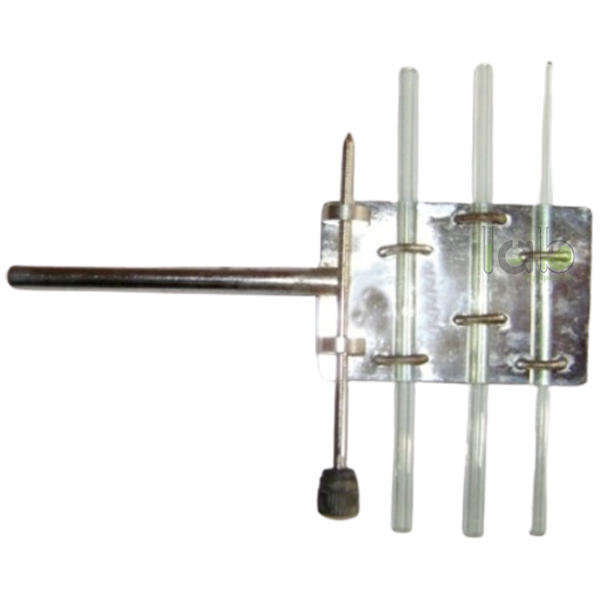
| Supply options | Table alone, with the capillary tube clamp as a separate item; or a complete capillary rise set of the table, the capillary tube clamp with its four 100 mm tubes, and a support that takes the 9 mm rod of the clamp |
| House code | EL-EAST-10417 |
| Manufacturer | Lab Exports, Delhi |
Using the rising table for capillary rise
In the capillary rise method the tube stays fixed and the liquid is brought to it. The beaker stands on the table, so the column can be formed and the reference reading taken without touching the clamp or the microscope.
- Setting the liquid level. Fix the 9 mm rod of the capillary tube clamp in its support, or in a bosshead on a retort stand, with the tube vertical above the table. Put a clean beaker of water on the table and raise it until the tube dips in. Lift it a little further, then lower it back, so the column falls to its level and the bore above it stays wet.
- Pin method for the height. Set a pointed pin beside the tube with its tip just touching the water surface. Read the lowest point of the meniscus in the tube with a travelling microscope. Lower the table, take the beaker away and focus on the tip of the pin. The difference between the two readings is the capillary rise h.
- Surface tension from the rise. Measure the internal radius r of the tube. For water in clean glass, T = rhρg/2, where ρ is the density of water and g is the acceleration due to gravity.
Frequently Asked Questions
Why is the beaker raised to the tube instead of moving the tube?
Moving the tube would disturb the clamp and the microscope setting. With the tube fixed, the rising table brings the liquid up and takes it away again, so both microscope readings are taken against the same fixed tube.
Which part of the meniscus is read with the travelling microscope?
For water, set the horizontal cross-wire to touch the lowest point of the curved meniscus. Water curves up at the glass wall, and the lowest point gives the height h used in the formula.
What happens when the angle of contact is obtuse?
The liquid does not wet the tube, its meniscus is convex, and the level inside the capillary falls below the outside surface. Mercury in glass behaves like this, so it shows a capillary fall, not a rise.
Which side of a curved liquid surface has the higher pressure?
The concave side. Just below the concave meniscus in the capillary, the pressure is lower than in the air above it by 2T/R, where R is the radius of curvature of the surface. This pressure difference holds the column up.
How high does the table rise?
It rises to a maximum of about 305 mm (12 inches) on an adjustable stand. The cast aluminium table top that carries the beaker is about 102 mm (4 inches) across.
More apparatus for surface tension work
More apparatus is in the Elasticity and Surface Tension section of the Physics Lab range.
To enquire, email [email protected] with the house code EL-EAST-10417 and the quantity, or use the Add To Cart button on this page.
Last updated: 23 November 2026