Quincke's Surface Tension Apparatus
Product Code : EL-EAST-10418
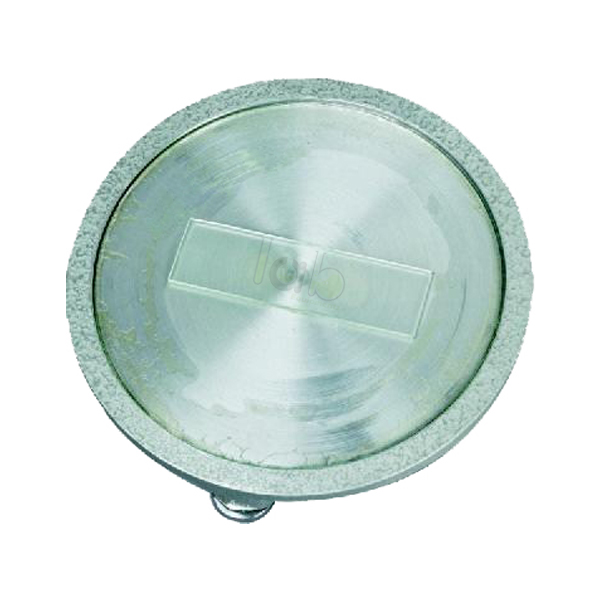
This apparatus gives the level base needed to find the surface tension of mercury by Quincke's method, from the depth of a large mercury drop. A 100 mm circular metal platform carries a removable, flat 65 x 65 mm glass plate. Three levelling screws and a sensitive spirit level set it exactly horizontal.
Specifications of the Quincke's apparatus
| Component | Specification |
|---|---|
| Levelling platform | Circular, metal, 100 mm diameter |
| Glass plate | Removable, flat, 65 x 65 mm; its diagonal is about 92 mm, so all four corners rest on the platform |
| Levelling | Three levelling screws |
| Level indicator | Sensitive spirit level |
| Application | Surface tension of mercury by Quincke's method |
| Mercury | Not included |
| House code | EL-EAST-10418 |
| Manufacturer | Lab Exports, Delhi |
Steps in Quincke's drop method
Mercury does not wet glass, so a large quantity on a clean, level glass plate forms a broad drop with a flat top. Let h be the depth from the top of the drop down to its widest section, where the side is vertical. The hydrostatic push on the part of the drop above that level is balanced by surface tension at the top. This gives T = ρgh2/2, where ρ is the density of mercury and g is the acceleration due to gravity.
- Levelling the plate. Stand the apparatus on a firm bench with the glass plate on the platform. Turn the three levelling screws until the bubble of the spirit level stays centred in every direction.
- Surface tension of mercury. Clean and dry the 65 x 65 mm glass plate and lay it on the levelled platform. Pour on enough mercury to form a drop several centimetres across. With a travelling microscope, set the cross-wire first on the top of the drop and then on its widest section. The difference is h. Afterwards, collect the mercury with a glass dropper and keep it in a sealed bottle.
- Angle of contact. Also read the total height H of the drop, from its top down to the glass. With T known, cos θ = 1 − ρgH2/(2T), where θ is the angle of contact between mercury and glass.
Frequently Asked Questions
Why is Quincke's method used for mercury?
Mercury does not wet glass, so it shows no capillary rise. Instead it forms a large, flat-topped drop on a level glass plate, and the depth of that drop gives its surface tension directly.
Why must the mercury drop be large?
Only a large drop has a flat top, and the formula T = ρgh2/2 assumes that flat top. In a small drop the whole surface is curved, so the measured depth no longer fits the formula.
Why must the glass and the mercury be clean?
Dirt or grease on the glass, or a film on the mercury, changes the angle of contact and the surface tension itself. The drop then sits unevenly and h comes out wrong. Clean and dry the glass plate before use.
How does temperature affect surface tension?
Surface tension falls as the temperature rises. Note the room temperature with each set of readings, so the result can be compared with a value quoted at a stated temperature.
Why are three levelling screws used?
Three points always define a plane, so the platform rests firmly without rocking. Adjusting the screws while watching the sensitive spirit level sets the platform horizontal, and the drop then spreads evenly in all directions.
What care is needed when working with mercury?
Mercury is toxic. Carry out the experiment on a spill tray in a ventilated room under supervision, and recover the mercury into a sealed container afterwards. Mercury is not supplied with the apparatus. For school classes, a mercury-free surface tension experiment is the better choice.
Apparatus for other surface tension methods
More apparatus is in the Elasticity and Surface Tension section of the Physics Lab range.
To enquire, email [email protected] with the house code EL-EAST-10418 and the quantity, or use the Add To Cart button on this page.
Last updated: 23 November 2026