Steel Wire (100gm)
Product Code : SCL-EAST-11219
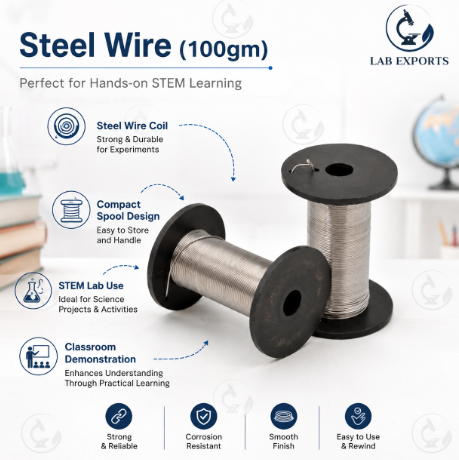
This laboratory steel wire comes in a 100 gm net pack and is cut to length as each practical needs. It is hard-drawn high-carbon spring wire, 0.50 mm in nominal diameter, with 0.40 mm as a finer option. Its main use is as the test wire in Young's modulus and other elasticity experiments. It also serves for suspending light components and for model-making.
Specifications of the steel wire
| Component | Specification |
|---|---|
| Material | High-carbon spring steel wire |
| Pack | One pack, 100 gm net |
| Type | Physics laboratory consumable |
| Diameter | 0.50 mm nominal (about 25 SWG), or 0.40 mm as the finer option |
| Temper | Hard-drawn; annealed wire for forming is a separate option |
| House code | SCL-EAST-11219 |
| Manufacturer | Lab Exports, Delhi |
Where the steel wire is used
Steel is strong and stiff, and it behaves elastically over a useful range of loads. Its Young's modulus is about 200 GPa. So a metre of thin steel wire stretches by only a fraction of a millimetre under a kilogram load. That is why the extension is read with a vernier or a micrometer.
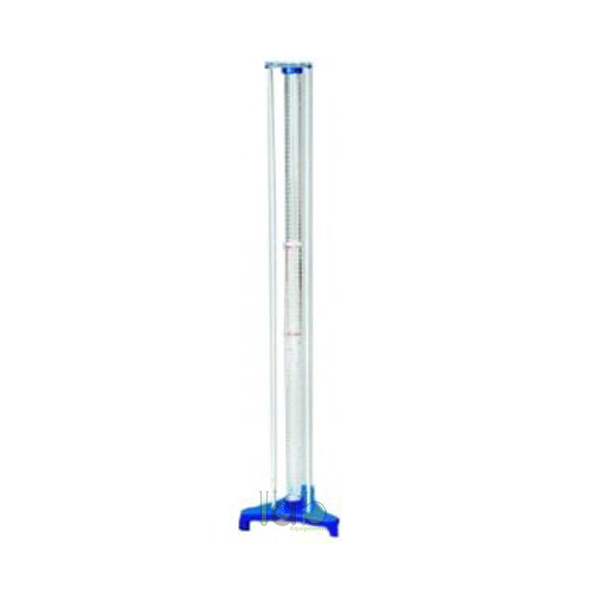
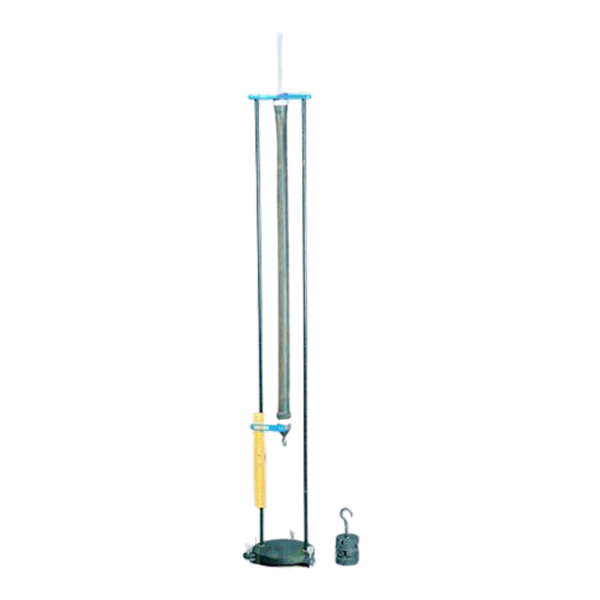
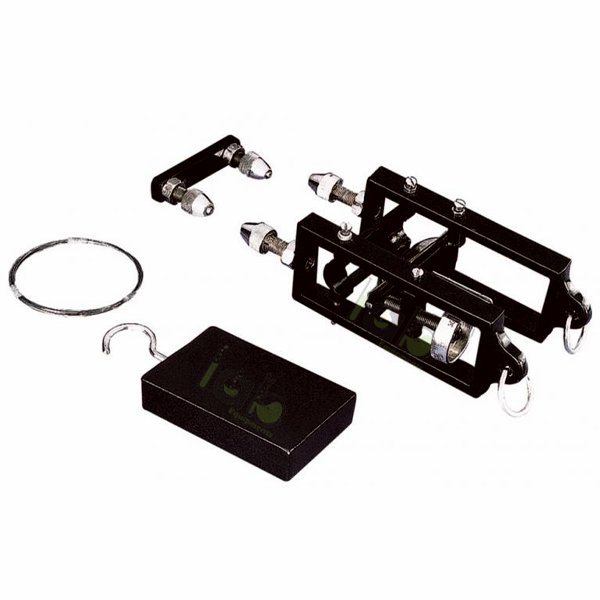
- Test wire for Young's modulus. Cut a length to suit a vernier type Young's modulus apparatus or the Young's modulus apparatus with wire holder and clamping assembly. Clamp it straight, with no kinks, before the first reading.
- Measuring the diameter. Read the diameter at several points along the length with a screw gauge and take the mean. The diameter enters the Young's modulus formula squared, so this reading needs the most care.
- Replacing an overloaded wire. A wire loaded past its elastic limit keeps a permanent set and gives wrong readings. Discard it and cut a fresh length from the pack. The tension a wire can safely take depends on its tensile grade, diameter and condition, and on the end grips.
- Suspensions and models. Short lengths are also used to suspend light components on the bench, and in model-making. Where a length must be bent to shape, the annealed option suits forming.
Cutting and preparing a length
- Check which diameter, 0.50 mm or 0.40 mm, the experiment instructions call for.
- Inspect the wire for rust, sharp bends or other visible damage.
- Measure the length needed with a ruler and cut it cleanly with a wire cutter.
- Straighten the length gently and clamp it into the apparatus.
Frequently Asked Questions
What are the main uses of steel wire in the physics lab?
Its main use is as the test wire in Young's modulus and other elasticity experiments. Short lengths cut from the pack also serve for suspending light components on the bench and for model-making. A fresh length replaces any wire that has been overloaded.
What is the Young's modulus of steel?
Steel has a Young's modulus of about 200 GPa. That is why a steel test wire stretches so little under a load, and why its extension must be read on a fine scale. The exact value varies a little with the grade of steel and with temperature.
What does a greater Young's modulus of steel than copper mean?
It means steel is stiffer than copper. Under the same stress, a steel wire stretches less than a copper wire of the same length and diameter. A larger stress is needed to produce the same strain in steel.
Why are springs made of steel and not copper?
Steel has a higher Young's modulus and a higher elastic limit than copper. A steel spring therefore needs a larger force for the same stretch, and it returns to its shape after larger loads. Copper takes a permanent set at much lower stresses.
How should steel wire be stored?
Keep it in its pack in a dry place, away from moisture and chemical fumes, so that it does not rust. Avoid sharp bends when coiling it back. Before each use, check the length for rust or kinks, because a damaged wire gives unreliable readings.
Other wires in 100 gm packs
More items are in the Elasticity and Surface Tension section of the Physics Lab range.
To enquire, email [email protected] with the house code SCL-EAST-11219 and the quantity, or use the Add To Cart button on this page. Tender buyers can also see the Tenders and OEM page.
Last updated: 23 November 2026