Transistor Characteristics Apparatus (Socket Type)
Product Code : SCL-EAE-11330
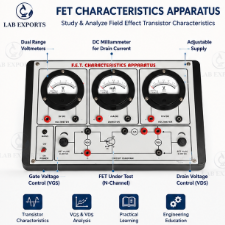
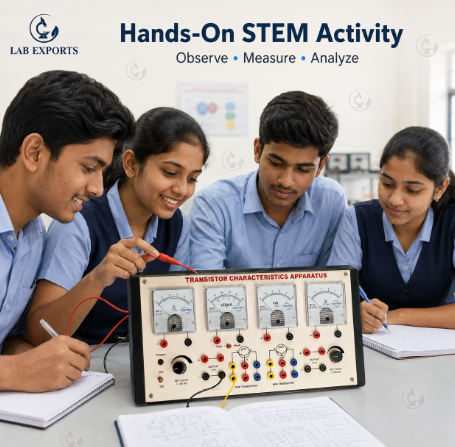
The apparatus provides a structured platform for investigating the electrical behaviour of a bipolar junction transistor. Students can vary the relevant input and output conditions, record voltage and current readings, and convert the observations into characteristic curves.
The socket-type arrangement allows the fitted transistor to be inserted into or removed from a designated holder, subject to the supplied configuration. This supports device replacement and comparative experiments without permanent soldering. The exact transistor polarity, circuit configuration, socket type, meter ranges and power-supply outputs must be confirmed before ordering.
Key Features
Socket-mounted transistor: Supports insertion and replacement of a compatible transistor without direct soldering.
Input-characteristic study: Enables measurement of input current against the corresponding input voltage.
Output-characteristic study: Supports plotting output current against output voltage at selected input-current values.
Operating-region analysis: Helps learners identify cutoff, active and saturation behaviour.
Current-gain experiment: Allows transistor current gain to be estimated from measured readings.
Visible measurement points: Helps students relate transistor terminals, circuit quantities and instrument readings.
Hands-on electronics learning: Converts semiconductor theory into repeatable laboratory observations.
Technical Specifications
|
Transistor Characteristics Apparatus Socket Type technical information |
|
|
Specification |
Detail |
|
Product name |
Transistor Characteristics Apparatus (Socket Type) |
|
Brand |
Lab Exports |
|
Equipment category |
Semiconductor characteristics laboratory apparatus |
|
Device studied |
Bipolar junction transistor |
|
Device mounting |
Socket type |
|
Primary experiments |
Input characteristics, output characteristics and current-gain study |
|
Capacity |
Not applicable; educational electronics apparatus |
|
Transistor polarity and configuration |
Not supplied; confirm before ordering |
|
Socket configuration |
Not supplied; confirm compatible transistor package |
|
Meter and power-supply ranges |
Not supplied; confirm before ordering |
|
Material, dimensions and weight |
Not supplied |
|
Standards or certifications |
No product-specific claim verified |
What's Included in the Kit
One Transistor Characteristics Apparatus Socket Type.
Transistor device only when specified in the accepted quotation.
Meters, connecting leads, power arrangement and experiment manual only when listed in the final supply scope.
Applications and Uses
Plotting transistor input-characteristic curves.
Plotting transistor output-characteristic curves.
Studying cutoff, active and saturation regions.
Observing the relationship between input current and output current.
Estimating DC or small-signal current gain where supported by the procedure.
Comparing compatible transistors using the replaceable socket.
Supporting basic electronics and semiconductor-device practicals.
Extending circuit studies with an Analog & Digital IC Trainer.
How to Use the Transistor Characteristics Apparatus Socket Type
Confirm the required transistor type, polarity and pin arrangement.
Switch off the apparatus and set all controls to minimum.
Insert the compatible transistor into the socket with the correct orientation.
Connect the circuit according to the approved experiment diagram.
Energise the apparatus under instructor supervision.
Vary the input condition gradually and record the corresponding readings.
Hold the selected input value and vary the output voltage in controlled steps.
Repeat the observations for additional input settings.
Plot the characteristic curves and calculate the required transistor parameters.
Switch off the apparatus before removing or replacing the transistor.
Safety note: Verify the transistor pinout before insertion. Incorrect orientation, excessive base current, excessive collector current or operation beyond the confirmed power rating can damage the device.
Care and Maintenance
Keep the socket, terminals, meter covers and panel clean and dry.
Insert and remove transistors gently without bending their leads.
Inspect test leads, socket contacts and insulation before each session.
Store the apparatus disconnected in a dry, dust-controlled cabinet.
Why Choose Lab Exports
Lab Exports manufactures and exports scientific instruments, educational experiment setups, science kits, mathematics kits, didactic models and STEM equipment. Its physics portfolio includes electrical, electronics and semiconductor training apparatus for academic and vocational laboratories. The company supplies institutional and international requirements. Buyers can confirm the transistor configuration, socket compatibility, measuring ranges and included accessories before production and dispatch. As a trusted source of physics demonstration kit India buyers rely on, Lab Exports also ships this socket-type transistor apparatus to schools and laboratories in Chad (Central Africa), Bangladesh (South Asia) and Nauru (Pacific), among many other markets worldwide.
Frequently Asked Questions
What is a Transistor Characteristics Apparatus Socket Type used for?
It is used to measure and plot transistor input and output characteristics and study transistor operating regions.
What is the benefit of the socket-type design?
The socket permits a compatible transistor to be fitted or replaced without permanent soldering, subject to the supplied socket configuration.
Does the apparatus use an NPN or PNP transistor?
The requested data does not specify the polarity. Buyers should confirm the transistor type and circuit configuration before ordering.
Can different transistors be compared?
Compatible devices may be compared when their package, pinout and electrical ratings match the socket and experimental circuit.
What curves can students plot?
Students can plot input and output characteristic curves using recorded voltage and current observations.
Are the transistor, meters and connecting leads included?
The complete supply scope was not confirmed. Verify the transistor, instruments, leads, power arrangement and manual in the quotation.
Request confirmation of the transistor type, socket pinout, meter ranges and included accessories, or explore the complete Electrical and Electronics Laboratory Equipment and Physics Laboratory Equipment ranges.