Electric Bell Demonstration
Product Code : SCL-EAE-11257
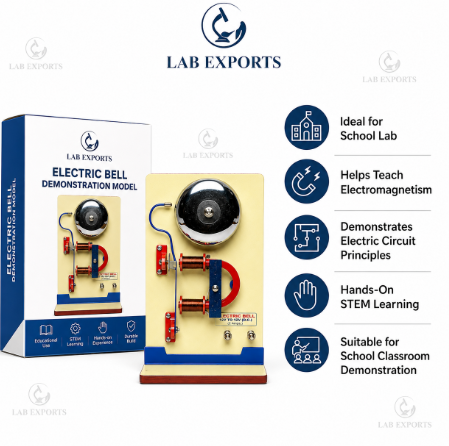
This electric bell demonstration lays every working part open on one board: the electromagnet coils, soft-iron armature, striker, contact and gong. Run from a low-voltage DC supply, it rings by repeated make-and-break action. Students can watch the magnetic effect of current switch itself on and off.
Specifications of the electric bell demonstration
| Component | Specification |
|---|---|
| Type | Electric bell demonstration apparatus, open board |
| Main parts | Bell gong, electromagnet coils, armature, striker, contact mechanism and terminals |
| Armature | Soft iron, returned by a spring |
| Gong | Demonstration size, heard clearly by a whole class |
| Mounting | Parts arranged on a demonstration board with supporting base |
| Supply | Low-voltage DC, through accessible terminals |
| House code | SCL-EAE-11257 |
| Manufacturer | Lab Exports, Delhi |
Lessons shown on the electric bell board
Closing the circuit magnetises the core of the coils. The armature is pulled in and the striker hits the gong. That same movement opens the contact, the core loses its magnetism and the spring pulls the armature back. The contact closes again and the cycle repeats many times a second.
- One make-and-break cycle. Connect the terminals to a Battery Eliminator set to a low DC output, through a Tapping Key that acts as the bell push. Press it and follow the armature, striker and contact as the bell rings.
- Energy changes. Trace the chain from electrical energy in the coils, to magnetic energy in the core, to movement of the armature, and finally to sound from the gong.
- Reversing the current. Swap the supply leads with a Reversing Key / Commutator. The bell still rings, because soft iron is attracted to either pole of the electromagnet.
- The electromagnet on its own. Show with an Electromagnet that its core holds iron only while current flows. Then point to the same action in the coils of the bell.
Documentation and supply
Most Lab Exports products carry a one-year manufacturer warranty.
Lab Exports manufactures the electric bell demonstration model at its works in Laxmi Nagar, Delhi, and supplies it to schools and colleges in India and 60+ countries, handling the export documents for each shipment. More about the company is on the About Lab Exports page.
Frequently Asked Questions
Does the electric bell model run from a battery eliminator or from cells?
Either will do, as long as the supply is low-voltage DC. A battery eliminator set to a low output, or cells joined in series, can be connected to the terminals. Put a switch or push key in the circuit so the bell rings only when needed.
Is the model meant for front-of-class demonstration or for student group practicals?
It is built mainly as a demonstration piece. All parts sit open on one board and the gong is demonstration size, so a whole class can see and hear it. Small groups can also wire it up at the bench and trace one cycle.
Why is soft iron used as the core of the electromagnet in an electric bell?
Soft iron magnetises strongly while current flows and loses almost all its magnetism as soon as the current stops. That lets the armature be pulled in and released many times a second. A steel core would stay magnetised and hold the armature down.
What is the purpose of the armature in an electric bell?
The armature carries the striker and works the contact. When the electromagnet pulls it, the striker hits the gong and the contact opens, breaking the circuit. The spring then returns the armature, the contact closes and the next stroke begins.
Other apparatus for electromagnet lessons
More apparatus is in the Electrical and Electronics section of the Physics Lab range.
To enquire, email [email protected] with the house code SCL-EAE-11257 and the quantity, or use the Add To Cart button on this page.
Last updated: 23 November 2026