FET Characteristics Apparatus
Product Code : SCL-EAE-11324
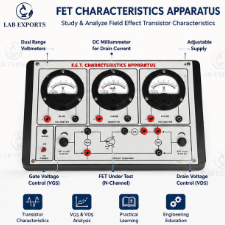
This apparatus is used to study a field-effect transistor, a voltage-controlled device whose gate draws almost no current. Students set the gate-source and drain-source voltages and read the drain current, then plot the drain and transfer characteristics. The FET type and polarity fitted are confirmed with each quotation.
Specifications of the FET characteristics apparatus
| Component | Specification |
|---|---|
| Device studied | Field-effect transistor (FET) |
| Apparatus type | Semiconductor characteristics laboratory apparatus |
| Principal measurements | Drain current ID, drain-source voltage VDS and gate-source voltage VGS |
| Primary experiments | Output (drain) characteristics and transfer characteristics |
| FET type and polarity | Confirmed with each quotation |
| Brand | Lab Exports |
| House code | SCL-EAE-11324 |
| Manufacturer | Lab Exports, Delhi |
Drain and transfer curves with the FET apparatus
In a FET the current between drain and source is set by the electric field from the gate voltage. Identify the gate, drain and source terminals and set both supplies to zero before starting. Two families of readings then describe the device.
- Drain characteristics. Fix VGS, raise VDS in steps and record ID. Repeat for several VGS values. Mark the ohmic region at low VDS and the saturation region where ID hardly changes, and find the drain resistance rd = ΔVDS/ΔID there.
- Transfer characteristic. Hold VDS in the saturation region and vary VGS, recording ID. The slope of this curve is the transconductance gm = ΔID/ΔVGS. The amplification factor follows as μ = rd × gm.
- Voltage control against current control. A digital multimeter on a current range in the gate lead shows that the gate current is too small to read. On the Transistor Characteristics panel, by contrast, the collector current is set by the base current supplied.
Frequently Asked Questions
What are the two types of FETs?
The two main types are the junction FET (JFET) and the metal-oxide-semiconductor FET (MOSFET). Each is made in N-channel and P-channel forms, and MOSFETs come as depletion or enhancement types. The FET type and polarity on this apparatus are confirmed with each quotation.
Are FET and MOSFET the same?
Not exactly. FET is the family name, and a MOSFET is one kind of FET whose gate is insulated from the channel by a thin oxide layer. A JFET instead uses a reverse-biased PN junction at the gate. Both are voltage controlled, so drain and transfer curves are plotted for either type.
What is the difference between a BJT and a FET?
A BJT is current controlled: a base current sets the collector current, and both electrons and holes carry it. A FET is voltage controlled: the gate-source voltage sets the drain current, carried by one type of charge carrier, and the gate draws almost no current.
What are the advantages of FETs over BJTs?
A FET has a very high input resistance, so it hardly loads the circuit that drives it. It is also quieter, more stable with temperature and simpler to make in integrated circuits. On the other hand, a single FET stage usually gives less voltage gain than a comparable BJT stage.
Other apparatus for semiconductor characteristics
- UJT Characteristics Apparatus
- SCR Characteristics Apparatus
- Transistor Characteristics Apparatus
- Discrete Component Trainer
More apparatus is in the Electrical and Electronics section of the Physics Lab range.
To enquire, email [email protected] with the house code SCL-EAE-11324 and the quantity, or use the Add To Cart button on this page.
Last updated: 23 November 2026