Loading Rheostat 50KW
Product Code : SCL-EAE-11317
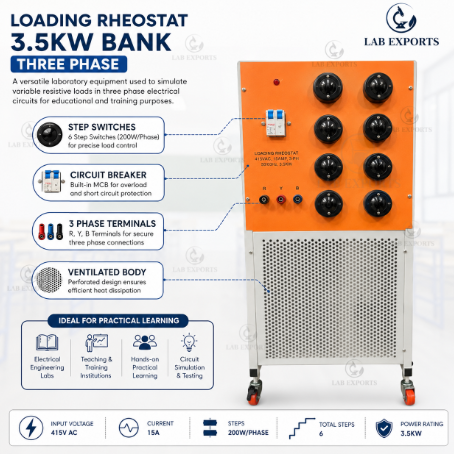
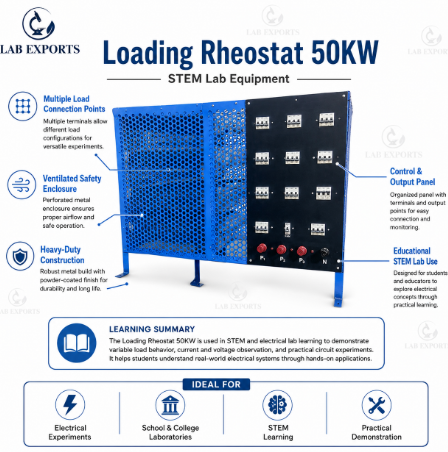
This loading rheostat is an adjustable high-power resistive load with a rated loading capacity of 50 kW. Its resistive elements sit in a supporting enclosure, frame or mounting structure. It lets larger compatible motors, generators and electrical systems be tested up to full load, and all the power it absorbs leaves as heat.
Specifications of the 50 kW loading rheostat
| Component | Specification |
|---|---|
| Equipment type | Adjustable high-power resistive load |
| Rated loading capacity | 50 kW |
| Load characteristic | Resistive |
| Construction | Integrated resistive loading elements with supporting enclosure, frame or mounting structure |
| Control | Load-adjustment or selection arrangement |
| Connections | Electrical connection terminals |
| Confirmed before procurement | Resistance range, rated voltage, maximum current, AC or DC suitability, cooling and duty cycle |
| House code | SCL-EAE-11317 |
| Manufacturer | Lab Exports, Delhi |
Full-load and load-sharing practicals
The rheostat is used like any loading rheostat. Its resistance is reduced from maximum to raise the current drawn, and voltage, current and power are read at each step. The larger rating lets bigger machines, or two machines together, be taken to full load.
- Load sharing between two DC shunt generators. Run the two generators in parallel on a common bus, with this rheostat as the shared load once it is confirmed for DC use. Put an analog ammeter panel in each generator lead and an analog voltmeter panel across the bus. Raise the load in steps and see how the current divides. Then shift load from one machine to the other with the field regulators.
- Temperature rise at full load. Hold a machine at its full-load current on the rheostat until its temperature settles. Record the rise in winding temperature against time. The run shows whether the machine carries its rated load without overheating.
- Planning for the heat. At full rating the rheostat turns 50 kW into heat. Over one hour that is 50 kWh, or about 180 MJ, released into the room. Students use this figure to plan clearances and air flow before the run.
Setting up the high-power rheostat
- Verify the resistance, voltage, current, phase and 50 kW ratings against the machine.
- Set the unit to its minimum-load position, which is maximum resistance.
- Isolate and lock out the electrical supply before connecting.
- Connect the rheostat as per the test circuit diagram, and check earthing, ventilation and terminal tightness.
- Restore the supply, bring the machine to rated conditions and apply the load in controlled steps.
Frequently Asked Questions
What is the difference between an AC and a DC resistive load bank?
The resistance elements work on either, but the switching differs. DC has no current zero, so switches and contactors that break DC load must be built for it. Whether this rheostat suits AC, DC or both is confirmed before procurement.
Can a high-power load bank be used indoors?
Only where the heat can be carried away. At full rating this rheostat gives off 50 kW as heat, so it needs generous clearances and ventilation. Its cooling method and duty cycle are confirmed before it is ordered.
What happens when the load is removed from two generators running in parallel?
The machine with the higher emf drives current into the other, which then runs as a motor. A circulating current flows between them. Reverse-current protection on each machine guards against this.
Why do generators need a drooping characteristic to share load?
A drooping characteristic makes load sharing stable. If one machine takes more load, its voltage falls a little and it passes load back to the other. With a rising characteristic, one machine would keep taking more load.
Other loads for machine testing
More apparatus is in the Electrical and Electronics section of the Physics Lab range.
To enquire, email [email protected] with the house code SCL-EAE-11317 and the quantity, or use the Add To Cart button on this page. Tender buyers can also see the Tenders and OEM page.
Last updated: 23 November 2026