Conversion of Galvanometer
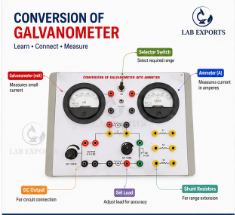
Product Code : SCL-EAE-11201
This apparatus is for the senior practical that turns a galvanometer into an ammeter and then a voltmeter. Students find the coil resistance and the figure of merit. They then calculate a low shunt for the ammeter and a high series resistance for the voltmeter. The set has a 0 to 100 µA galvanometer with a 1.00 kΩ coil, and 0 to 100 mA and 0 to 10 V reference meters for the check.
Specifications of the conversion of galvanometer apparatus
| Component | Specification |
|---|---|
| Galvanometer | Moving-coil, 0 to 100 µA, coil resistance 1.00 kΩ nominal |
| Reference meters | 0 to 100 mA and 0 to 10 V |
| Supply | Current-limited DC source |
| Also supplied | Resistance elements and connecting leads |
| Experiment 1 | Galvanometer to ammeter: shunt S = IgG/(I - Ig) in parallel; about 1.001 Ω for a 100 mA range |
| Experiment 2 | Galvanometer to voltmeter: R = V/Ig - G in series; 99.0 kΩ for a 10 V range |
| Supporting measurements | Galvanometer resistance G (for example by the half-deflection method) and figure of merit |
| Check | Converted meter compared with the reference meter of the same quantity |
| Level | Senior-secondary and college practical syllabi |
| House code | SCL-EAE-11201 |
| Manufacturer | Lab Exports, Delhi |
Steps of the conversion practical
Here G is the coil resistance and Ig the full-scale current of the galvanometer. I and V are the ammeter and voltmeter ranges wanted. On this set Ig is 100 µA and G is 1.00 kΩ nominal, so the measured values can be checked against them.
- Coil resistance G. Use the half-deflection method. A high resistance goes in series with the galvanometer, and a plug-type resistance box serves as the shunt that halves the deflection.
- Full-scale current. Find the figure of merit, then work out Ig from the number of scale divisions.
- Ammeter. Calculate S, about 1.001 Ω for a 100 mA range. Form it from the resistance elements, or cut it from manganin wire, and join it across the galvanometer. Vary the current with a rheostat and compare readings with the 0 to 100 mA reference meter.
- Voltmeter. Calculate R, 99.0 kΩ for a 10 V range, and join that resistance in series with the galvanometer. Compare readings with the 0 to 10 V reference meter. Record any difference between calculated and actual values.
Frequently Asked Questions
Which instruments are used with a galvanometer conversion set-up?
A galvanometer, a low shunt, a high resistance, a DC source, a key, a rheostat, leads and standard meters for the check. This set supplies the 0 to 100 µA galvanometer, 0 to 100 mA and 0 to 10 V reference meters, a current-limited DC source, resistance elements and leads.
Can the range of the converted meter be chosen?
Yes. The range is set by the resistance you connect. For an ammeter of range I use a shunt S = IgG/(I - Ig). For a voltmeter of range V use a series resistance R = V/Ig - G. A galvanometer with a different coil resistance or full-scale current needs different resistors.
Why can a galvanometer not be used directly as an ammeter or voltmeter?
Its coil gives full-scale deflection for a very small current and can safely carry little more. A larger circuit current would drive the pointer off scale and could burn out the delicate coil.
What material is used for the shunt wire?
A shunt is usually made of manganin or constantan wire. Both alloys change their resistance very little with temperature, so the shunt keeps its value as the current warms it.
What happens if the converted ammeter is connected in parallel by mistake?
A very large current flows through it, because its resistance is very low. This is close to a short circuit and can burn out the shunt and the galvanometer coil. An ammeter always goes in series with the load.
Why is a rheostat used as a potential divider to check the converted voltmeter?
It lets the applied voltage be raised smoothly from zero up to the full range of the converted voltmeter. Readings can then be compared with the standard voltmeter at several points across the scale.
Other apparatus for the conversion practical
- Galvanometer
- Resistance Box Plug Type
- Manganin Wire (100gm)
- Rheostat Constantine (Eureka) Wire
- One Way Plug Key
More apparatus is in the Electrical and Electronics section of the Physics Lab range.
To enquire, email [email protected] with the house code SCL-EAE-11201 and the quantity, or use the Add To Cart button on this page.
Last updated: 23 November 2026