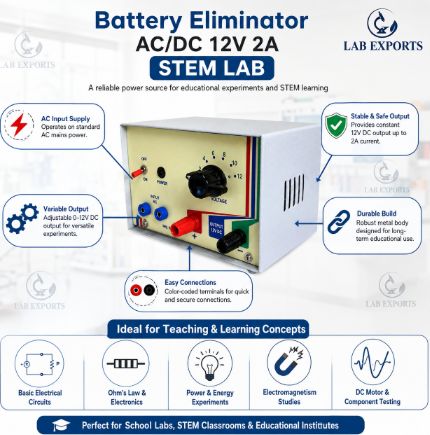
Battery Eliminator AC/DC
Product Code : SCL-EAE-11334
This battery eliminator gives both a low-voltage AC output and a DC output from one bench unit. The DC side runs circuits in place of dry cells. The AC side feeds work that cells cannot do, such as diode rectification and transformer demonstrations. The output voltages, current rating and connection details are confirmed with the quotation.
Specifications of the AC/DC battery eliminator
| Component | Specification |
|---|---|
| Equipment type | Low-voltage laboratory power supply |
| Outputs | Low-voltage AC and low-voltage DC from one unit |
| DC output used for | Circuits that would otherwise run on dry cells, such as Ohm's law, series and parallel circuits and electrolysis |
| AC output used for | Rectification with diodes, transformer demonstrations and comparing AC and DC effects |
| Output voltages, current rating and connections | Confirmed with the quotation |
| House code | SCL-EAE-11334 |
| Manufacturer | Lab Exports, Delhi |
Practicals that need the AC output as well as DC
Wire each circuit with the unit switched off. Choose AC or DC for the task, keep to the polarity on DC, and start at the lowest suitable voltage.
- Half-wave rectification. Join the PN Junction Diode Unit in series with a load resistor across the AC output. A digital multimeter on its DC range across the load now gives a reading, because current flows through the load one way only. Reverse the diode and the reading changes sign.
- Transformer action. Feed the primary coil of the Electrical Transformer from the AC output. Measure the primary and secondary voltages on the AC range of the multimeter and relate their ratio to the turns ratio.
- Telling AC from DC. Read each output on the AC and the DC ranges of the multimeter in turn. Students see which setting gives a steady reading on each output, and why DC has a fixed positive and negative terminal.
Frequently Asked Questions
How can you tell whether a power supply output is AC or DC?
Look at the output markings first. A DC output has a marked positive and negative terminal, while an AC output has no fixed polarity. A multimeter confirms it: a DC output reads steadily on the DC volts range, and an AC output reads on the AC volts range.
What should a school check when choosing a classroom power supply?
Check that the output voltages and current rating cover your practicals, whether you need AC as well as DC, and what protection is fitted. For this unit the output voltages, current rating and connection details are confirmed with the quotation, so list your practicals when you enquire.
What is the difference between a battery eliminator and a transformer?
A transformer only changes the size of an AC voltage, so its output is still AC. A battery eliminator also rectifies the supply, so it gives DC like a battery. This AC/DC model offers both kinds of output, a low-voltage AC supply and a DC supply.
What is the main difference between AC and DC?
The direction of the current. In DC the current flows steadily one way, so the terminals keep a fixed polarity. In AC it reverses many times every second. That is why DC replaces cells in circuits, while transformers and rectifier practicals need AC.
Other supplies and meters for AC and DC practicals
More apparatus is in the Electrical and Electronics section of the Physics Lab range.
To enquire, email [email protected] with the house code SCL-EAE-11334 and the quantity, or use the Add To Cart button on this page.
Last updated: 23 November 2026