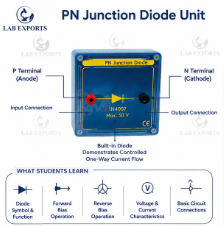
PN Junction Diode Unit
Product Code : SCL-EAE-11267
The PN Junction Diode Unit is used to plot the V-I characteristics of a semiconductor diode in forward and reverse bias. The anode and cathode are identified by panel markings or the circuit diagram. Students read the knee voltage from the forward curve and compare the forward and reverse resistance.
Specifications of the PN junction diode unit
| Component | Specification |
|---|---|
| Semiconductor device | PN junction diode |
| Primary experiment | Forward- and reverse-bias V-I characteristics |
| Terminals | Anode and cathode, identified by panel markings or circuit diagram |
| Connections | Points for a power supply and measuring instruments |
| Diode type, meter ranges, panel details | Confirmed by email with the house code |
| House code | SCL-EAE-11267 |
| Manufacturer | Lab Exports, Delhi |
Plotting the diode curve
Where P-type and N-type material meet, a depletion region forms with a barrier potential. Forward bias, with the P side positive, lowers the barrier. Reverse bias widens it, so only a very small current flows.
- Forward bias. Join the anode, through a current-limiting resistor, to the positive output of an IC Regulated Battery Eliminator. Place a milliammeter in series and a Digital LCD Voltmeter across the diode. Raise the supply from zero in small steps. The current climbs steeply past the knee voltage, about 0.7 V for silicon and 0.3 V for germanium.
- Reverse bias. Reverse the diode, change to a microammeter and record the much smaller reverse current. A Digital Multimeter on a low current range can serve here.
- Forward and reverse resistance. Divide the voltage by the current at points on each curve. The forward resistance is low and the reverse resistance very high, which is the one-way action used in rectifiers.
Documentation and supply
Most Lab Exports products carry a one-year manufacturer warranty.
Lab Exports manufactures the PN junction diode unit at its works in Laxmi Nagar, Delhi, and supplies it to schools, colleges and universities in India and 60+ countries, handling the export documents for each shipment. More about the company is on the About Lab Exports page.
Frequently Asked Questions
Which diode is better, silicon or germanium?
For most work silicon is preferred. A silicon diode has a much smaller reverse current and copes with higher temperatures. A germanium diode starts to conduct at a lower forward voltage, about 0.3 V against about 0.7 V, so it suits very small signals.
How do you test a diode with a digital multimeter?
Set the meter to diode test. With the red probe on the anode and the black on the cathode, a good diode shows its forward voltage drop. Reversed, it should read open. A reading both ways means a shorted diode, and none either way means it is open.
What does the arrowhead in the diode symbol represent?
The arrowhead is the anode, the P side, and it points the way conventional current flows in forward bias. The bar at its tip is the cathode, the N side. Current flows easily in the arrow direction and hardly at all the other way.
What is the static resistance of a diode?
It is the DC voltage across the diode divided by the current through it at one point on the curve, R = V/I. It is low in forward bias above the knee and very high in reverse bias, so it changes from point to point.
Why is a PN junction called a diode?
Because it has two electrodes, the anode and the cathode. The prefix di means two. It conducts well in one direction only, which makes it the basic part of a rectifier.
Other apparatus for diode characteristics
- PN Junction Diode Characteristics Apparatus
- Digital PN Junction Diode
- LED Characteristics Apparatus
- Solar Cell Characteristics Apparatus
More apparatus is in the Electrical and Electronics section of the Physics Lab range.
To enquire, email [email protected] with the house code SCL-EAE-11267 and the quantity, or use the Add To Cart button on this page.
Last updated: 23 November 2026