Torsion Pendulum

Product Code : EL-AM-10317
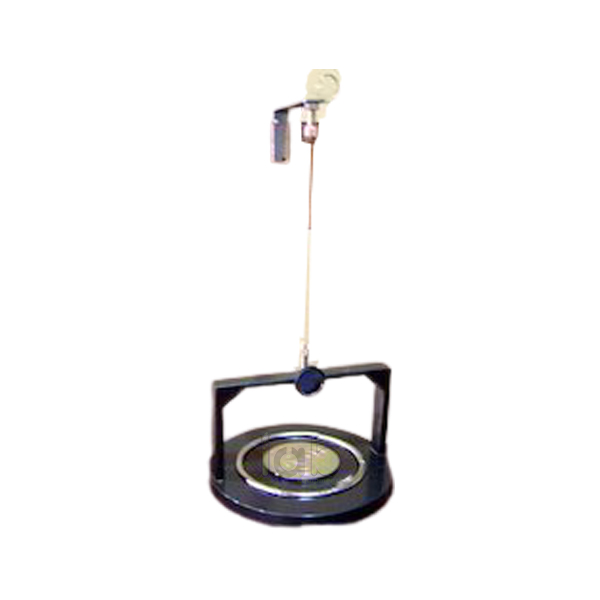
This torsion pendulum, also called a torsional pendulum, finds the moment of inertia of a disc and the rigidity modulus of a wire from two timings. A solid brass disc, 12.5 cm in diameter and 1.25 cm thick, hangs on a test wire held by a chuck nut at each end. A heavy brass ring adds a known moment of inertia. Ten steel and hard-drawn copper test wires are supplied.
Specifications of the torsion pendulum
| Component | Specification |
|---|---|
| Disc | Solid brass, 12.5 cm diameter, 1.25 cm thick |
| Ring | Heavy brass, same outside diameter as the disc |
| Test wires | Ten, about 0.4 mm diameter: five steel, which carry the disc with or without the ring, and five hard-drawn copper, for the disc alone |
| Wire ends | Held by a chuck nut at each end |
| Suspension | Hung from a universal clamp |
| Other disc size | Also available with a 6 inch brass disc |
| House code | EL-AM-10317 |
| Manufacturer | Lab Exports, Delhi |
Experiments with the disc and ring
Twisted and released, the disc swings to and fro about the wire with period T = 2π√(I/C). Here I is the moment of inertia of the body on the wire, and C is the torsional constant of the wire. The ring raises I by a known amount, so the period becomes longer.
- Moment of inertia of the disc. Time 20 oscillations of the disc alone with an analog stop clock to get T0. Place the ring centrally on the disc and time again to get T1. Weigh the ring on a compact balance and measure its radii with a vernier caliper. The ring adds Iring = M(R12 + R22)/2, where M is its mass and R1 and R2 its inner and outer radii. The disc then has I0 = IringT02/(T12 - T02).
- Rigidity modulus of steel and copper. Measure the length l of wire between the chuck nuts. Find its radius r, half the diameter, with a screw gauge. The same two periods give η = 8πlIring/[r4(T12 - T02)], with no need to know I0 or C first. Then clamp a copper wire in place of the steel one and time the disc alone, without the ring, to get its period T. With I0 from the steel runs, η = 8πlI0/(r4T2). Copper twists more easily than steel, so it gives the longer period and the smaller η.
- Checking the disc value. For a uniform solid disc, I = mR2/2 about its axis, where m is the mass of the disc and R its radius. Weigh the disc, measure its diameter, and compare this value with the I0 found from the timings.
Timing the oscillations
- Clamp a steel or copper test wire in the two chuck nuts, hang it from the universal clamp and let the disc come to rest. Add the ring only when a steel wire is clamped.
- Mark the edge of the disc and set a fixed pointer next to the mark, so that each oscillation can be counted.
- Twist the disc through a small angle and let go without pushing it sideways.
- Start the clock as the mark passes the pointer and stop it after 20 complete oscillations. Repeat and use the mean time.
- Place the ring centrally on the disc and repeat the timing for T1.
Frequently Asked Questions
What does the brass ring add to the experiment?
It adds a moment of inertia that can be worked out from its mass and radii. With the ring on the disc the period becomes longer. Comparing the two periods gives both the moment of inertia of the disc and the rigidity modulus of the wire.
Is the motion of a torsion pendulum simple harmonic?
Yes, for small twists. The restoring torque of the wire is proportional to the angle of twist, so the disc moves with simple harmonic motion. Its period then depends only on I and C, not on the starting angle, as long as the twist stays small.
How is a torsion pendulum different from a simple pendulum?
A torsion pendulum twists to and fro about the wire, while a simple pendulum swings from side to side. Its restoring torque comes from the twisted wire, not from gravity. So its period depends on the moment of inertia and the stiffness of the wire, not on g.
Why must the wire be straight and the chuck nuts tight?
A kinked or bent wire does not twist evenly along its length. A loose chuck nut lets the wire turn in its grip, so the oscillations die away quickly and the timing goes wrong. The test wires are only about 0.4 mm thick, so handle them gently, straighten each one before clamping and tighten both nuts firmly.
Where else is the torsion pendulum principle used?
It is used in torsion pendulum clocks, in the torsion balance of the Cavendish experiment and in the balance wheel of a mechanical watch. In each one, a twisted wire, fibre or spring gives a restoring torque in proportion to the angle.
Other apparatus for moment of inertia practicals
More apparatus is in the Applied Mechanics section of the Physics Lab range.
To enquire, email [email protected] with the house code EL-AM-10317 and the quantity, or use the Add To Cart button on this page.
Last updated: 20 November 2026