Torsion Apparatus Searle's Type
Product Code : EL-AM-10319
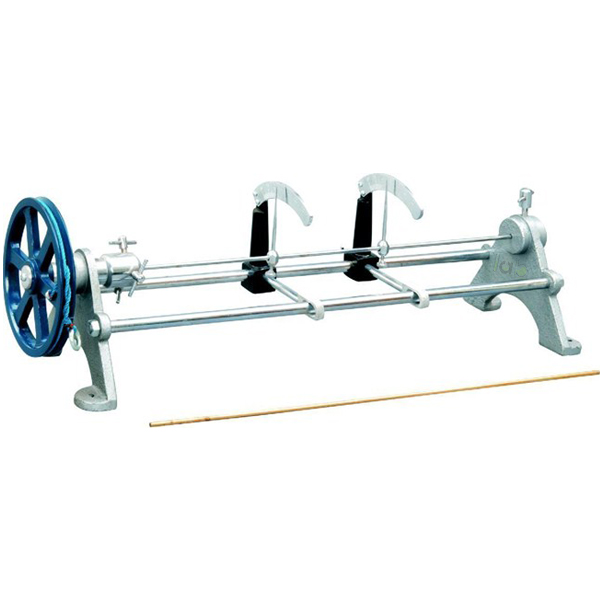
This Searle's type torsion apparatus measures the modulus of rigidity of a rod by the static method. The rod lies horizontal between a split collet chuck and a rear clamping block. A mass on a cord round a 165 mm grooved wheel twists it, and two pointers over 30-0-30 degree brass scales read the twist. Brass and steel test rods are supplied.
Specifications of the Searle's torsion apparatus
| Component | Specification |
|---|---|
| Pattern | Horizontal bench |
| Wheel | 165 mm diameter, grooved, moving in ball bearings on the front foot |
| Chuck | Split collet chuck on the spindle, holding one end of the test rod |
| Rear support | Clamping block through the rear foot |
| Scales | Two brass scales, graduated 30-0-30 degrees, on adjustable pillar supports |
| Pointers | Two, with clamps for attaching to the specimen |
| Test rods | One brass rod and one steel rod |
| Feet | Two cast iron feet, each with three through-holes and grub securing screws, joined by two supporting rods |
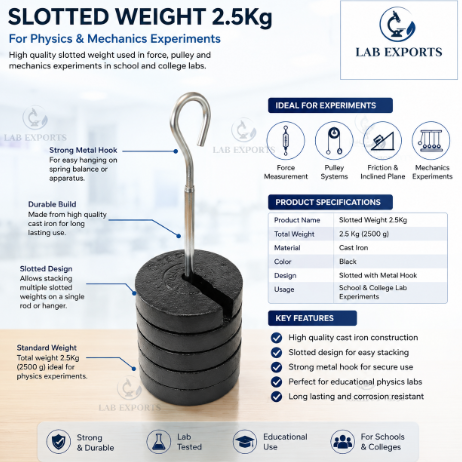
| Loading | Cord and hook for carrying masses (weights not included) |
| Option | Also available with a one-metre-long rod |
| House code | EL-AM-10319 |
| Manufacturer | Lab Exports, Delhi |
Static torsion practicals on the bench apparatus
A mass M on the hook pulls the cord round the wheel. This applies a twisting couple MgR to the free end of the rod. Here R is the radius of the wheel, half its diameter, and g is the acceleration due to gravity. The clamping block holds the other end still, and each pointer shows how far the rod has turned at its own position.
- Modulus of rigidity of the brass rod. Hang a slotted mass hanger with its masses on the hook. The difference between the two pointer readings, in radians, is the twist φ over the length l between the pointers. Find the rod radius r from screw gauge readings at several places. Then η = 2MgRl/(πr4φ).
- Twist against load. Add masses in equal steps and record both pointers each time. While the rod stays elastic, a graph of φ against M is a straight line through the origin. Its slope gives a mean value of η that one poor reading cannot upset.
- Brass against steel. Repeat the loading on the steel rod. Steel has a higher modulus of rigidity than brass, so a steel rod of the same size twists through a smaller angle under the same couple.
Reading the twist step by step
- Grip one end of the test rod in the split collet chuck and the other end in the rear clamping block.
- Clamp the two pointers on the rod and measure the distance l between them.
- Adjust the scales on their pillars so that both pointers read zero with the hook unloaded.
- Add masses in equal steps and read both pointers each time, then take them off in the same steps and read again.
- Wind the cord the other way round the wheel, repeat the loading, and use the mean twist for each load.
Frequently Asked Questions
Why are two pointers used instead of one?
The difference between two pointer readings gives the twist over a measured length of rod. Any slip at the chuck or the clamping block turns both pointers by the same amount, so it cancels. A single pointer would add that slip to the twist.
Why are the pointer readings repeated as the masses are removed?
Matching readings on loading and unloading show that the rod has stayed within its elastic limit. A small lag in the rod shows up as a difference between the two sets. Using the mean of the two readings for each load reduces that error.
Why is the rod twisted in both directions?
Twisting both ways cancels small zero errors. A pointer that is not quite central, or a scale set slightly off zero, adds to the reading one way and takes away from it the other way. The mean twist for each load is then free of that offset.
On what does the modulus of rigidity depend?
It depends on the material of the rod and, to a small extent, on its temperature. It does not depend on the length or radius of the rod. A thicker rod twists less under the same couple, but the modulus worked out from it stays the same.
Which test rods and masses come with the apparatus?
One brass rod and one steel rod are supplied, and a version with a one-metre-long rod is also available. The cord and hook are included, but the weights are not, so masses for the hook have to be ordered separately.
Other apparatus for elasticity practicals
- Rigidity Apparatus (Searle's Pattern)
- Young's Modulus Apparatus (Searle's Pattern)
- Bending of Beam Apparatus
- Cantilever Apparatus
More apparatus is in the Applied Mechanics section of the Physics Lab range.
To enquire, email [email protected] with the house code EL-AM-10319 and the quantity, or use the Add To Cart button on this page.
Last updated: 19 November 2026