Petrol Engine Model Four Stroke
Product Code : SCL-AM-11274
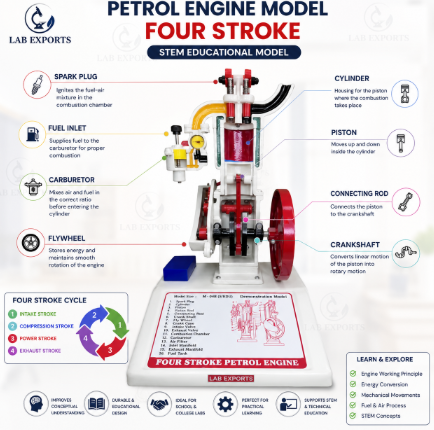
This four-stroke petrol engine model is a teaching model of a spark-ignition engine. Turned slowly, it shows the piston, connecting rod, crankshaft, flywheel and valve mechanism moving through the intake, compression, power and exhaust strokes. Students can then link each stroke to the parts that cause it, in physics, automotive and heat-engine lessons.
Specifications of the four-stroke petrol engine model
| Component | Specification |
|---|---|
| Engine type | Four-stroke petrol engine demonstration model |
| Cycle shown | Intake, compression, power and exhaust |
| Ignition principle | Spark ignition |
| Visible parts | Piston, cylinder, connecting rod, crankshaft, flywheel and valve mechanism |
| Material, dimensions and drive | For the current model, available from [email protected] |
| House code | SCL-AM-11274 |
| Manufacturer | Lab Exports, Delhi |
Following the four strokes on the model
One working cycle takes four strokes of the piston and two full turns of the crankshaft. The connecting rod changes the up-and-down motion of the piston into rotation of the crankshaft. Watch the valves and the piston together to name each stroke:
- Intake: the inlet valve is open and the piston moves down, drawing the fuel-air mixture into the cylinder.
- Compression: both valves are shut and the piston moves up, squeezing the mixture.
- Power: a spark fires the mixture near the top of the stroke, and the hot expanding gases force the piston down.
- Exhaust: the exhaust valve opens and the rising piston pushes the burnt gases out.
- Petrol and diesel compared. Set the model beside the Diesel Engine Model Four Stroke. Both engines use the same four strokes. A petrol engine fires a compressed fuel-air mixture with a spark, while a diesel engine compresses air alone until it is hot enough to ignite fuel injected into it.
- Four strokes and two strokes. Compare it with the Two Stroke Petrol Engine. A two-stroke engine completes its cycle in one turn of the crankshaft, so it has a power stroke on every turn. The four-stroke engine has one on every second turn.
- Link to heat-engine theory. The idealised form of the petrol-engine cycle is the Otto cycle. It connects the moving model to work on heat engines and their efficiency in thermodynamics lessons.
Documentation and supply
Most Lab Exports products carry a one-year manufacturer warranty.
Lab Exports manufactures the four-stroke petrol engine model at its works in Laxmi Nagar, Delhi, and supplies it to schools, colleges and universities in India and 60+ countries, handling the export documents for each shipment. More about the company is on the About Lab Exports page.
Frequently Asked Questions
Why is a petrol engine called a spark-ignition engine?
Because an electric spark sets the compressed fuel-air mixture alight. The compression is kept low enough that the charge does not ignite on its own, so the spark decides exactly when burning starts.
Why is the intake stroke also called the suction stroke?
As the piston moves down with the inlet valve open, the space above it grows and the pressure inside falls below that of the outside air. The fuel-air mixture is pushed in to fill the space, so the stroke seems to suck the charge into the cylinder.
How often does each valve open during the cycle?
Each valve opens once in every two turns of the crankshaft. The inlet valve opens for the intake stroke and the exhaust valve for the exhaust stroke. Both stay shut for compression and power. In a real engine, the camshaft that works the valves turns at half the crankshaft speed.
Why does a single-cylinder engine need a heavy flywheel?
Only one stroke in four gives power. The flywheel stores energy during the power stroke and gives it back to carry the crankshaft through the exhaust, intake and compression strokes. Without it, the engine would slow sharply or stop between power strokes.
What are the five events of a four-stroke cycle?
They are intake, compression, ignition, power and exhaust. Ignition is counted as a separate event because the spark fires near the end of the compression stroke, before the piston starts down on the power stroke. The events still fit into four strokes and two crankshaft turns.
Other engine models for heat lessons
More apparatus is in the Applied Mechanics section of the Physics Lab range.
To enquire, email [email protected] with the house code SCL-AM-11274 and the quantity, or use the Add To Cart button on this page.
Last updated: 19 November 2026