Torsion Pendulum (Bridge Type)
Product Code : EL-AM-10318
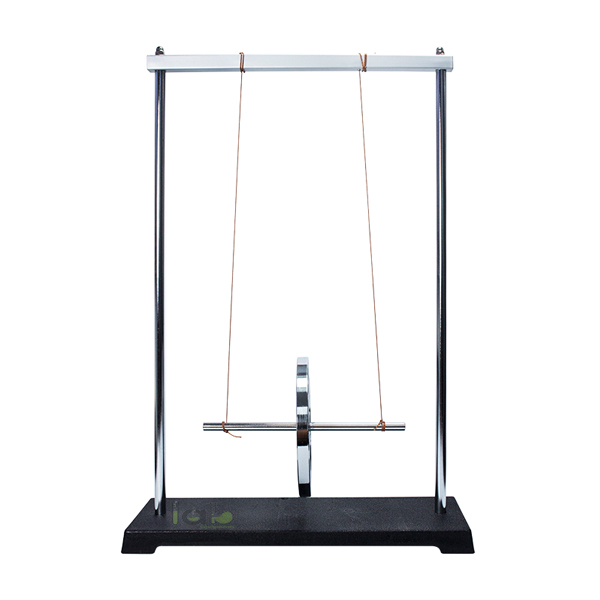
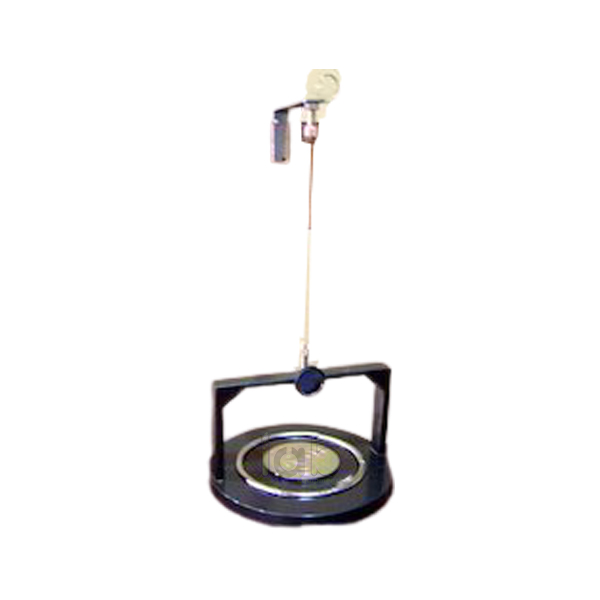
The bridge type torsion pendulum hangs its load on a torsion bar inside a tall U-shape metal bridge. An upper split chuck on the bridge grips the top of the bar. A lower quick-action chuck fixes the load to the bar, so the load twists with it. The load is a 160 mm diameter disc or a ring. Five aluminium torsion bars, 2 to 6 mm in diameter, are used in place of a wire.
Specifications of the bridge type pendulum
| Component | Specification |
|---|---|
| Frame | Tall U-shape metal bridge |
| Upper chuck | Split chuck on the bridge; grips the top end of the torsion bar |
| Lower chuck | Quick-action chuck at the load; fixes the disc or ring to the torsion bar so that the load twists with it |
| Disc | 160 mm diameter |
| Ring | Second load, fixed in the lower chuck in place of the disc |
| Torsion bars | Five, aluminium, 2 to 6 mm diameter, used in place of a wire |
| House code | EL-AM-10318 |
| Manufacturer | Lab Exports, Delhi |
Practicals on the bridge type pendulum
The torsion bar runs from the split chuck on the U-shape bridge down to the quick-action chuck, so the load hangs within the frame. Given a small twist, the load makes torsional oscillations with period T = 2π√(I/C). Here I is the moment of inertia of the load about the bar. For a bar of radius r and free length l, the torsional constant is C = πηr4/(2l), where η is the rigidity modulus of the bar material.
- Rigidity modulus with the disc. Weigh the disc to get M, and measure its diameter with a digital vernier caliper. Its moment of inertia is I = MR2/2, where R is half the diameter. Find T by timing 20 oscillations on an analog stop clock. Measure the bar with a screw gauge and its free length l between the chucks, then η = 8πIl/(r4T2).
- Bars of different diameter. Repeat with each of the five bars, measuring r and l for every one. The period falls steeply as the bar gets thicker, because C rises with r4. All five bars are aluminium, so their values of η should agree within experimental error.
- Disc and ring compared. Fix the ring in the quick-action chuck in place of the disc, on the same bar, and time it again. For a ring of mass M with inner radius R1 and outer radius R2, I = M(R12 + R22)/2. On one bar T2 is proportional to I, so the ratio of the two values of T2 should match the ratio of the two moments of inertia.
Frequently Asked Questions
Why is the bar diameter measured at several places?
The radius of the torsion bar enters the formula as its fourth power, so its percentage error is multiplied by four in the rigidity modulus. Take screw gauge readings along the bar, turning it a quarter turn between readings, and average them.
Why must the disc turn without swinging sideways?
The formula assumes pure twisting about the torsion bar. If the disc or ring also swings like an ordinary pendulum, the two motions mix and the timing is spoiled. Let the load hang level and come to rest, then twist it gently without any sideways push.
How does the moment of inertia of the load change the period?
A larger moment of inertia gives a longer period, since on the same bar the period is proportional to the square root of I. A ring keeps more of its mass far from the axis than a disc of the same mass and outer size, so it has the larger I.
What does the split chuck do?
The upper split chuck on the bridge grips the top end of the torsion bar, so the bar cannot turn there. The lower quick-action chuck fixes the disc or ring to the bar, so every twist passes into the bar without slipping. A load that slips loses energy at the joint, and the oscillations die away too soon.
Other apparatus for rotational motion practicals
More apparatus is in the Applied Mechanics section of the Physics Lab range.
To enquire, email [email protected] with the house code EL-AM-10318 and the quantity, or use the Add To Cart button on this page. Tender buyers can also see the Tenders and OEM page.
Last updated: 20 November 2026