Inclined Plane Apparatus

Product Code : SCL-AM-11224
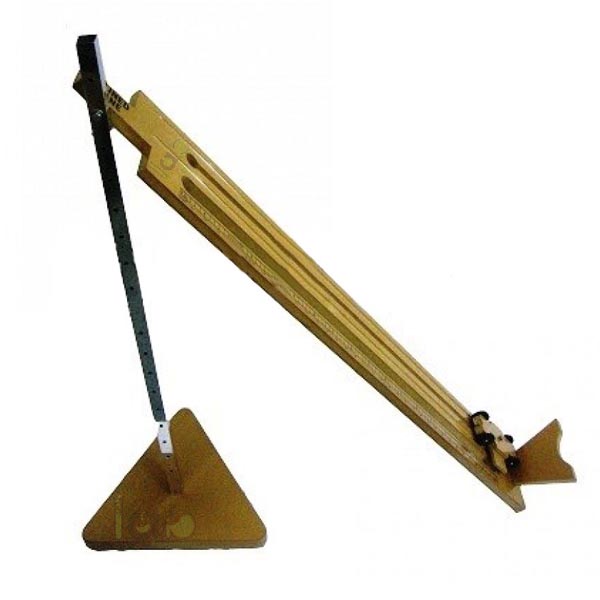
This inclined plane apparatus is a simple-machine set-up for the mechanics lab. Its 584 × 102 mm steel plane locks at any angle from 0 to 45°, read in 1° steps. It shows how the slope changes the force needed to move a load, and compares the work done along the slope with the gain in potential energy. It also serves for friction and mechanical advantage practicals.
Specifications of the inclined plane apparatus
| Component | Specification |
|---|---|
| Type | Applied mechanics and simple machines laboratory equipment |
| Principles shown | Inclined-plane mechanics, force, friction, work and mechanical advantage |
| Supply | One inclined plane apparatus assembly |
| Plane | Steel, 584 × 102 mm |
| Angle range | 0 to 45°, lockable, with 1° graduations; zero with the plane horizontal |
| Pulley | Adjustable |
| Load carrier | Roller or cart |
| Accessories | Pan, cord and guide |
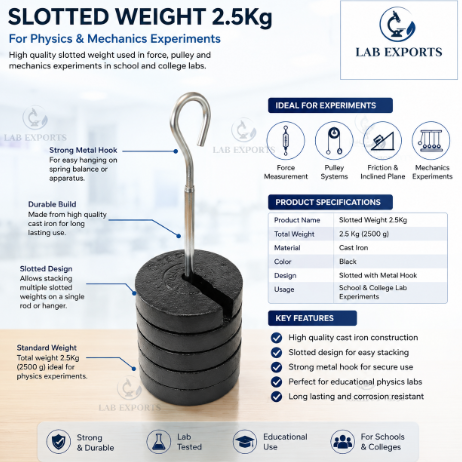
| Masses | Separate from the assembly; they provide the applied load |
| House code | SCL-AM-11224 |
| Manufacturer | Lab Exports, Delhi |
Work and energy on the inclined plane
Set the angle θ on the scale, which reads zero with the plane horizontal, and lock it. A load of weight W is pulled down the slope by the component W sin θ. The part at right angles to the surface, W cos θ, is balanced by the normal reaction of the plane. L is the distance along the slope from end to end, and h is the height of the top end above the bottom end. Pulling the load up the full slope with force F does work F × L. The load gains potential energy W × h.
- Work put in and energy gained. Hang the load from an ESAL spring balance and read its weight W. Measure L and h. Then hook the balance to the load and pull it up the plane at a steady speed, keeping the balance parallel to the surface. Compare F × L with W × h. The difference is the work done against friction.
- Force and distance at different slopes. Repeat the pull with the plane at two or three angles, measuring F, L and h each time. At a gentle angle the pull is smaller, but the load travels further along the slope for each centimetre of height gained. At every angle, F × L stays above W × h by the work done against friction.
- Effort and load at one angle. Keep the angle fixed and add masses from a brass mass set to the roller or cart in steps. Each time, run the cord over the adjustable pulley to the pan, and add masses to the pan until the load moves up at a steady speed. The effort is the weight of the pan and its masses. Plot it against the total weight of the load. The points lie close to a straight line, because both the down-slope part and the friction rise in step with the load.
Frequently Asked Questions
Is a screw a kind of inclined plane?
Yes. A screw thread is an inclined plane wrapped round a cylinder. Each turn moves the screw only a short distance along its axis, while the thread travels a long spiral path. So a small turning force gives a large force along the screw. A wedge is two inclined planes back to back.
Does the normal reaction of the plane do any work on the load?
No. The normal reaction acts at right angles to the surface, while the load moves along the surface. A force does work only through its component along the motion, and here that component is zero.
Why do roads up a hill zigzag instead of going straight up?
Each zigzag section is a gentler inclined plane. A vehicle then needs less driving force at every point, though it travels further to gain the same height. The same rule applies on this apparatus: a lower angle means a smaller pull over a longer distance.
Why is the pull read while the load moves at a steady speed?
At a steady speed the load is not accelerating, so the forces on it balance. The pull then equals the friction force plus the share of the weight acting down the slope. A jerky pull adds extra force to speed the load up and gives a reading that is too high.
What plane size, angle range and accessories does this apparatus have?
The steel plane is 584 × 102 mm and locks at any angle from 0 to 45°, with 1° graduations and zero when horizontal. An adjustable pulley, a roller or cart, a pan, cord and a guide come with it. The masses for the load are separate, and some practicals also use a spring balance.
Simple machine apparatus for the mechanics bench
More apparatus is in the Applied Mechanics section of the Physics Lab range.
To enquire, email [email protected] with the house code SCL-AM-11224 and the quantity, or use the Add To Cart button on this page.
Last updated: 23 November 2026