Newton’s Third Law Model (3rd Law of Motion Apparatus)
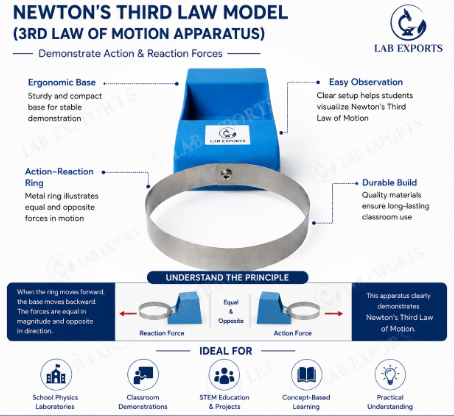
Product Code : SCL-AM-11166
This 3rd law of motion apparatus shows action and reaction with two low-friction carts. A compressed spring bumper between the carts is released and pushes on both at the same moment, so they roll apart in opposite directions. The equal and opposite forces also lead into conservation of momentum. A track version adds a matched level track about 1.2 m long and two removable cart masses.
Specifications of the third law apparatus
| Component | Specification |
|---|---|
| Type | Newton's third law apparatus with interaction carts |
| Carts | Two, low-friction, with spring bumpers |
| Interaction | Spring bumper released between the carts to push them apart |
| Guide | Instructional guide with experiment templates |
| Base set | The two carts and the guide; a track and extra masses are optional |
| Track version | Two aluminium-body carts, a matched level track about 1.2 m long and two removable cart masses |
| House code | SCL-AM-11166 |
| Manufacturer | Lab Exports, Delhi |
Action and reaction tests with the two carts
When body A pushes on body B, body B pushes back on A with a force of equal size in the opposite direction. The released spring acts on both carts for the same short time. Each cart therefore gets an equal and opposite impulse, and m1v1 = m2v2. Here m1 and m2 are the cart masses and v1 and v2 their speeds just after release.
- Equal carts. Set both carts on the track, touching, with the spring bumper compressed. With the base set, use a smooth, level bench instead. Mark the start and release the spring. With equal masses the carts move off at the same speed and cover equal distances in the same time.
- One cart loaded. Find the mass of each cart on a Triple-Beam Balance. Load one cart, with a removable cart mass on the track version or with masses from a Physical Weight Box Iron, and release the spring again. The loaded cart moves off more slowly, and the ratio of the speeds matches the inverse ratio of the masses.
- Two stops, one sound. Place a block in the path of each cart. Move the blocks until both carts strike them at the same instant, heard as a single knock. The two distances from the start are then in the inverse ratio of the cart masses.
Frequently Asked Questions
How does the third law apparatus work?
The two carts start at rest, touching, with the spring bumper compressed between them. Releasing the spring pushes on both carts at the same moment, so they roll apart in opposite directions. With carts of equal mass, both move off at the same speed.
If action and reaction are equal and opposite, why do they not cancel?
They act on different bodies. The spring pushes one cart forwards and the other cart backwards, so each cart feels one unbalanced force and moves. Forces cancel only when they act on the same body.
Does the heavier cart push harder than the lighter one?
No. The spring pushes on both carts with forces of equal size, whatever their masses. The loaded cart moves off more slowly only because the same impulse gives a larger mass less speed, so m1v1 = m2v2.
Why must the carts run on a level, smooth surface?
A slope adds part of the weight of each cart as an extra force, and rough patches add uneven friction. Either one makes one cart slow down more than the other, so the distances no longer show the equal and opposite push. The track version comes with a matched level track.
What are everyday examples of Newton's third law?
A gun recoils when it fires, a swimmer pushes water back to move forward, and a rocket pushes hot gas down to rise. In walking, your foot pushes back on the ground and the ground pushes you forward.
Momentum and motion apparatus
More apparatus is in the Applied Mechanics section of the Physics Lab range.
To enquire, email [email protected] with the house code SCL-AM-11166 and the quantity, or use the Add To Cart button on this page.
Last updated: 23 November 2026