Inertia Disc
Product Code : EL-AM-10315
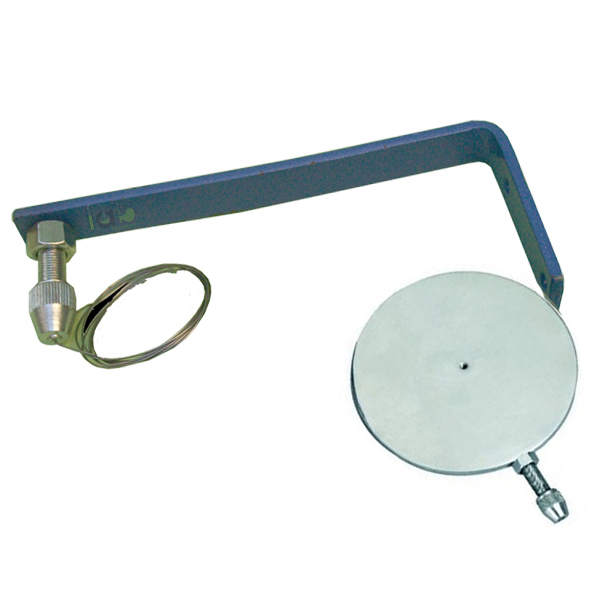
The inertia disc is a brass disc of about 15 cm diameter and 6 mm thickness, with an arrangement for clamping a split chuck at its centre. Hung on a wire, it becomes a torsion pendulum. Its moment of inertia can be worked out from its mass and diameter, so it is used to find the rigidity modulus of the wire.
Specifications of the inertia disc
| Component | Specification |
|---|---|
| Material | Brass |
| Diameter | Approx. 15 cm |
| Thickness | 6 mm |
| Clamping | Split chuck clamping arrangement at the centre |
| Wall bracket | Not included |
| House code | EL-AM-10315 |
| Manufacturer | Lab Exports, Delhi |
Torsion pendulum work with the inertia disc
A uniform disc of mass M and radius R has a moment of inertia I = MR2/2 about its central axis, where R is half the measured diameter. Hung by its centre and twisted, the disc oscillates with period T = 2π√(I/C), where C is the torsional constant of the wire. For a wire of length l and radius r, the rigidity modulus is η = 8πIl/(r4T2).
- Rigidity modulus of a wire. Grip a length of steel wire in the split chuck and fix its upper end to a rigid support. Twist the disc slightly, release it and time 20 oscillations with an analog stop clock. Measure the free length of the wire, and its radius with a screw gauge / micrometer.
- Period against wire length. Shorten the wire in steps and find T at each length. A graph of T2 against l is a straight line through the origin, and its slope gives η from one plot instead of a single reading.
- Torsional constant of a wire. With I known from the mass and diameter of the disc, C = 4π2I/T2. Once C is known, the same wire can be used to find the moment of inertia of another body hung in place of the disc.
Frequently Asked Questions
What is a torsion pendulum?
It is a body hung from a fixed point by a wire that oscillates by twisting about the wire, not by swinging. The twisted wire gives a restoring torque proportional to the angle of twist. This brass disc becomes a torsion pendulum once it is hung by its split chuck.
What precautions should be taken in a torsion pendulum experiment?
Check that the wire has no kinks and is gripped firmly at both ends, or it may slip and the period will drift. Twist the disc gently so the wire is not strained beyond its elastic limit. Wait for any side-to-side swing to die away before you start timing.
Why is a graph of T squared against wire length a straight line?
Because T2 is proportional to l. A longer wire twists more easily, so its torsional constant falls in proportion to 1/l, while the moment of inertia of the disc stays fixed. If the line misses the origin, the measured length is probably wrong.
Why is the disc clamped exactly at its centre?
The formula I = MR2/2 holds only about the central axis of the disc. An off-centre grip makes the disc hang tilted, raises its moment of inertia and adds a wobble to the motion. The split chuck holds the wire on that axis.
Is a wall bracket included with the inertia disc?
No. The disc comes with its split chuck clamping arrangement only. Fix the upper end of the wire to a wall bracket or another firm support that cannot sway, since any movement at the top changes the period.
Other items for torsional oscillation practicals
More apparatus is in the Applied Mechanics section of the Physics Lab range.
To enquire, email [email protected] with the house code EL-AM-10315 and the quantity, or use the Add To Cart button on this page.
Last updated: 19 November 2026