Steam Engine Model with Boiler
Product Code : SCL-AM-11275
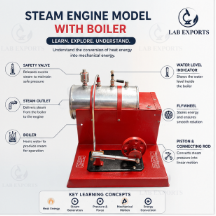
This steam engine model with boiler is a mounted demonstration heat engine. Steam raised in the boiler drives a piston, and a connecting rod, crank and flywheel turn that back-and-forth movement into rotation. Boiler and engine share one demonstration base, so the class can follow heat becoming steam pressure and then motion.
Specifications of the steam engine model
| Component | Specification |
|---|---|
| Subject area | Physics laboratory equipment, heat and thermodynamics |
| Function | Demonstration of steam-powered mechanical motion |
| Energy conversion | Thermal energy to mechanical energy |
| Mechanism | Steam-driven piston and cylinder, connecting rod, crank and flywheel |
| Steam connection | Pipe from the boiler to the engine cylinder |
| Mounting | Boiler and engine on a demonstration base |
| Heat source | Ask for one in the enquiry if it is needed |
| Boiler rating and heating arrangement | For the current version, available from [email protected] |
| House code | SCL-AM-11275 |
| Manufacturer | Lab Exports, Delhi |
Demonstrating a heat engine with the steam model
Stand the model on a stable, heat-resistant bench and fill the boiler with water. Heat the boiler and wait for steam to form. If needed, give the flywheel a gentle start, then watch the piston, crank and flywheel. When the demonstration ends, remove the heat and let the model cool fully before handling or refilling.
- Tracing the energy chain. Ask students to name each stage: energy from the heat source, thermal energy in the steam, work done on the piston and kinetic energy of the flywheel. The connecting rod and crank link the to-and-fro piston to the turning shaft.
- Heat into work, and work into heat. The steam engine turns heat into mechanical work. Joule’s Mechanical Heat Experiment Apparatus runs the other way, turning mechanical work into heat. Showing both helps students see heat and work as two forms of energy transfer.
- Burning outside or inside the cylinder. Here the heat is supplied under the boiler, away from the engine. In the Petrol Engine Model Four Stroke, the fuel burns inside the cylinder itself. Ask students where the hot gas or steam comes from in each engine, and what pushes the piston.
Running the engine safely
The engine should be run by the teacher or under close supervision. The boiler, the pipe and escaping steam become hot enough to scald. Never heat the boiler dry, and keep hands clear of the moving flywheel.
Frequently Asked Questions
Why is a steam engine called an external combustion engine?
Because any fuel burns outside the engine, under a separate boiler, and not in the cylinder. The heat turns water into steam, and the steam carries the energy to the piston. Petrol and diesel engines are internal combustion engines.
Is a heat source supplied with the model?
It is not listed as part of the model, so ask for one in your enquiry if it is needed. The boiler rating and heating arrangement for the current version are available from [email protected], so that the heat source can be matched to that arrangement.
Why does pressure build up in the boiler?
Water takes up far more volume as steam than as liquid. In a closed boiler the steam has nowhere to go, so its pressure rises. Led through the pipe to the cylinder, it pushes on the piston and does work as it expands.
Where were steam engines used before electric motors?
They drove railway locomotives, ships, factory machinery and pumps that drained water from mines. Steam is still used in many power stations, but there it spins turbines instead of moving pistons.
Internal combustion engine models for comparison
More apparatus is in the Applied Mechanics section of the Physics Lab range.
To enquire, email [email protected] with the house code SCL-AM-11275 and the quantity, or use the Add To Cart button on this page.
Last updated: 19 November 2026