Inertia Table

Product Code : EL-AM-10314
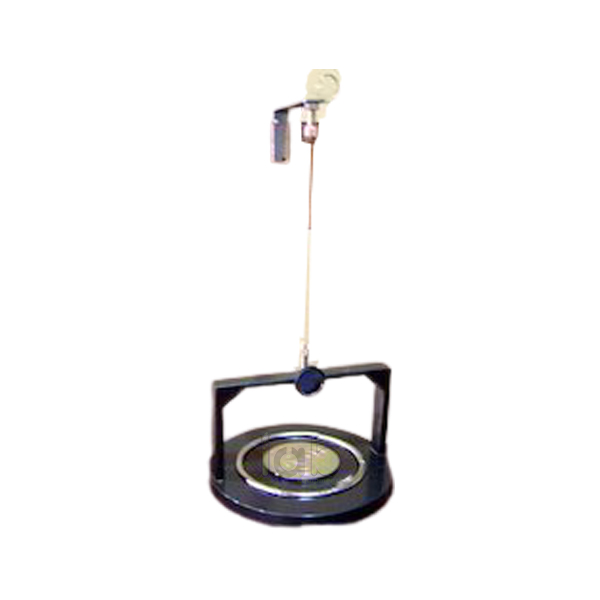
The inertia table finds the moment of inertia of an irregular body about an axis through its centre of gravity, perpendicular to its plane, by the dynamical method. An aluminium disc of about 6 inch diameter hangs by a steel wire from a framework. Three balancing weights in a concentric groove level the disc, and the circular base has levelling screws.
Specifications of the inertia table
| Component | Specification |
|---|---|
| Disc | Aluminium, approx. 6 inch (about 15 cm) diameter, with a concentric groove |
| Balancing weights | Three, in the groove of the disc; moved round the groove to level the suspended disc |
| Suspension | Steel wire at the centre of the framework |
| Frame | Long framework on a circular base |
| Base | Fitted with levelling screws |
| Method | Dynamical method, from torsional oscillations |
| House code | EL-AM-10314 |
| Manufacturer | Lab Exports, Delhi |
Finding moment of inertia on the inertia table
Hung from its steel wire, the table is a torsion pendulum with period T = 2π√(I/C). Here I is the moment of inertia of everything that turns with the wire, and C is the torsional constant of the wire. Three periods are timed. T0 is for the empty table, T1 is with a regular body of known moment of inertia I1, and T2 is with the irregular body. Then I = I1(T22 - T02)/(T12 - T02), and C is never needed. The three balancing weights stay at the same radius wherever they sit in the groove. So moving them to level the disc does not change their share of I.
- Moment of inertia of an irregular body. Level the base, then move the balancing weights round the groove until the disc hangs level. Give the empty table a small twist and time 20 oscillations with an analog stop clock. Repeat with the regular body on the table, and then with the irregular body placed so that its centre of gravity lies on the wire axis.
- Preparing the regular body. A uniform disc makes a convenient regular body, since I1 = MR2/2 about its axis. Find its mass M on a physical balance and its diameter with a vernier caliper; R is half the diameter.
- Checking the method. Treat a second regular body, such as a ring of measured mass and radii, as if it were unknown. Compare the value from the table with the one calculated from its dimensions to judge the accuracy of your readings.
Documentation and supply
Installation instructions and a manual are supplied with the apparatus. Most Lab Exports products carry a one-year manufacturer warranty.
Lab Exports manufactures the Inertia Table at its works in Laxmi Nagar, Delhi, and supplies it to schools, colleges and universities in India and 60+ countries, handling the export documents for each shipment. More about the company is on the About Lab Exports page.
Frequently Asked Questions
How do you calculate the moment of inertia of an irregular body on the inertia table?
Time the oscillations three times: with the table empty, with a regular body of known moment of inertia, and with the irregular body. The rise in T2 caused by each body is proportional to its moment of inertia. Scaling the known value by the ratio of these rises gives the answer.
Why must the centre of gravity of the body lie on the wire axis?
The method measures the moment of inertia about the axis of the wire. If the centre of gravity is off that axis, the result is too large by the mass times the square of the offset, by the parallel axis theorem. An off-centre load can also tilt the table and make it wobble. Moving the balancing weights round the groove levels it again without changing their moment of inertia.
Why is the base levelled before taking readings?
Levelling sets the wire vertical through the centre of the table. The table then turns in a horizontal plane about a fixed axis, without swinging like a simple pendulum. Adjust the levelling screws on the circular base first. Then move the three balancing weights round the groove until the disc itself hangs level.
Upon what factors does the moment of inertia depend?
It depends on the mass of the body, how that mass is spread out, and the position of the axis. Mass far from the axis adds much more than mass near it, because each part counts with the square of its distance from the axis.
What is the radius of gyration, and how is it found here?
The radius of gyration k is the distance from the axis at which the whole mass of a body could sit and give the same moment of inertia. So I = Mk2. After finding I on the inertia table, weigh the body and take k = √(I/M).
Why are 20 oscillations timed instead of one?
Your reaction time when starting and stopping the clock is spread over all 20 swings instead of one. Divide the total time by 20 to get the period, and repeat each set to make sure the values agree.
Other apparatus for moment of inertia practicals
More apparatus is in the Applied Mechanics section of the Physics Lab range.
To enquire, email [email protected] with the house code EL-AM-10314 and the quantity, or use the Add To Cart button on this page. Tender buyers can also see the Tenders and OEM page.
Last updated: 20 November 2026