Torsion (Barton's) Apparatus Vertical Pattern
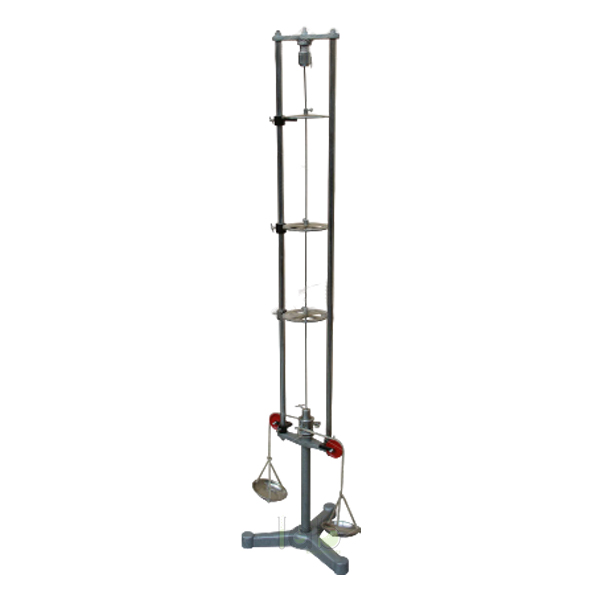
Product Code : EL-AM-10320
On this vertical pattern Barton's apparatus, a steady couple twists the rod, and the angle of twist gives its modulus of rigidity by the static method. A 900 mm long, 5 mm diameter test rod stands upright between a 3-jaw chuck and a torsional drum. Two scale pans, one on each pulley string, form a couple that turns the drum. Three pointers on sliding circular scales follow the twist at three heights.
Specifications of the Barton's apparatus
| Component | Specification |
|---|---|
| Frame | Steel |
| Base | Heavy cast iron, with levelling screws |
| Test rod | 900 mm long, 5 mm diameter |
| Upper clamp | 3-jaw chuck |
| Lower end | Clamped into the axis of a torsional drum |
| Loading | Two scale pans (hangers), one on the string over each of the two frictionless pulleys; the two loads form a couple that rotates the drum |
| Pointers | Three, for clamping to the test rod |
| Scales | Three freely sliding circular scales, single-degree graduations, clampable at any position |
| Supplied with | Three test rods, strings, two scale pans |
| Weights | Not included |
| House code | EL-AM-10320 |
| Manufacturer | Lab Exports, Delhi |
Experiments with the vertical torsion apparatus
With the rod vertical, the loads in the two pans form a couple that turns the drum and twists the rod about its own axis. A couple C on a rod of radius r twists it through an angle φ = 2Cl/(πηr4) at a distance l from the fixed chuck. Here η is the modulus of rigidity of the rod. So the twist grows in step with the distance from the chuck.
- Modulus of rigidity of a test rod. Put equal masses from a brass mass set in the two scale pans. Each pan hangs on its own string over one pulley, and the two strings pull on opposite sides of the drum. The torque of this couple is C = Mgd. Here M is the mass placed in each pan, g the acceleration due to gravity and d the separation between the two strings. With the strings leaving the drum on opposite sides, d is the drum diameter. Measure it with a vernier caliper and the rod diameter with a screw gauge. Then η = 2Cl/(πr4φ), with φ in radians.
- Twist along the rod. Read all three pointers for each load and plot each twist against the distance of its pointer from the chuck. The points should fall on a straight line of slope 2C/(πηr4). A line that misses the origin shows that the rod is slipping in the chuck.
- Comparing the test rods. Three test rods are supplied. Take a full set of readings on each rod and compare the values of η found.
Setting up the vertical pattern
- Level the cast iron base with the levelling screws so that the rod stands truly vertical.
- Clamp the top of the rod in the 3-jaw chuck and its lower end in the axis of the drum.
- Fix the three pointers at chosen heights on the rod, and note how far each one is from the chuck.
- Slide each circular scale to its pointer, clamp it, and note the zero reading with the pans empty.
- Load both pans in equal steps and read every pointer, then unload in the same steps and read again.
Documentation and supply
Installation instructions and a manual are supplied with the apparatus. Most Lab Exports products carry a one-year manufacturer warranty.
Lab Exports manufactures the Barton's torsion apparatus at its works in Laxmi Nagar, Delhi, and supplies it to colleges, universities and schools in India and 60+ countries, handling the export documents for each shipment. More about the company is on the About Lab Exports page.
Frequently Asked Questions
Why does the Barton's apparatus have three pointers?
Three pointers show how the twist builds up along the rod. With readings at three heights you can check that the twist rises in proportion to the distance from the fixed chuck. A line through three points also gives a steadier value than a single pair of readings.
Why are two scale pans and two pulleys used?
Equal loads on the two strings pull on opposite sides of the drum, so together they form a pure couple. The rod is then twisted about its axis without being pulled sideways. The torque equals the force on one side, the weight of the load in one pan, times the separation between the two strings.
How does the static method differ from the torsion pendulum method?
The static method applies a steady, known couple and measures the angle of twist it produces. The dynamic method times the oscillations of a disc hung on a wire instead. The static method suits stiff rods, while the dynamic method suits thin wires.
Which stress and strain does the modulus of rigidity relate?
It is the ratio of shearing stress to shearing strain. When the rod twists, each thin layer turns slightly relative to the next, which is a shear. The modulus measures how strongly the material resists this change of shape, which takes place without any change in volume.
Why do the circular scales slide freely?
So that each scale can be brought level with its pointer, wherever that pointer is clamped on the rod. Once in place, the scale is clamped and its zero noted. The pointer positions can then be chosen to suit the length of rod being tested.
Other apparatus for elastic constants
- Rigidity Apparatus (Searle's Pattern)
- Young's Modulus Apparatus (Vernier Type)
- Bending of Beam Apparatus, Koenig’s Method
More apparatus is in the Applied Mechanics section of the Physics Lab range.
To enquire, email [email protected] with the house code EL-AM-10320 and the quantity, or use the Add To Cart button on this page. Tender buyers can also see the Tenders and OEM page.
Last updated: 20 November 2026