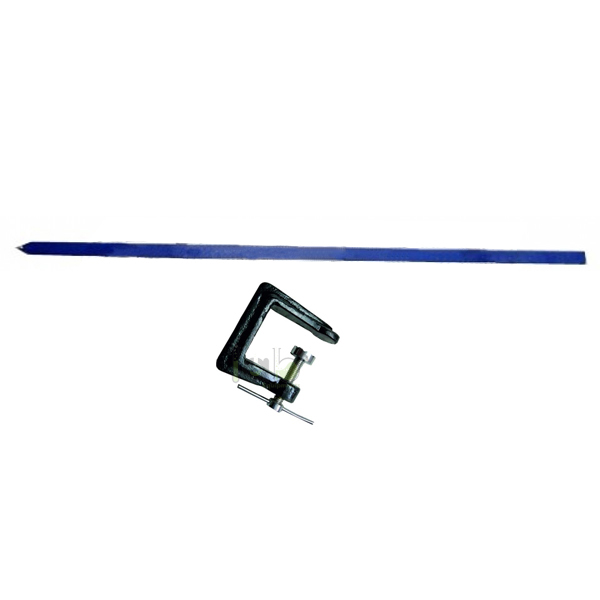
Newton’s Second Law Model (2nd Law of Motion Apparatus)

Product Code : SCL-AM-11167
This 2nd law of motion apparatus verifies F = ma with a low-friction dynamics cart. A string from the cart passes over a clamp-on pulley at the bench edge to a 10 g hanger that takes nine 10 g slotted masses. Students time the cart over a measured distance and find how its acceleration changes with the pulling force and with the mass.
Specifications of the second law apparatus
| Component | Specification |
|---|---|
| Model type | Dynamics cart and pulley system (F = ma demonstrator) |
| Cart | Low-friction dynamics cart, high-impact |
| Pulley | Low-friction rotary pulley with adjustable table clamp |
| String | One spool of inelastic string |
| Weights | One 10 g hanger and nine 10 g slotted masses, brass or steel, 100 g in total |
| Base | Rigid metal base that steadies the mounting |
| Primary application | Physics and mechanics education |
| House code | SCL-AM-11167 |
| Manufacturer | Lab Exports, Delhi |
Verifying F = ma on the bench
The second law says that acceleration is proportional to the net force and inversely proportional to the mass being accelerated. A hanging mass m pulls with a force mg, where g is the acceleration due to gravity. The cart, of mass M, and the hanging mass move together, so a = mg/(M + m) when friction is small. If the cart starts from rest and covers a distance s in time t, then a = 2s/t2.
- Setting up and timing. Clamp the pulley at the edge of a level bench, in line with the cart. Tie the string to the cart, pass it over the pulley and attach the hanger. Mark two lines a measured distance apart, release the cart from rest at the first, and time each run with an Analog Stop Clock. Repeat and take the mean.
- Force varied, mass fixed. Find the mass of the cart on a Triple-Beam Balance. Start with the nine 10 g slotted masses on the cart. Shift them one at a time to the hanger, so the pull grows while M + m does not change. The points of a against mg then lie on a straight line through the origin.
- Mass varied, force fixed. Keep the same load on the hanger and add mass to the cart. The acceleration falls. A graph of a against 1/(M + m) is a straight line, which shows that a is inversely proportional to the total mass M + m.
Documentation and supply
An instruction and experiment manual is supplied with the apparatus. Most Lab Exports products carry a one-year manufacturer warranty.
Lab Exports manufactures the Newton's Second Law Model (2nd Law of Motion Apparatus) at its works in Laxmi Nagar, Delhi, and supplies it to schools, colleges and universities in India and 60+ countries, handling the export documents for each shipment. More about the company is on the About Lab Exports page.
Frequently Asked Questions
How is the acceleration of the cart measured?
By timing the cart from rest over a measured distance. If it covers a distance s in time t, its acceleration is a = 2s/t2. Time several runs for each load with a stop clock and use the mean time.
Why is the tension in the string less than the weight on the hanger?
Because the hanging mass is accelerating downwards. The net force on it is mg minus the tension T, so T = m(g - a), which is less than mg. The tension equals mg only when nothing moves.
Why might the force graph not pass through the origin?
Friction in the cart wheels and the pulley uses up part of the pull. The line then cuts the force axis a little above zero, and that intercept is roughly the friction force. Tilting the surface the cart runs on just enough to balance friction brings the line back through the origin.
Why should the hanger not reach the floor during a run?
Once the hanger lands, the string goes slack and stops pulling the cart. The cart then slows down instead of speeding up, so the timed run gives a wrong acceleration. Choose a string length that keeps the hanger clear of the floor until the cart passes the finish line.
What causes errors in the F = ma experiment?
Friction in the wheels and pulley, reaction time when starting and stopping the clock, and a bench that is not level. Measuring the run distance carelessly also adds error. Several timed runs for each load, averaged, reduce the effect of timing errors.
Carts, trolleys and friction models for dynamics
More apparatus is in the Applied Mechanics section of the Physics Lab range.
To enquire, email [email protected] with the house code SCL-AM-11167 and the quantity, or use the Add To Cart button on this page.
Last updated: 23 November 2026