Whirling Table

Product Code : EL-AM-10336
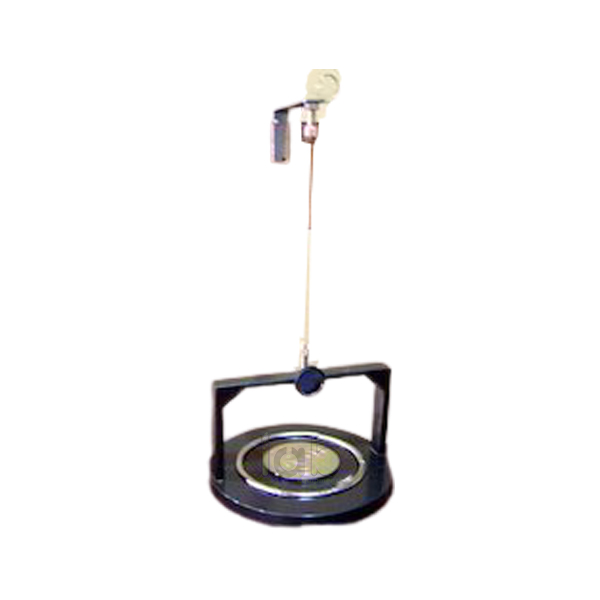
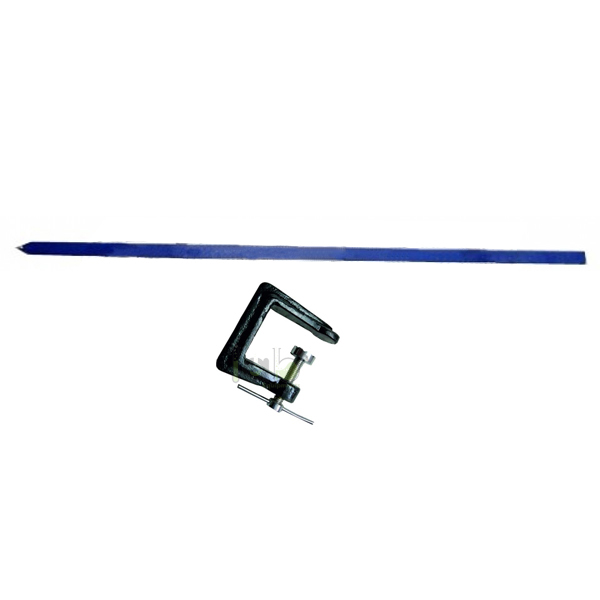
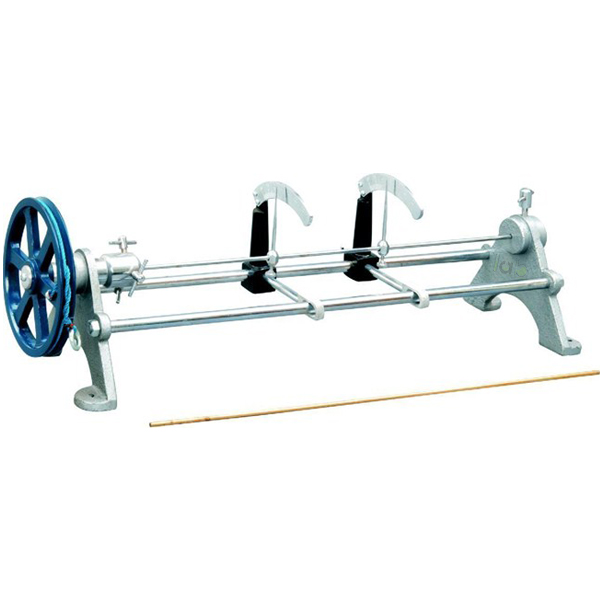
The whirling table is a sturdily built, hand-operated rotator for experiments on circular motion and centripetal force. A hand crank turns it through a belt-driven pulley, and it can be used in a vertical or a horizontal position. It has a mounting adaptor. The add-on accessories are a Savart wheel, a siren disc and a Watt governor.
Specifications of the whirling table
| Component | Specification |
|---|---|
| Drive | Hand crank through a belt-driven pulley; speed set by the operator |
| Mounting | Mounting adaptor |
| Orientation | Can be used vertically or horizontally |
| Construction | Sturdily built, specially designed |
| Add-on accessories | Savart wheel, siren disc, Watt governor |
| Not in the base table | Calibrated masses and an adjustable radius arm |
| House code | EL-AM-10336 |
| Manufacturer | Lab Exports, Delhi |
Experiments with the whirling table and its accessories
A body of mass m moving in a circle of radius r needs a force towards the centre, F = mv2/r = mω2r. Here v is its speed and ω its angular speed. The whirling table supplies the rotation. Set it firmly on the bench, upright or flat as the experiment needs, and fix the accessory securely before turning.
- Measuring the speed of rotation. Turn the crank at a steady rate and count n turns of the rotating part in a time t on an analog stop clock. The angular speed is ω = 2πn/t. Count the rotating part itself, since the belt drive need not turn it at the same rate as the crank.
- Watt governor. Fit the governor and raise the speed slowly. The balls swing outwards and rise as the speed goes up, because the arms must supply the inward force mω2r. Slow down and they fall back towards the spindle.
- Savart wheel. Fit the toothed wheel and hold a card lightly against its teeth while turning. Each tooth gives one tap, so the note has a frequency f = Nn/t. Here N is the number of teeth and n the turns counted in a time t. Match the note with a fork from a tuning fork set to link pitch with frequency.
- Siren disc. Blow a steady stream of air through a narrow tube at one ring of holes while the disc turns. The frequency of the note equals the number of holes in that ring times the number of turns per second. The pitch rises as the disc turns faster.
Documentation and supply
Installation instructions and a manual are supplied with the apparatus. Most Lab Exports products carry a one-year manufacturer warranty.
Lab Exports manufactures the Whirling Table at its works in Laxmi Nagar, Delhi, and supplies it to schools, colleges and universities in India and 60+ countries, handling the export documents for each shipment. More about the company is on the About Lab Exports page.
Frequently Asked Questions
What happens to the centripetal force if the speed is doubled?
It becomes four times as large, because F = mv2/r depends on the square of the speed. On the whirling table, turning the rotating part twice as fast at the same radius needs four times the inward force to hold a body in its circle.
What happens to the centripetal force when the radius is increased?
It depends on what is kept constant. At the same angular speed, F = mω2r grows in proportion to r. At the same linear speed, F = mv2/r falls as r grows. The base table has no adjustable radius arm, but the Watt governor shows the idea, as its balls move out to a larger radius when the speed rises.
How can timing errors be reduced when measuring the rate of turning?
Time many turns, not one. Keep the crank at a steady rate, count a large number of turns against the stop clock and divide the time by the count. Your reaction time at the start and stop is then shared over all the turns.
What safety steps are needed when using a whirling table?
Set the table firmly on the bench and check that the accessory is tightly fixed to the rotating part. Keep a clear space around it and build up speed slowly. Students standing nearby should wear safety glasses in case anything comes loose.
Which accessories are needed with the whirling table?
That depends on the experiment. The add-on accessories are a Savart wheel and a siren disc for sound and frequency, and a Watt governor for circular motion. The base table has a hand crank, a belt-driven pulley and a mounting adaptor, but no calibrated masses or adjustable radius arm.
Other apparatus for rotation and circular motion
More apparatus is in the Applied Mechanics section of the Physics Lab range.
To enquire, email [email protected] with the house code EL-AM-10336 and the quantity, or use the Add To Cart button on this page. Tender buyers can also see the Tenders and OEM page.
Last updated: 20 November 2026