Inclined Plane Economy
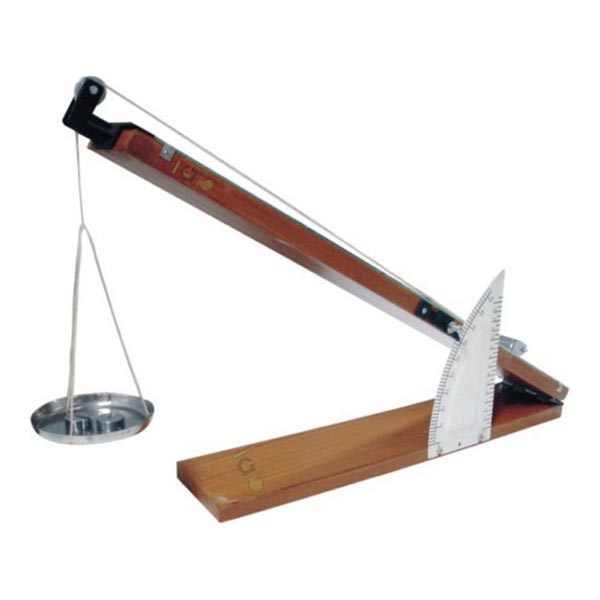
Product Code : EL-AM-10329
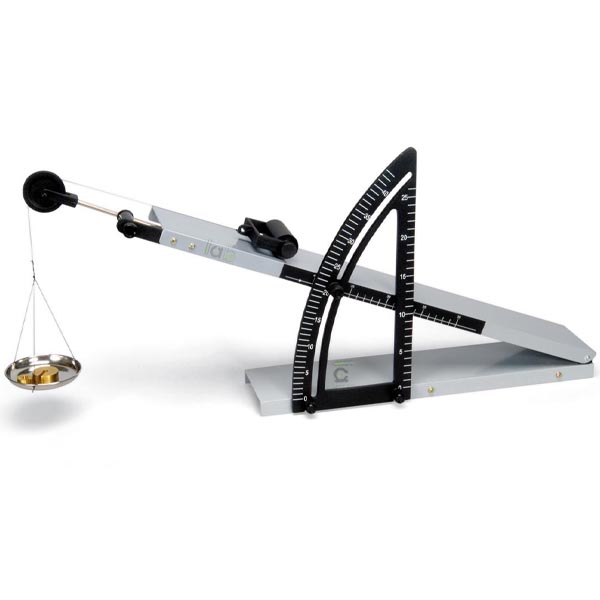
The economy inclined plane is a hinged, polished hardwood board, about 600 × 75 × 18 mm. It has a frictionless pulley, and its angle is set on a graduated cast aluminium arc. An iron roller, a glass plate and a scale pan for loading masses come with it. It suits school practicals on the down-slope part of a weight and on friction between surfaces.
Specifications of the economy inclined plane
| Component | Specification |
|---|---|
| Board | Hinged hardwood, polished, about 600 × 75 × 18 mm |
| Pulley | Frictionless |
| Angle scale | Graduated cast aluminium arc, adjustable; a separate part from the scale pan |
| Scale pan | Hanging pan for loading masses on the free end of the cord |
| Included parts | Iron roller, glass plate, scale pan |
| Variant | Also available with brass parts |
| House code | EL-AM-10329 |
| Manufacturer | Lab Exports, Delhi |
Friction and force practicals on the economy plane
When the board is tilted to an angle θ, the weight W of a body on it has a component W sin θ pulling along the slope. The other component, W cos θ, acts at right angles to the board and holds the body against it. The glass plate gives a smooth, hard running surface for the iron roller, and the bare polished wood gives a second surface to compare with it.
- Balancing load on glass and on wood. Weigh the iron roller on an ESAL spring balance to find W. Set an angle, place the roller on the glass plate and run a cord from it over the pulley to the supplied scale pan. Put in masses from a brass mass set one at a time, and stop when the roller just begins to roll up the slope. Count the weight of the pan in the load. Repeat on the bare wood. The extra load needed there shows the added friction.
- Angle of repose and coefficient of friction. Lay a flat wooden block, not supplied, on the board. Raise the angle slowly until the block just begins to slide, and read the angle on the arc. The coefficient of static friction is the tangent of this angle of repose. Repeat with the block on the glass plate.
- Checking the arc reading. With a metre rule, which is not supplied, measure the height of the raised end of the board above its hinged end. Divide that height by the length of the board between the same two points to get sin θ, a check on the angle read from the arc.
Frequently Asked Questions
What is the angle of repose, and how does it give the coefficient of friction?
It is the steepest angle at which a body can rest on the plane without sliding. At that angle the down-slope pull W sin θ just equals the limiting friction μW cos θ. So the coefficient of static friction μ equals tan θ for the angle of repose.
Is the angle of friction the same as the angle of repose?
They are equal in size but defined differently. The angle of friction lies between the normal reaction and the resultant of the normal reaction and limiting friction. The angle of repose is the slope angle at which sliding just begins. The tangent of each equals the coefficient of friction.
What happens to the two parts of the weight as the board is raised?
The down-slope part W sin θ grows and the part pressing into the board, W cos θ, shrinks. On a flat board the down-slope part is zero. As the board steepens, more of the weight pulls along the slope, while the normal force, and so the limiting friction, gets smaller.
Why does a block often speed up once it starts to slide?
Static friction is usually larger than kinetic friction. The block needs the full limiting friction overcome before it moves, but once it slides, the friction on it drops. At the angle where it just starts, the down-slope pull is then larger than the friction, so it accelerates.
Why is a glass plate supplied with the plane?
The glass gives a smooth, hard and flat track for the iron roller, so rolling friction stays very small. The balancing load then measures W sin θ closely. Running the same roller on the bare polished wood shows how a rougher surface adds to the force needed.
Other apparatus for force and friction practicals
More apparatus is in the Applied Mechanics section of the Physics Lab range.
To enquire, email [email protected] with the house code EL-AM-10329 and the quantity, or use the Add To Cart button on this page.
Last updated: 20 November 2026