Newton’s Cradle Model
Product Code : SCL-AM-11165
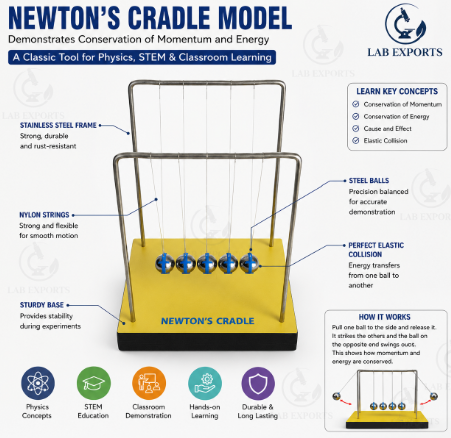
This Newton's cradle has five polished stainless steel spheres, each 25 mm across, hung in a line from a frame on bifilar high-tensile nylon suspensions. Pull back one end sphere and let it go: it stops on impact and the sphere at the far end swings out. Classes use it to study momentum and kinetic energy in nearly elastic collisions.
Specifications of the Newton's cradle
| Component | Specification |
|---|---|
| Spheres | Five, identical, polished stainless steel, 25 mm diameter |
| Suspension | High-tensile nylon, bifilar, keeping the spheres in one plane and in a single row |
| Frame | About 230 mm long, 180 mm wide and 230 mm high |
| Arrangement | Spheres hang in a straight line, just touching |
| Supply condition | Pre-assembled: base, frame and suspended spheres |
| Guide | Instructional guide on the physics and suggested experiments |
| House code | SCL-AM-11165 |
| Manufacturer | Lab Exports, Delhi |
Collision experiments on the cradle
Two quantities matter in each collision: momentum, mv, and kinetic energy, ½mv2, where m is the mass of a sphere and v its speed. When hard steel spheres collide, both are nearly conserved. With identical spheres, the only way to keep both is for the same number of spheres to leave at the same speed.
- Predict, then release. Stand the cradle on a level bench and check that all five spheres hang in line and touch. Pull out one end sphere with its suspension taut and release it. Repeat with two and then three spheres, asking the class to predict each result first.
- Both ends at once. Pull out one sphere at each end and release them together. Both bounce back out at the same moment, while the middle spheres stay almost still.
- How the swing dies away. Release one sphere and time how long the motion lasts with an Analog Stop Clock. Discuss where the energy goes on each impact: sound, a little heat and air resistance.
- Are the spheres alike? Measure the diameter of each sphere with a Vernier Caliper IME Type. Each should read 25 mm. The clean one-in, one-out pattern relies on spheres of equal size and mass.
Frequently Asked Questions
Why does only one sphere swing out at the far end?
Because momentum and kinetic energy must both be kept. If two spheres left at half the speed, the momentum would match but the kinetic energy would be halved. With identical spheres, only one sphere at the original speed satisfies both laws.
What happens when two spheres are released together?
Two spheres swing out at the far end, at almost the same speed. Only the same number leaving at the same speed keeps both the momentum and the kinetic energy. Release three and three swing out, with the middle sphere moving in both groups.
Why do the middle spheres hardly move?
Each middle sphere passes the push on to the next one almost at once. The impulse travels through the row as a brief compression, and each sphere gives up its momentum as soon as it receives it. Only the last sphere has nothing to pass it to.
Are the collisions in a Newton's cradle perfectly elastic?
No, only nearly. Hard steel spheres lose very little energy on impact, but the click you hear is energy lost as sound, and some becomes heat. With air resistance, these losses make the swings shrink until the spheres stop.
Why must the spheres hang exactly in line?
The impacts must be head-on and pass straight through the centres. If a sphere hangs out of line or with a gap, the push goes partly sideways and the spheres start to wobble. The bifilar suspension keeps the spheres swinging in one plane. Stand the cradle on a level bench and keep the threads untangled.
Why are the spheres made of steel?
Hard steel spheres deform very little on impact and spring back almost at once. So each collision loses only a little energy, and the swings last for many impacts. Spheres of a soft material, such as clay, would soak up much of the energy and soon stop.
Other apparatus for momentum and energy lessons
More apparatus is in the Applied Mechanics section of the Physics Lab range.
To enquire, email [email protected] with the house code SCL-AM-11165 and the quantity, or use the Add To Cart button on this page.
Last updated: 23 November 2026