Maxwell Vibration Needle

Product Code : EL-AM-10313
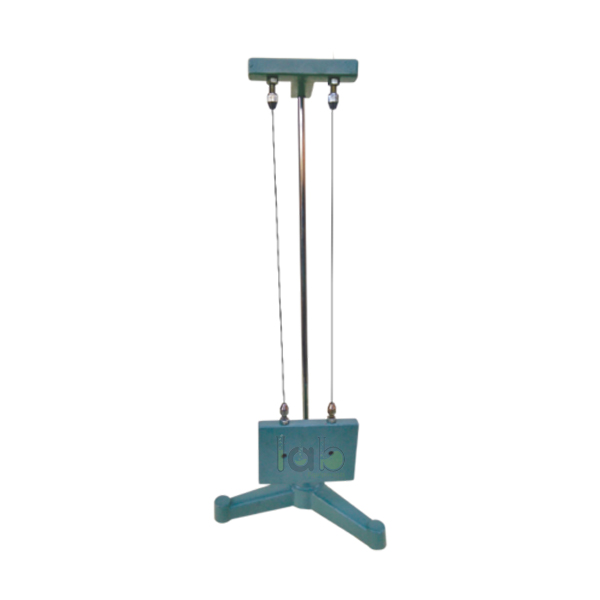
The Maxwell vibration needle, often just called the Maxwell needle, finds the modulus of rigidity of a wire from its torsional oscillations. It is a 200 mm hollow brass tube with a pointer, a wire chuck and a mirror. Four removable 50 mm inserts, two solid and two hollow, fit inside the tube, and a ceiling attachment is supplied for hanging the wire.
Specifications of the Maxwell needle
| Component | Specification |
|---|---|
| Tube | Hollow brass, 200 mm long |
| Inserts | Four, removable, each 50 mm long: two solid and two hollow, fitting inside the tube |
| Insert positions | Moved between the inner and outer positions to change the moment of inertia; no vernier on the inserts and no sliding weights |
| Fittings | Pointer, wire chuck and mirror |
| Scales | Graduated scales |
| Suspension | Ceiling attachment supplied |
| Stand | Not included |
| House code | EL-AM-10313 |
| Manufacturer | Lab Exports, Delhi |
Practicals done with the Maxwell needle
The needle hangs level from the wire under test. Moving the solid and hollow inserts between the inner and outer positions changes how the mass is spread along the tube, but not the total mass. Only the moment of inertia changes between the two sets of readings, so the unknown inertia of the tube and its fittings cancels out.
Let T1 be the period with the solid inserts in the outer positions and T2 the period with them in the inner positions. L is the length of the wire and r its radius. l is the length of the tube, 200 mm, and m1 and m2 are the masses of one solid and one hollow insert. Each insert is a quarter of the tube length, as this formula assumes. Then η = 2πLl2(m1 - m2) / [r4(T12 - T22)].
- Modulus of rigidity of a steel wire. Hang the needle on a length of steel wire from the ceiling attachment. Time 20 oscillations in each arrangement of the inserts with an analog stop clock. Follow the swing with the pointer, or with a lamp and scale seen in the mirror. Take the wire radius at several points with a screw gauge, because r enters as its fourth power.
- Comparing two metals. Repeat the experiment with brass wire of about the same length and thickness. A less rigid metal gives a smaller torsional constant, longer periods and a lower value of η.
- Effect of wire length. Use the same wire at two or three lengths. The difference T12 - T22 grows in proportion to L, while η stays the same within experimental error.
Frequently Asked Questions
How is the modulus of rigidity calculated with a Maxwell needle?
It comes from two periods of torsional oscillation, one with the solid inserts outside and one with them inside. Weigh one solid and one hollow insert, measure the tube length and the wire length and radius, and put these values into the formula above.
Why is this method better than a simple torsion pendulum?
Because the moment of inertia of the needle never has to be worked out. A simple torsion pendulum needs I of the hanging body, which is hard to calculate for a tube with a pointer, chuck and mirror. Here only the change in I is used, and it follows from the insert masses and the tube length.
Why should the oscillations be kept small?
Small twists keep the wire well inside its elastic limit, so the restoring torque stays proportional to the angle. The motion is then simple harmonic and the period does not depend on the amplitude. A large twist can also start a sideways swing that spoils the timing.
What happens if a thicker wire is used?
The wire becomes much stiffer, because its torsional constant depends on the fourth power of the radius. The periods get shorter and harder to time well. A thin wire gives longer periods, but its radius must then be measured with great care.
What precautions are needed in the Maxwell needle experiment?
Use a straight wire without kinks and grip it firmly in the wire chuck and the ceiling attachment. Keep the tube horizontal and let it come to rest before giving the twist. Push each insert fully home, so that it sits exactly in its inner or outer position.
What else is needed to run the experiment?
Besides the needle and its ceiling attachment, you need the test wire, a stop clock, a screw gauge, a metre scale and a balance for the insert masses. A lamp and scale viewed in the mirror helps to follow the oscillations. No stand is included.
Other apparatus for modulus of rigidity
- Torsion Apparatus Searle's Type
- Torsion (Barton's) Apparatus Vertical Pattern
- Rigidity Apparatus (Searle's Pattern)
- Torsion Pendulum
More apparatus is in the Applied Mechanics section of the Physics Lab range.
To enquire, email [email protected] with the house code EL-AM-10313 and the quantity, or use the Add To Cart button on this page.
Last updated: 20 November 2026