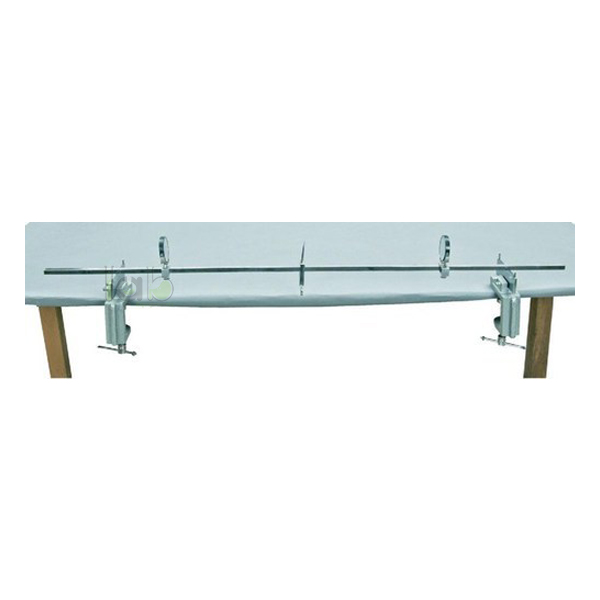
Parallelogram Force Apparatus

Product Code : EL-AM-10330
This parallelogram force apparatus is a free-standing board of 12 mm thick plywood, 650 × 500 mm. It works like the wall-type version but needs no wall mounting, so it suits laboratories with limited wall space. Two clamp-mounted 50 mm aluminium pulleys, three mass hangers, twelve 50 g slotted masses and cords with rings come with it, for the parallelogram law and vector addition of forces.
Specifications of the parallelogram force apparatus
| Component | Specification |
|---|---|
| Board | Plywood, 12 mm thick, 650 × 500 mm |
| Type | Free-standing; no wall mounting needed |
| Working | Same as the wall-type parallelogram force apparatus |
| Pulleys | Two, aluminium, 50 mm, clamp-mounted |
| Mass hangers | Three |
| Slotted masses | Twelve, 50 g each |
| Cords | With rings |
| Junction | The three cords meet at a knot; no central dish |
| Suited to | Laboratories with limited wall space |
| House code | EL-AM-10330 |
| Manufacturer | Lab Exports, Delhi |
Force practicals on the parallelogram force board
The law deals with two forces acting at one point. Draw them in size and direction as the adjacent sides of a parallelogram, and the diagonal from that point gives their resultant. On this board, two cords pass over the clamp-mounted pulleys and the third hangs straight down from the knot where they meet. There is no central dish. Each cord carries a mass hanger at its end, with known loads. When the knot rests, the third force balances the resultant of the other two.
- Verifying the law. Stand the board upright on the bench and fix a sheet of paper on it. Weigh each mass hanger on an ESAL spring balance first, because its weight is part of the load. Load the three hangers with the 50 g slotted masses, so that the loads are P, Q and R. When the knot is at rest, mark each cord direction with two points. Draw P and Q to scale along their lines and complete the parallelogram. The diagonal should equal R and point the opposite way.
- Weight of an unknown body. Hang the body from the third cord in place of R, with known loads as P and Q. The diagonal of the parallelogram, read on the same scale, gives the weight of the body. Check it by weighing the body on a physical balance.
- Different pairs of forces. Repeat with other numbers of slotted masses on the hangers, so that the angle between P and Q changes. Each time the diagonal should match the balancing force, which shows that the law holds for any pair.
Documentation and supply
Installation instructions and a manual are supplied with the apparatus. Most Lab Exports products carry a one-year manufacturer warranty.
Lab Exports manufactures the parallelogram force apparatus at its works in Laxmi Nagar, Delhi, and supplies it to schools, colleges and universities in India and 60+ countries, handling the export documents for each shipment. More about the company is on the About Lab Exports page.
Frequently Asked Questions
Why must the board stand vertical and steady?
The loads hang straight down, so the strings and the knot lie in a vertical plane. If the board leans or rocks, the strings rub on it or the paper is no longer in the plane of the forces. The directions marked would then be wrong.
Why should the hangers and the knot hang clear of the board?
Any contact adds friction at that point. A hanger or knot that rubs on the board takes up part of the force, so the pull in the string no longer equals the load hung on it. Keep a small gap between the strings and the paper.
What scale should be used to draw the parallelogram?
Pick a scale as large as the paper allows, with the knot near the middle of the sheet. Long sides make small errors in marking and drawing a smaller fraction of each length. Mark the directions with a sharp pencil and add arrows to show which way each force acts.
Why can forces not be added like ordinary numbers?
Forces are vectors, so their directions matter as well as their sizes. Two forces of fixed size give a large resultant when they act close together and a small one when nearly opposite. Only forces along one line add or subtract like plain numbers.
How does a free-standing board differ from the wall type?
It works in the same way but stands on the bench instead of being fixed to a wall. That suits laboratories with limited wall space. The working surface is a 12 mm thick plywood board, 650 × 500 mm, with two clamp-mounted pulleys.
Other apparatus for adding and resolving forces
More apparatus is in the Applied Mechanics section of the Physics Lab range.
To enquire, email [email protected] with the house code EL-AM-10330 and the quantity, or use the Add To Cart button on this page.
Last updated: 23 November 2026