Bending of Beam Apparatus, Koenig’s Method
Product Code : EL-AM-10322
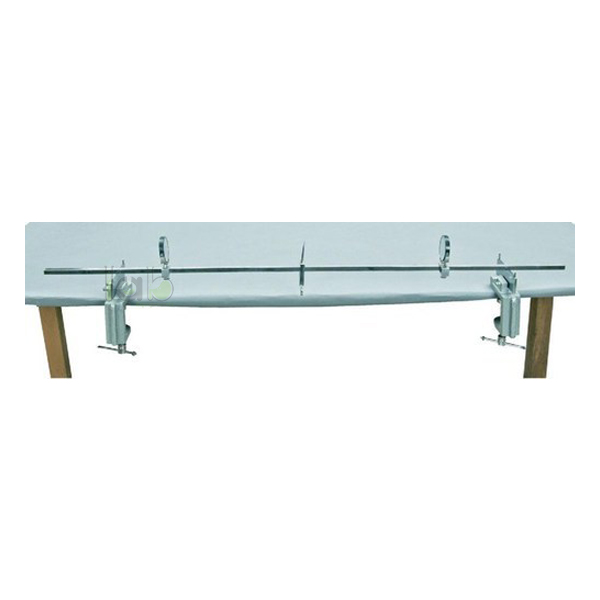
Koenig's method finds the Young's modulus of brass from the tilt of a loaded beam, not from its sag. A one-metre brass beam of 9 mm square section rests on the knife edges of two heavy table clamps. The load goes on a sharp knife-edge hanger, and two tilting mirrors turn with the beam as it bends.
Specifications of the Koenig's method apparatus
| Component | Specification |
|---|---|
| Beam | Brass, 9 mm square section, one metre long |
| Supports | Knife edges of two heavy table clamps |
| Loading | Sharp knife edge with hanger on the beam |
| Mirrors | Two, tilting type |
| Weights | Available with or without weights |
| Telescope and scale | Ask for them in the enquiry if they are needed |
| House code | EL-AM-10322 |
| Manufacturer | Lab Exports, Delhi |
Measuring Young's modulus by Koenig's method
A load W at the centre of a span L bends the beam, and each end tilts through a small angle θ = WL2/(16YI). Here Y is the Young's modulus and I is the geometrical moment of inertia of the cross-section. For a square bar of side d, I = d4/12. The mirrors near the ends turn with the beam. A telescope views a scale after reflection in both mirrors. The tiny tilt then shows as a readable shift of the scale image, as in an optical lever.
- Young's modulus of brass. Measure the side d of the bar at several points with a screw gauge, and the span L between the knife edges. Load the hanger in equal steps and note the scale reading in the telescope each time. Calculate Y from the mean shift per unit load, the mirror and scale distances, L and d.
- Load against scale shift. Plot the shift of the scale image against the load, for loading and for unloading. A straight line shows that the brass bends elastically over the range of loads used.
- Cross-check by direct depression. Keep the same span and loads, and follow the fall of the centre of the beam with a travelling microscope. For this square bar the central depression is δ = WL3/(4Yd4), which gives a second value of Y to compare.
Setting up the mirrors
- Fix the two table clamps firmly to the bench and rest the beam on their knife edges. Place the knife-edge hanger midway between the two supports.
- Tilt the two mirrors until the scale is seen through the telescope after reflection in both of them.
- Note the scale division on the cross-wire with no load on the hanger.
- Add masses in equal steps and note each new division, then repeat while taking the masses off.
Frequently Asked Questions
Why does Koenig's method use mirrors and a telescope instead of a direct scale?
The tilt of the beam ends is far too small to read by eye. A mirror turns a reflected ray through twice its own tilt, and a distant scale makes the shift larger still. Reflection in two mirrors adds the tilts of both ends, so the shift seen in the telescope is easy to read.
Why is this called non-uniform bending?
With one load at the centre, the bending moment is greatest under the load and falls to zero at the supports. The curvature therefore changes along the beam. In uniform bending, equal loads hang on both overhanging ends, and the part between the knife edges bends into a circular arc.
Why is the side of the bar measured with a screw gauge?
The side has the greatest effect on the result. For a square bar the moment of inertia depends on the fourth power of the side. Any percentage error in d is therefore multiplied by four in Y. A screw gauge reads much finer than a vernier caliper.
Why are readings taken while unloading as well as loading?
If the scale image returns to the same divisions as the load comes off, the brass bent elastically and took no permanent set. Averaging the two readings for each mass also evens out any small lag in the beam.
Are a telescope and scale supplied with the apparatus?
Not as part of the standard set. The set is the brass beam, two table clamps with knife edges, the knife-edge hanger and two tilting mirrors, with or without weights. If you need a telescope and scale to read the mirrors, ask for them in the enquiry.
Other apparatus for elasticity practicals
- Young's Modulus Apparatus (Searle's Pattern)
- Young's Modulus Apparatus (Vernier Type)
- Rigidity Apparatus (Searle's Pattern)
More apparatus is in the Applied Mechanics section of the Physics Lab range.
To enquire, email [email protected] with the house code EL-AM-10322 and the quantity, or use the Add To Cart button on this page.
Last updated: 19 November 2026