Cantilever Apparatus
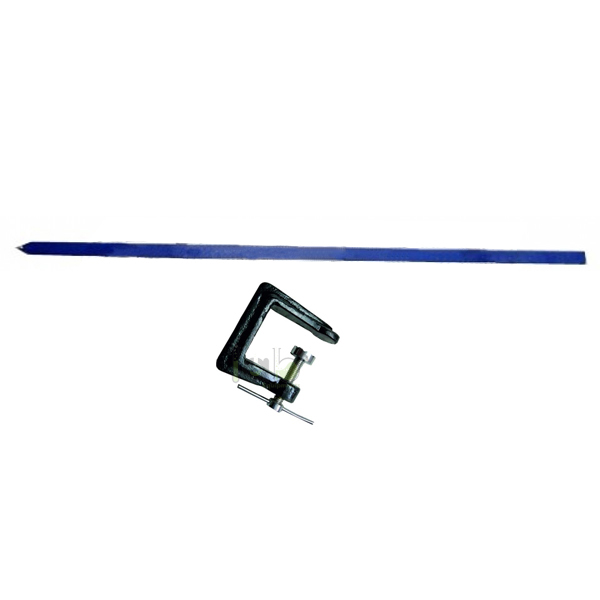
Product Code : EL-AM-10323
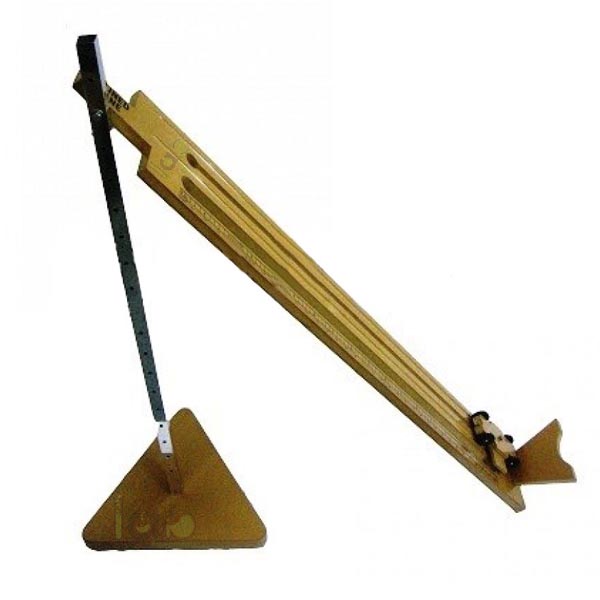
This cantilever is a chrome-plated steel bar, 100 cm long, 20 mm broad and 3 mm thick. It is marked with a line every 5 cm and has a hook at one end. Clamped at the other end with its breadth flat, it is loaded at the hook. Students measure the depression to find the Young's modulus of steel and to test how it grows with length.
Specifications of the cantilever apparatus
| Component | Specification |
|---|---|
| Bar | Steel, chrome plated, 100 cm long |
| Markings | Lines at 5 cm intervals along the bar |
| Hook | At one end, for hanging loads |
| Position in use | Horizontal, with the breadth in the horizontal plane |
| Section | 20 mm breadth, 3 mm thickness |
| House code | EL-AM-10323 |
| Manufacturer | Lab Exports, Delhi |
Practical work with the cantilever bar
A cantilever is fixed at one end and loaded at the other. A load W = Mg hung at a distance L from the clamp lowers the loaded end by δ = 4WL3/(Ybd3). Here b is the breadth of the bar, d its thickness and Y the Young's modulus of the steel.
- Young's modulus of steel. Hang a slotted mass hanger from the hook and add masses in equal steps. Follow the fall of the hook end with a travelling microscope. Measure d with a screw gauge and b with a digital vernier caliper, then calculate Y.
- Depression and loaded length. Clamp the bar at different marked lines, so that L changes in 5 cm steps. Keep the load the same and plot δ against L3. A straight line confirms the cube law.
- Load and depression graph. At one fixed length, plot the depression against the load while loading and unloading. The slope gives δ/M for the formula, and matching readings show the steel has stayed elastic.
Frequently Asked Questions
What is the depression of a cantilever?
It is the vertical distance the loaded end moves down when a weight is hung on it. On this bar it is read at the hook end, as the difference between the reading with no load and the reading with the load.
Why does the depression depend on the cube of the length?
Three factors of L multiply together. The bending moment at the clamp grows with L, and the bar curves along a greater length. The loaded end also lies farther out, so a given turn moves it further. The lines every 5 cm let you set exact lengths to test this.
How do the breadth and thickness of the bar change the depression?
The depression is inversely proportional to the breadth and to the cube of the thickness. A wider bar sags less in simple proportion, but a thicker bar sags far less, because the thickness enters as its cube. So the thickness needs the most careful measurement.
Why is the bar clamped with its breadth horizontal?
Laid flat, the 3 mm thickness is the vertical dimension, so the bar bends across it and the depression is large enough to read. Bending stiffness depends on the cube of that vertical dimension. Turned on edge, the 20 mm breadth would take its place and the bar would become far stiffer. The flat position is also the one the formula assumes.
What precautions are needed in the cantilever experiment?
Clamp the plain end tightly at the chosen line, because any slip adds to the reading. Hang masses gently and let the bar settle before each reading. Use only loads after which the bar comes back to its zero reading when unloaded.
What are the breadth and thickness of the bar?
The bar is 20 mm broad and 3 mm thick. It is chrome-plated steel, 100 cm long and marked every 5 cm. Measure both yourself before the experiment as well, since Y depends on the breadth and on the cube of the thickness.
Other apparatus for stretching and twisting experiments
- Young's Modulus Apparatus
- Poisson's Ratio of Rubber Apparatus
- Torsion (Barton's) Apparatus Vertical Pattern
More apparatus is in the Applied Mechanics section of the Physics Lab range.
To enquire, email [email protected] with the house code EL-AM-10323 and the quantity, or use the Add To Cart button on this page.
Last updated: 20 November 2026