Bifilar Pendulum
Product Code : EL-AM-10325
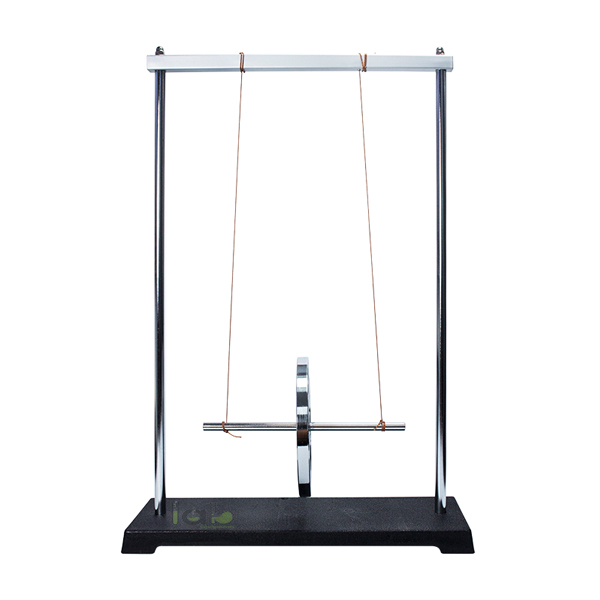
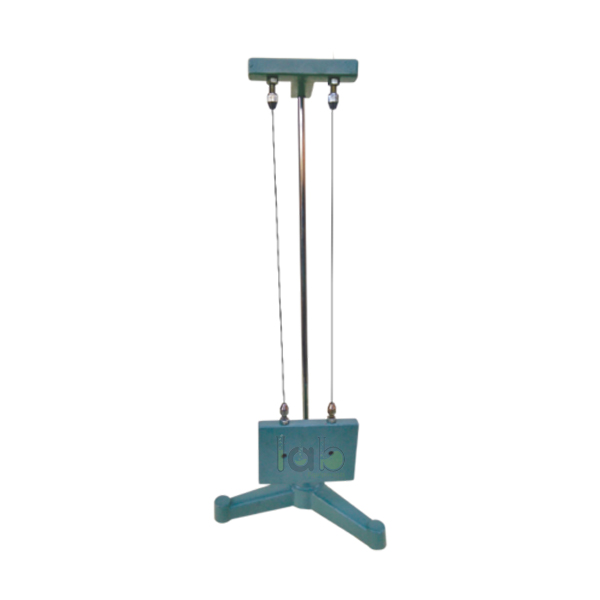
The bifilar pendulum finds the moment of inertia of a rectangular plate from its twisting oscillations. The cast iron plate, 15 x 10 x 1.5 cm, has six holes on three faces. Two strings of equal length hang it from a heavy T-shaped clamp with two split chucks, mounted on a heavy base.
Specifications of the bifilar pendulum
| Component | Specification |
|---|---|
| Plate | Cast iron, rectangular, 15 x 10 x 1.5 cm |
| Holes | Six: two on the top, two on the front side, two on a third side |
| Suspension | Two strings of equal length |
| Clamp | Heavy, T-shaped, with two split chucks |
| Base | Heavy |
| House code | EL-AM-10325 |
| Manufacturer | Lab Exports, Delhi |
Experiments on the bifilar suspension
The plate hangs from two parallel strings of length l, each a distance d from the vertical axis midway between them. Turned slightly about that axis and released, it twists to and fro, with gravity giving the restoring couple. The period is T = 2π(k/d)√(l/g), where k is the radius of gyration. If m is the mass of the plate, its moment of inertia is I = mk2 = mgd2T2/(4π2l).
- Moment of inertia of the plate. Weigh the plate on a physical balance and time its oscillations with an analog stop clock, then work out I. Measure the sides a and b of the face at right angles to the axis with a vernier caliper. Compare your result with I = m(a2 + b2)/12.
- Period and string length. Change the string length in the split chucks and time the plate at each length. Plotted against l, the values of T2 lie on a straight line through the origin, and k follows from its slope.
- Three axes of one plate. Hang the plate from each pair of holes in turn, so that it twists about each of its three axes. Measure d again each time, and compare the three moments of inertia with the values worked out from the plate sides.
Frequently Asked Questions
How does the period depend on the length of the strings?
The period is proportional to the square root of the string length. With longer strings, a given twist lifts the plate less, so the restoring couple is weaker and the plate turns back more slowly. Long strings therefore give a slower oscillation that is easier to time.
Does the mass of the plate change the period?
No. A heavier plate needs a larger couple to turn it, but its weight also gives a larger restoring couple in the same proportion. The mass cancels, and the period depends only on k, d, l and g.
How does the distance between the strings affect the period?
The period is inversely proportional to the distance d of each string from the axis. With the strings wider apart, each twist lifts the plate more, so it swings back faster. The spacing can differ from one pair of holes to another, so measure d every time.
Why should the plate be turned through only a small angle?
The formula holds only for small twists, where the restoring couple is proportional to the angle and the motion is simple harmonic. Large turns make the period depend on the amplitude. They can also set the plate swinging from side to side as well as twisting.
What are the main sources of error in the bifilar pendulum experiment?
Common ones are strings of unequal length, strings that stretch or hang out of parallel, and a plate that is not level. A sideways swing mixed with the twist also upsets the timing. Set the strings carefully in the split chucks and time many oscillations.
Other apparatus for moment of inertia practicals
More apparatus is in the Applied Mechanics section of the Physics Lab range.
To enquire, email [email protected] with the house code EL-AM-10325 and the quantity, or use the Add To Cart button on this page.
Last updated: 19 November 2026