Fly Wheel
Product Code : EL-AM-10316
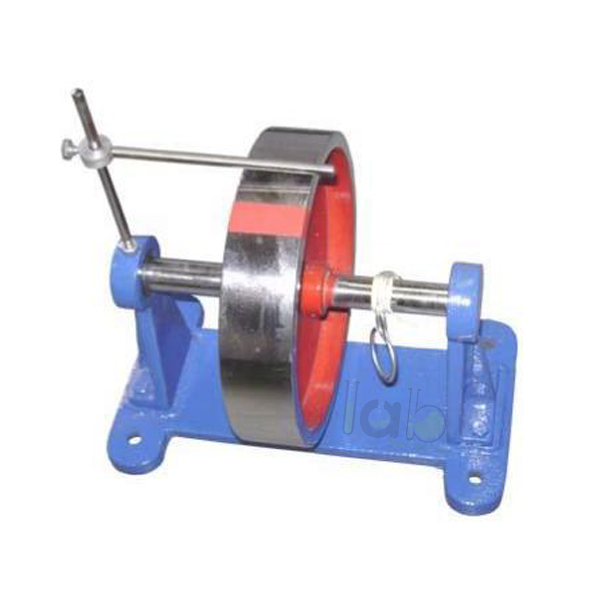
This fly wheel is used to find the moment of inertia of a flywheel from the energy given to it by a falling mass. A machined and balanced cast iron wheel turns on a steel spindle in ball bearings. Its base is fixed to a wall, and a cord and hook are supplied. The wheel is made in 15, 20 and 25 cm diameters.
Specifications of the fly wheel
| Component | Specification |
|---|---|
| Wheel | Cast iron, machined and balanced, sides painted |
| Top of wheel | Chrome plated, marked with a thick line |
| Spindle | Steel, on ball bearings in iron brackets |
| Shaft | Diametric hole to take a pin and cord |
| Pointer | Fixed to one of the brackets |
| Mounting | Base with four holes for wall fixing |
| Supplied with | Cord and hook |
| Wheel diameter | 15 cm, 20 cm or 25 cm |
| Superior model | With revolution counter |
| House code | EL-AM-10316 |
| Manufacturer | Lab Exports, Delhi |
Flywheel practicals by the falling mass method
A mass m on the cord falls and sets the wheel turning. The cord is wound n1 times round the axle of radius r, so it leaves the axle after the mass has fallen h = 2πrn1. The wheel then makes n2 more turns in a time t before friction stops it. It slows down steadily, so its angular velocity ω at the moment the cord leaves is twice the average, or ω = 4πn2/t.
Let f be the work done against friction in one turn. Energy gives mgh = ½mv2 + ½Iω2 + n1f, with v = ωr and n2f = ½Iω2. So I = [n2/(n1 + n2)] × [2mgh/ω2 - mr2].
- Moment of inertia of the flywheel. Loop the cord over the pin in the shaft, wind it n1 times and hang a slotted mass hanger with weights on the hook. Release it, and from the moment the cord comes free, time the remaining n2 turns with an analog stop clock. Measure the axle diameter with a vernier caliper; r is half of it.
- Friction in the bearings. The same readings give the work lost per turn, f = ½Iω2/n2. Comparing f found with different masses checks that the friction loss per turn stays the same, as the method assumes.
- Repeating with other masses. Run the experiment with two or three different masses on the hook. I belongs to the wheel alone, so the results should agree within experimental error.
Frequently Asked Questions
Why is the time taken only after the cord leaves the axle?
After the cord leaves, friction is the only torque on the wheel, so it slows down at a steady rate. The time for the last n2 turns then gives the angular velocity at the moment the cord leaves. The number n2 also gives the friction loss per turn.
How does friction in the bearings affect the result?
Friction takes part of the energy of the falling mass, so ignoring it would make I come out too large. The method allows for it through the n1f term, found from how long the wheel keeps turning. The ball bearings keep this loss small.
What precautions should be taken in a flywheel experiment?
Wind the cord evenly in one layer, and leave its loop loose on the pin so that it slips off cleanly. Choose a cord length that lets it leave the axle just as the mass reaches the floor. Start the stop clock exactly as the cord comes free.
Why are flywheels made heavier at the rim?
Mass far from the axle adds much more to the moment of inertia than mass near it. A heavy rim therefore stores more rotational energy for its weight and resists changes in speed. Engines use this to keep turning smoothly between power strokes.
How are the turns of the wheel counted?
Watch the thick line on the chrome-plated top of the wheel. Each time it passes the pointer fixed to the bracket, the wheel has made one full turn. The superior model has a revolution counter that records the turns for you.
Which wheel diameter should a lab choose?
Any of the three sizes suits the falling mass method, because the same formula and procedure apply to each. The wheel is made in 15, 20 and 25 cm diameters, and a larger wheel of the same design has a larger moment of inertia.
Other apparatus for rotational motion practicals
More apparatus is in the Applied Mechanics section of the Physics Lab range.
To enquire, email [email protected] with the house code EL-AM-10316 and the quantity, or use the Add To Cart button on this page.
Last updated: 19 November 2026