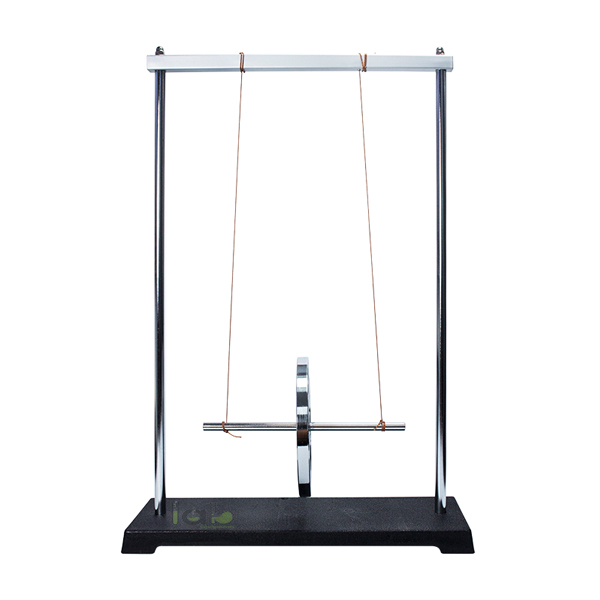
Moments Disc Apparatus

Product Code : EL-AM-10332
The moments disc apparatus is used to verify the principle of moments. Its 270 mm gridded aluminium disc, machine turned and well balanced, turns freely in a vertical plane. It rests on a central support pin in a fulcrum fitting on a tripod stand. A weight holder with slotted masses and a spring balance load the disc. A horizontal graduated mirror glass scale with a plumb line helps to measure the lever arms.
Specifications of the moments disc
| Component | Specification |
|---|---|
| Disc | Aluminium, 270 mm diameter, gridded, machine turned, well balanced |
| Support | Rests on a central support pin |
| Rotation | Turns freely about its axis |
| Mounting | Clamped on a tripod stand in a vertical plane |
| Loading | Weight holder with slotted masses, and a spring balance |
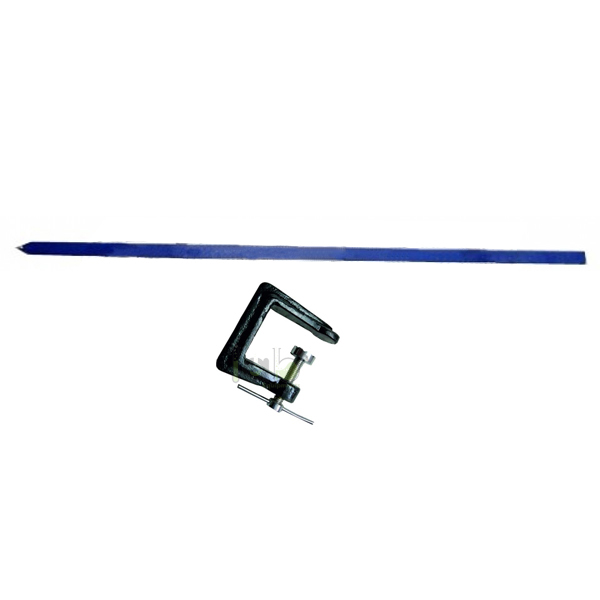
| Fulcrum | Fulcrum fitting supplied; it holds the support pin and clamps to the tripod stand |
| Scale | Horizontal graduated mirror glass scale, with plumb line |
| Not part of this set | Removable loading pins and hanging pans |
| House code | EL-AM-10332 |
| Manufacturer | Lab Exports, Delhi |
Moment experiments on the disc
The moment of a force about the axis is the force times the perpendicular distance from the axis to its line of action. The weight holder hangs straight down, so its lever arm is the horizontal distance from the axis to the vertical line through its point of attachment. At rest, the clockwise and anticlockwise moments are equal, which is rotational equilibrium.
- Weight against spring balance. Hang the weight holder on one side of the centre and load it with slotted masses. On the other side, pull straight down with the spring balance until the disc rests. Read both lever arms with the plumb line and mirror scale, or from the grid. Then compare Wd1 with Fd2. Here W is the weight of the holder and its masses, F the spring balance reading, and d1 and d2 their lever arms.
- Lever arm against distance along the disc. Attach the weight holder at a point above or below the horizontal line through the axis. Its distance from the axis along the disc is larger than its lever arm. Only the horizontal distance makes the moments agree, which shows that the perpendicular distance is what counts.
- A force at an angle. Pull with the spring balance at a slant instead of straight down. Its lever arm is now the perpendicular distance from the axis to the line of the balance. As that distance gets smaller, the reading needed to hold the disc gets larger.
- An unknown load. Hang one bob from a metal bob set in place of the weight holder, and balance it with the spring balance. Its weight is Wx = Fd/dx, where F is the balance reading, d its lever arm and dx the lever arm of the bob. Check the answer by weighing the bob on a physical balance.
Reading the lever arm without parallax
- Wait until the disc has come to rest, the weight holder hangs still and the spring balance reading is steady.
- Hang the plumb line from the point where the load is attached, so that its thread passes in front of the mirror glass scale.
- Move your eye until the thread covers its own image in the mirror, then read the scale.
- Take the reading for the axis in the same way, and use the difference between the two readings as the lever arm.
Frequently Asked Questions
How are the loads applied to the disc?
With the supplied weight holder, which carries the slotted masses, and with the spring balance. The holder gives a known weight on one side, and the spring balance gives a measured force on the other. Loading pins and hanging pans are not part of this set.
Why must the disc turn freely and be well balanced?
An unbalanced disc would add a moment from its own weight, and a stiff support could hold it away from true balance. This disc is machine turned and rests on a central support pin for that reason. Unloaded, it should stay at rest in any position.
How is parallax avoided when reading the mirror scale?
Line up the plumb thread with its image in the mirror glass before reading. When the thread hides its image, your eye is straight in front of the scale. Reading from one side would shift the apparent position of the thread.
Why should fans be switched off during the experiment?
Moving air swings the weight holder and the plumb line, so the disc does not settle and readings drift. Switch off fans, close nearby windows if needed, and read only when the disc, holder and thread are all still.
How can you tell whether the moments are balanced?
Work out the sum of the clockwise moments and the sum of the anticlockwise moments about the axis. If they are equal, the disc stays at rest in that position. If not, it turns until the lever arms change enough to make them equal.
Other apparatus for turning forces
More apparatus is in the Applied Mechanics section of the Physics Lab range.
To enquire, email [email protected] with the house code EL-AM-10332 and the quantity, or use the Add To Cart button on this page.
Last updated: 20 November 2026