Force and Friction Model

Product Code : SCL-AM-11114
The force and friction model is a single demonstration model for lessons on friction, the force that opposes motion between surfaces in contact. A class can compare the force needed to start motion with the force needed to keep it going, and see how extra load changes frictional resistance. The basic demonstration is mechanical and needs no power.
Specifications of the force and friction model
| Component | Specification |
|---|---|
| Format | Single demonstration model |
| Topics | Applied force, frictional resistance, static friction, sliding friction, load effect and motion |
| Power | None needed for the basic mechanical demonstration |
| Materials, dimensions and accessories | Given on request with the house code |
| House code | SCL-AM-11114 |
| Manufacturer | Lab Exports, Delhi |
Friction lessons with the model
Friction acts along the surface of contact and opposes motion or attempted motion. Before anything moves, static friction grows to match the pull, up to a limit μsN. Here N is the normal reaction and μs the coefficient of static friction. Once sliding starts, kinetic friction μkN takes over and is usually a little smaller.
- Starting force and sliding force. Place the model on a clean, level table. Pull slowly with a spring balance and note the reading at the moment motion begins. Then keep the object moving steadily and note the smaller reading.
- Effect of load. Add known masses from a physical weight box and repeat both readings. Plot both forces against the normal reaction. The slopes of the two lines give the coefficients of static and sliding friction.
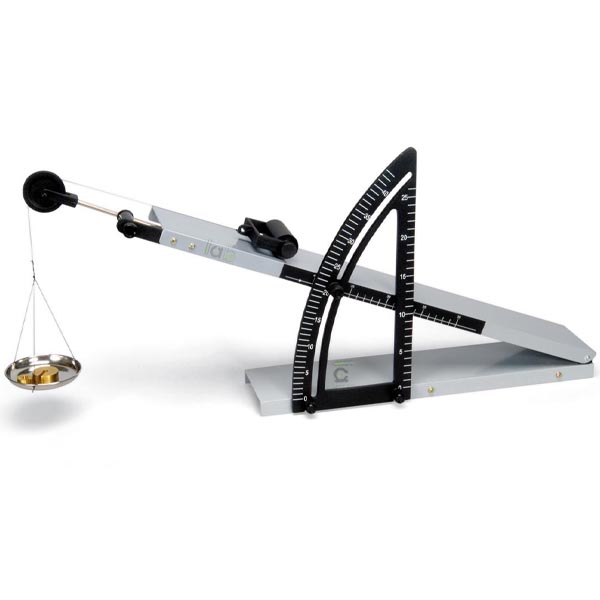
- Friction on a slope. As a follow-up, an inclined plane apparatus finds the coefficient of static friction from the angle θ at which a block just starts to slide, μs = tan θ.
Frequently Asked Questions
What is the difference between static and sliding friction?
Static friction acts before an object moves and grows with the pull up to a limit. Sliding friction acts once the surfaces slip past each other. Sliding friction is usually a little smaller, so it takes less force to keep an object moving than to start it.
What is limiting friction?
Limiting friction is the maximum value static friction can reach, just before motion starts. It equals μsN, where N is the normal reaction. In the demonstration it is the force reading at the moment the object begins to move.
How does adding load change the friction?
Friction rises in proportion to the normal reaction. Doubling the load on a level surface doubles N, so both the starting force and the sliding force roughly double. The coefficient of friction stays the same, because it depends on the two surfaces, not the load.
How is rolling friction different from sliding friction?
Rolling friction acts when a body rolls instead of sliding, as with wheels and ball bearings. For the same load it is much smaller than sliding friction. That is why wheels and bearings are used to cut friction in machines.
Is friction a conservative force?
No. The work done against friction depends on the path taken and turns into heat, so it cannot be recovered as mechanical energy. Surfaces dragged across each other for a long time become slightly warm for this reason.
Other apparatus for force and motion lessons
More apparatus is in the Applied Mechanics section of the Physics Lab range.
To enquire, email [email protected] with the house code SCL-AM-11114 and the quantity, or use the Add To Cart button on this page.
Last updated: 19 November 2026