Hydraulic Brake Model
Product Code : SCL-AM-11154
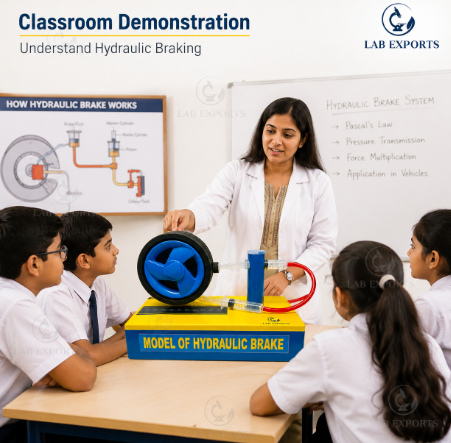
This hydraulic brake model is a working model of a vehicle brake and of Pascal's law. A 10 ml input syringe and a 20 ml wheel syringe, joined by flexible tubing, are mounted with a wheel and brake assembly on one base. It is supplied dry and filled with clean water before use. Pressing the input syringe by hand raises the water pressure, and the wheel syringe moves to brake the wheel.
Specifications of the hydraulic brake model
| Component | Specification |
|---|---|
| Principle | Pascal's law, transmission of pressure through an enclosed liquid |
| Actuators | Two syringes: 10 ml at the input, 20 ml at the wheel |
| Connection | Flexible connecting tubing between the two actuators |
| Liquid | Clean water, filled by the user; the model is supplied dry |
| Brake | Wheel and brake demonstration assembly |
| Mounting | All parts assembled on a common base |
| Operation | Manual, by pressing the input actuator |
| Subject area | Physics: applied mechanics and fluid pressure |
| House code | SCL-AM-11154 |
| Manufacturer | Lab Exports, Delhi |
Demonstrations with the hydraulic brake model
Pressure is force per unit area, p = F/A. In a closed liquid, a pressure applied at one point is passed on to every part of the liquid. A force F1 on an input piston of area A1 therefore gives F2 = F1 × A2/A1. Here F2 is the force on the output piston and A2 its area. The force gain is set by the ratio of the piston areas, not by the syringe volumes alone.
- Pressure carried along a pipe. Fill the syringes and tubing with clean water and push out any trapped air, so that the motion is steady. Press the input plunger slowly. The output syringe moves almost at once and the brake grips the wheel. Draw the plunger back and the brake lets go. Ask the class how the push travels round the bends in the tubing.
- The law before the machine. Introduce the law itself on a Pascal Law Apparatus, Weinholds Type. Then return to the brake model to show where the same law does useful work in a vehicle.
- Force and piston area. Discuss why a wider output piston gives a larger force but moves a shorter distance, so no work is gained. A Fluid Pressure Apparatus, Hydraulic Press uses the same rule to press or lift heavy loads.
What each part of the model stands for
- Input syringe (10 ml): the master cylinder, which the brake pedal drives in a car.
- Flexible tubing: the brake lines. In the model, water does the job of the brake fluid.
- Output syringe (20 ml): the cylinder at the wheel, which pushes the brake on.
- Wheel and brake assembly: the road wheel and the brake that slows it.
Documentation and supply
Most Lab Exports products carry a one-year manufacturer warranty.
Lab Exports manufactures the Hydraulic Brake Model at its works in Laxmi Nagar, Delhi, and supplies it to schools, colleges and universities in India and 60+ countries, handling the export documents for each shipment. More about the company is on the About Lab Exports page.
Frequently Asked Questions
What is Pascal's law?
Pascal's law states that a pressure applied to an enclosed fluid at rest is passed on undiminished to every part of the fluid and to the walls of its container. In this model the closed line is the tubing between the two syringes.
How do hydraulic brakes work in a vehicle?
Pressing the brake pedal pushes a piston into the master cylinder. Brake fluid carries that pressure along the brake lines to a cylinder at each wheel, and its piston pushes the brake on. In this model the input syringe acts as the master cylinder and the second syringe as the wheel cylinder.
What parts does the hydraulic brake model have?
It has a 10 ml input syringe and a 20 ml wheel syringe joined by flexible tubing, and a wheel and brake demonstration assembly. All the parts are mounted on one common base. It is supplied dry, to be filled with clean water. The model is worked by hand, by pressing the input actuator.
Why does air in the tubing make a hydraulic brake weak?
Air is easily squeezed, while a liquid hardly changes volume. Pressing the plunger then compresses the bubble instead of moving the output syringe, so the brake feels soft and grips poorly. That is why the brake lines of a vehicle are bled to remove air. On the model, push the air out while filling it with water.
Can a hydraulic system turn a small force into a large one?
Yes. The pressure is the same at both pistons, so the output force is larger in the ratio of the piston areas. The larger piston moves a shorter distance, so the work put in and the work got out stay equal.
Where else is Pascal's law used?
It is used in hydraulic jacks, presses and lifts, in the brakes of cars and motorcycles, and in the arms of earth-moving machines. In each, a liquid in a closed system passes a push from a small piston to a larger one.
Other apparatus for fluid pressure lessons
- Simple Pascal Law Experiment (Pressure String)
- Fluid Pressure Apparatus (Spouting Cylinder)
- U-Tube Manometer on Stand Table Model
More apparatus is in the Applied Mechanics section of the Physics Lab range.
To enquire, email [email protected] with the house code SCL-AM-11154 and the quantity, or use the Add To Cart button on this page.
Last updated: 23 November 2026