Kater's Reversible Pendulum
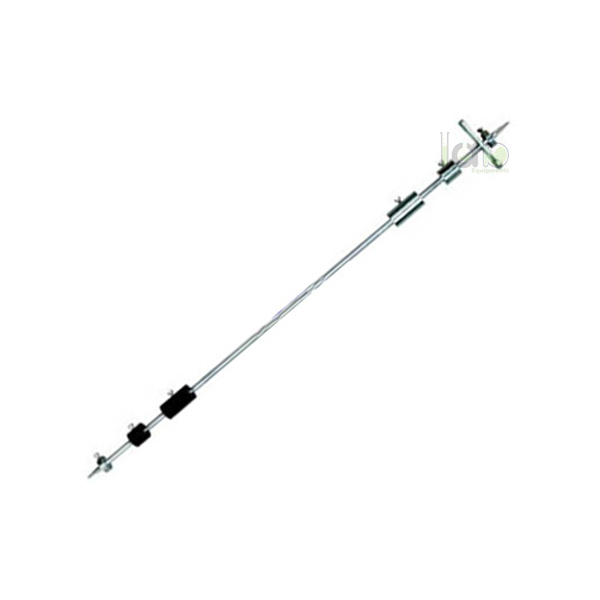
Product Code : EL-AM-10324
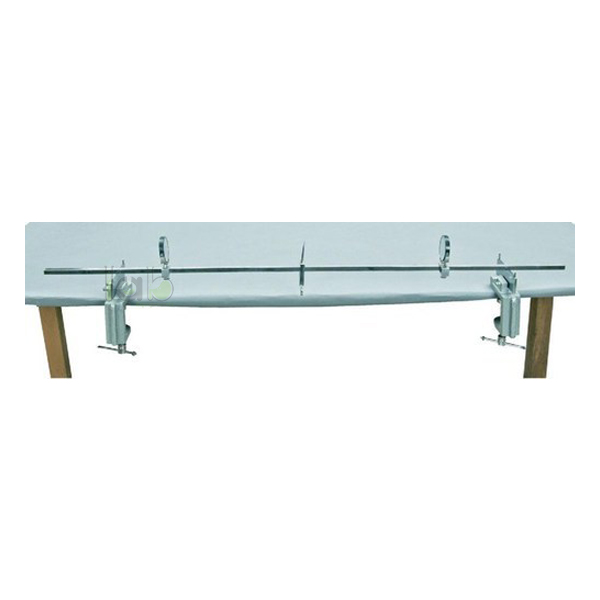
Kater's reversible pendulum measures the acceleration due to gravity, g, from two equal periods of swing. Its round nickel-plated brass rod is 1,200 mm long and 10 mm in diameter, with pointed ends and two sets of adjustable knife edges. It has large and small brass weights and two hardwood weights. A cast iron wall bracket and a stand of about 52 inches come with it.
Specifications of Kater's pendulum
| Component | Specification |
|---|---|
| Rod | Round, nickel-plated brass, 1,200 mm long, 10 mm diameter, pointed ends |
| Knife edges | Two sets, adjustable |
| Brass weights | Large and small |
| Hardwood weights | Two, similar |
| Wall bracket | Cast iron |
| Stand | Approx. 52 inches (about 1.3 m) high |
| Variants | Stainless steel rod with brass weights, or steel chrome-plated rod |
| House code | EL-AM-10324 |
| Manufacturer | Lab Exports, Delhi |
Finding g with the reversible pendulum
A compound pendulum can have the same period about two points on opposite sides of its centre of gravity. This happens when the distance L between the points equals the length of the equivalent simple pendulum. With the same period T about both knife edges, g = 4π2L/T2.
In practice the periods T1 and T2 about the two knife edges are made nearly equal, not exactly equal. Bessel's formula, given in the first task below, then yields g. In it, l1 and l2 are the distances of the two knife edges from the centre of gravity.
- g by Kater's method. Hang the pendulum by one knife edge on the wall bracket or stand. Time a fixed number of small swings with an analog stop clock to get T1, then reverse it and get T2. Move the weights until the two agree closely. Balance the pendulum, with its weights in place, on a knife edge to find its centre of gravity and measure l1 and l2. Then 8π2/g = (T12 + T22)/(l1 + l2) + (T12 - T22)/(l1 - l2).
- Periods against weight position. Move one brass weight along the rod in steps, finding T1 and T2 at each step. Plot both against the weight position. The two curves cross where the periods are equal, which shows where to set the weight.
- Comparison with a simple pendulum. Hang one of the pendulum bobs on a thread and time it at a few lengths. The slope of T2 against length gives another value of g to set beside the Kater result.
Frequently Asked Questions
What is the principle of Kater's pendulum?
Its principle is that the point of suspension and the centre of oscillation of a compound pendulum can be swapped without changing the period. Matching the periods on two knife edges finds such a pair of points, and their spacing is the equivalent simple pendulum length.
Why is Kater's pendulum more accurate than a bar pendulum?
Because g then depends mainly on the distance between the knife edges, which can be measured precisely. A bar pendulum needs its centre of gravity and radius of gyration found accurately. With Kater's method the centre of gravity is needed only roughly, for the small second term of Bessel's formula.
Why does the pendulum carry hardwood weights as well as brass ones?
They let the pendulum stay weighted towards one end while keeping a similar outside shape at both ends. The light hardwood weights balance the shape of the heavy brass ones, not their mass. Air drag then acts alike on both swings, so its effect on the two periods largely cancels.
Why are both large and small brass weights provided?
They give coarse and fine adjustment of the periods. Moving the large weight changes T1 and T2 quickly and brings them near each other. The small weight then makes the last small changes until the two periods agree closely.
What precautions should be taken in the Kater's pendulum experiment?
Keep the swings small, since the period grows at larger amplitudes. Seat the knife edge firmly and level on the bracket, and check that the rod does not wobble sideways. Time many swings, and measure the distance between the knife edges with care.
Is the pendulum available with a steel rod?
Yes. The standard model has a round nickel-plated brass rod, 1,200 mm long and 10 mm in diameter, with pointed ends. Variants have a stainless steel rod with brass weights, or a steel chrome-plated rod. Name the one you need in the enquiry.
Other apparatus for oscillation practicals
More apparatus is in the Applied Mechanics section of the Physics Lab range.
To enquire, email [email protected] with the house code EL-AM-10324 and the quantity, or use the Add To Cart button on this page.
Last updated: 20 November 2026