Windmill Model Kit
Product Code : SCL-AM-11321
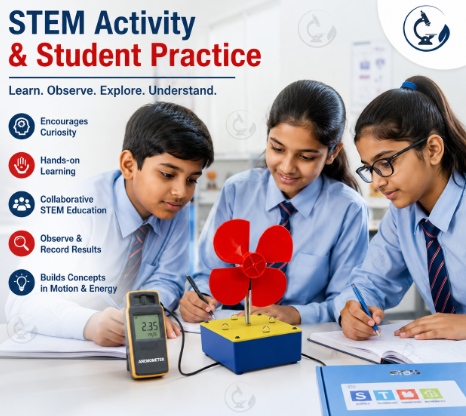
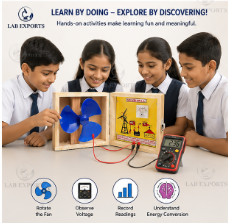
This windmill model kit is a renewable energy demonstration model in which moving air acting on the blades turns a rotor, the working principle of a wind turbine. The mechanical kit has blades, hub, shaft, bearings, tower, base and fasteners, with an assembly guide. An external fan supplies the airflow. Teachers use it to compare wind with solar and hydro power.
Specifications of the windmill model kit
| Component | Specification |
|---|---|
| Catalogue name | Windmill Model |
| Model type | Physics laboratory renewable energy demonstration model |
| Principle | Airflow on the blades producing rotational motion of the rotor |
| Use | Teacher demonstrations, student observation and STEM activities |
| Kit contents | Blades, hub, shaft, bearings, tower, base, fasteners and an assembly guide |
| Electrical option | Generator, leads, output terminals and load, as a separate option |
| Airflow | From an external fan |
| House code | SCL-AM-11321 |
| Manufacturer | Lab Exports, Delhi |
Teaching wind power with the kit
Each blade is set at an angle to the oncoming air. Air striking the blade is turned aside, and the blade is pushed the opposite way. The part of that push acting around the axle makes the rotor turn, and faster air gives a larger push.
- Action and reaction at the blade. First show a pair of equal and opposite forces with the Newton’s Third Law Model. Then build the windmill from the assembly guide, stand it on a flat, dry table and direct a steady airflow from a fan at it. Hold a light paper strip just behind a blade to see the air turned aside, and ask which way the blade is pushed in return.
- Comparing renewable sources. Set the windmill beside the Hydro Power Model and the Solar Energy Kit with Lamp. Discuss what drives each one: moving air, moving water or light. Then discuss why wind output varies with the weather, and why wind turbines are sited on high, open ground.
- The limit on wind energy. No wind machine can capture all the kinetic energy of the air passing through it, because the air must keep moving to leave the blades. The theoretical maximum, the Betz limit, is 16/27, or about 59 per cent of the energy in the wind.
Documentation and supply
Most Lab Exports products carry a one-year manufacturer warranty.
Lab Exports manufactures the Windmill Model Kit at its works in Laxmi Nagar, Delhi, and supplies it to schools, colleges and universities in India and 60+ countries, handling the export documents for each shipment. More about the company is on the About Lab Exports page.
Frequently Asked Questions
Why are windmill blades set at an angle to the wind?
An angled blade turns the oncoming air aside, and the reaction pushes the blade round the axle. A blade square to the wind is only pushed backwards, and one edge-on to the wind catches almost nothing. Between these two, a suitable angle turns the rotor fastest.
Does a windmill with more blades turn faster?
Not necessarily. More blades give more turning force at low wind speeds, which suits slow work such as pumping water. Fewer, slimmer blades usually spin faster. That is one reason most wind turbines built to make electricity have three blades.
What comes in the windmill model kit?
The mechanical kit has blades, a hub, a shaft, bearings, a tower, a base, fasteners and an assembly guide. A generator, leads, output terminals and a load form a separate electrical option. The airflow comes from an external fan.
Is a windmill the same as a wind turbine?
Not quite. A traditional windmill uses the wind to do mechanical work directly, such as grinding grain or pumping water. A wind turbine uses the same turning motion to drive a generator and make electricity. The rotor works on the same principle in both. With the electrical option fitted, this kit works as a small wind turbine model.
Why are wind turbines built on high, open ground?
The wind there is stronger and steadier. Near the ground, hills, buildings and trees slow the air and make it gusty. Faster, steadier wind keeps the rotor turning for more of the time and carries more energy.
Other models for comparing energy sources
More apparatus is in the Applied Mechanics section of the Physics Lab range.
To enquire, email [email protected] with the house code SCL-AM-11321 and the quantity, or use the Add To Cart button on this page.
Last updated: 23 November 2026