Inclined Plane Brass

Product Code : EL-AM-10326
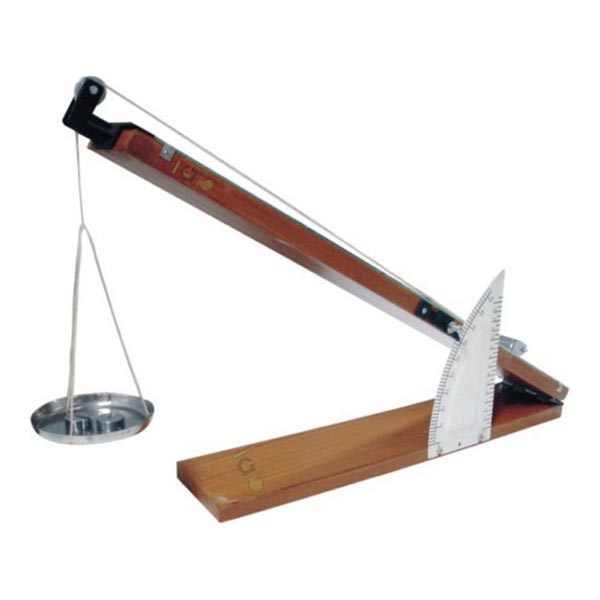
This inclined plane apparatus is a 15 × 60 cm wooden board with a glass top, hinged on an iron base. It clamps at any angle up to 45 degrees, read on a sector with a graduated arc and vertical scale. A 5 cm pulley, a brass roller, a cart and a pan are supplied for finding the downward force on a slope.
Specifications of the inclined plane
| Component | Specification |
|---|---|
| Board | Wooden, 15 × 60 cm, glass top |
| Base | Iron, with the board hinged on it |
| Angle | Clampable at any angle up to 45 degrees |
| Angle scale | Sector with graduated arc and vertical scale |
| Pulley | 5 cm dial, frictionless, on an adjustable clamp at the end |
| Supplied with | Brass roller, cart and pan |
| Weights | Not included |
| House code | EL-AM-10326 |
| Manufacturer | Lab Exports, Delhi |
Force experiments on the inclined plane
On a smooth plane at angle θ, the weight W of the roller has two parts. W sin θ acts down the slope and W cos θ presses into the surface. A cord from the roller runs over the pulley to the pan. The pan balances the down-slope part when its total weight P equals W sin θ, as long as the cord is parallel to the plane.
- Downward force on a roller. Weigh the brass roller on a spring balance to get W. Set an angle and load the pan with masses from a brass mass set until the roller stays at rest. Repeat at several angles up to 45 degrees. A graph of P against sin θ is a straight line through the origin, with slope W.
- Roller and cart compared. Repeat the readings with the cart in place of the roller. Each set should follow P = W sin θ for its own weight, as long as rolling friction stays small.
- The inclined plane as a simple machine. The pan load P is the effort that holds the load W on the slope. The mechanical advantage W/P equals 1/sin θ, so it falls as the board is raised.
Taking a balance reading on the slope
- Set the board to the chosen angle on the graduated arc and clamp it.
- Adjust the pulley clamp until the cord from the roller runs parallel to the glass top.
- Add masses to the pan until the roller moves slowly up the slope at a steady speed after a light push.
- Remove masses until it moves slowly down instead, and take the mean of the two pan loads.
- Record P, the weight of the pan and its load together, against the angle.
Frequently Asked Questions
Why must the cord run parallel to the plane?
Only then does the pull of the pan act along the slope and balance W sin θ exactly. If the cord slopes up or down from the plane, part of the pull lifts the roller or presses it down. Adjust the pulley clamp to line the cord up with the glass.
Why is the force plotted against sin θ and not against the angle?
The down-slope force equals W sin θ, so it is proportional to sin θ and not to the angle itself. Plotted against sin θ, the points lie on a straight line through the origin. Plotted against the angle, they would curve.
Why is a roller used rather than a block?
A roller rolls, so the friction it meets on the smooth glass is far smaller than the sliding friction on a block. The pan load then measures the down-slope part of the weight almost alone. A block would need extra load to overcome friction, which hides the sin θ relation.
What are the main sources of error in this experiment?
The main ones are friction in the pulley and between the roller and the plane, a misread angle and a cord that is not parallel to the plane. Read the arc at eye level, keep the glass clean, and average the loads for slow upward and downward motion.
Why does an inclined plane make it easier to raise a load?
The effort needed along the slope is only W sin θ, which is less than the weight W for any slope less steep than vertical. In return, the load travels a longer distance along the slope. Like other simple machines, it trades a smaller force for a longer path.
Other apparatus for resolving forces
More apparatus is in the Applied Mechanics section of the Physics Lab range.
To enquire, email [email protected] with the house code EL-AM-10326 and the quantity, or use the Add To Cart button on this page.
Last updated: 19 November 2026