DCC Copper Wire (100gm)
Product Code : SCL-AM-11223
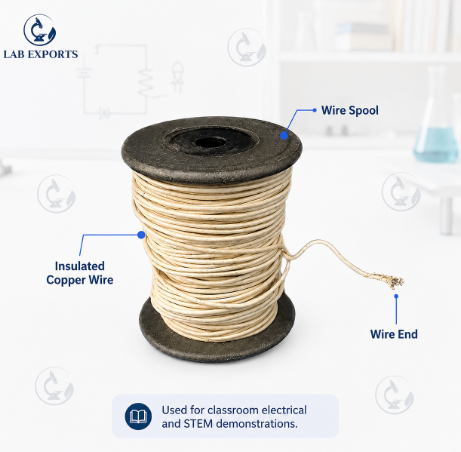
This DCC copper wire is double cotton covered: 0.90 mm bare copper with two cotton wraps, in a 100 gm net pack for winding coils. The covering keeps neighbouring turns apart, so current flows round the full length of the coil instead of shorting between turns. It is used for electromagnets, induction experiments and simple motor, relay and transformer models.
Specifications of the DCC copper wire
| Component | Specification |
|---|---|
| Conductor | Copper, 0.90 mm bare diameter |
| Designation | DCC (double cotton covered copper wire) |
| Covering | Two cotton wraps; the diameter over the covering is larger than the 0.90 mm conductor |
| Pack weight | 100 gm net |
| Type | Electrical and electronics laboratory consumable |
| Enamelled option | Enamelled conductor under the cotton covering, as a separate insulation option |
| Insulation rating | Cotton covering only; it carries no stated mains insulation rating |
| House code | SCL-AM-11223 |
| Manufacturer | Lab Exports, Delhi |
Coil-winding practicals with DCC wire
DCC stands for double cotton covered: here two cotton wraps cover a 0.90 mm copper conductor. The covering carries no stated mains insulation rating, so use these coils with low-voltage supplies only. The pack can be cut into shorter lengths for group or individual work. Before making any connection, scrape the covering off each free end to expose bare copper.
- Making an electromagnet. Wind the wire neatly round an iron nail or soft iron core, all turns in the same direction, leaving two free ends. Connect it to a low-voltage supply such as a battery eliminator through a one way plug key. Close the key and count the pins the core picks up, then add turns and test again.
- Current and magnet strength. Keep the number of turns fixed and put a rheostat in series. Change the current in steps and count the pins each time. The core holds more pins as the current rises.
- Electromagnetic induction. Wind a coil on a card tube and join its ends to a galvanometer. Push one pole of a bar magnet into the coil and pull it out again. The needle deflects one way, then the other, and only while the magnet is moving.
- Motor, relay and transformer models. The same wire winds the coils of a simple motor, a relay or a transformer model. In each one, the covering keeps the turns from touching each other.
Documentation and supply
Most Lab Exports products carry a one-year manufacturer warranty.
Lab Exports manufactures the DCC copper wire at its works in Laxmi Nagar, Delhi, and supplies it to schools, colleges and universities in India and 60+ countries, handling the export documents for each shipment. More about the company is on the About Lab Exports page.
Frequently Asked Questions
How is DCC wire different from enamelled copper wire?
DCC wire has a fibrous covering wrapped round the copper, while enamelled wire has only a thin film of insulating varnish. The covered wire takes more space per turn, but it is easy to handle and to bare by scraping. Enamelled wire packs more turns into a small coil. An enamelled conductor under the cotton covering is a separate option for this wire.
What wire gauge is supplied?
The conductor is 0.90 mm bare copper, and the double cotton covering makes the overall diameter larger. As a rule, a thicker wire carries more current with less heating. A thinner wire fits more turns into the same space.
How can an electromagnet wound with this wire be made stronger?
Add more turns, pass a larger current, or wind the coil on a soft iron core. The strength rises with the number of turns and with the current. Keep the turns close together and wind them all in the same direction, so that their fields add.
Why does the coil get warm, and how can this be avoided?
Current flowing through the resistance of the wire turns some electrical energy into heat. A long run at high current can make the coil hot. Use a low-voltage supply, close the key only while taking a reading, and let the coil cool between tests.
Why must the covering be scraped off the ends?
The covering is an insulator, so current cannot pass through it into a terminal. Scraping exposes bare copper for a firm contact. Scrape all the way round each end, and leave the rest of the wire covered so that the turns stay insulated.
Other items for electromagnetism practicals
More apparatus is in the Applied Mechanics section of the Physics Lab range.
To enquire, email [email protected] with the house code SCL-AM-11223 and the quantity, or use the Add To Cart button on this page.
Last updated: 23 November 2026