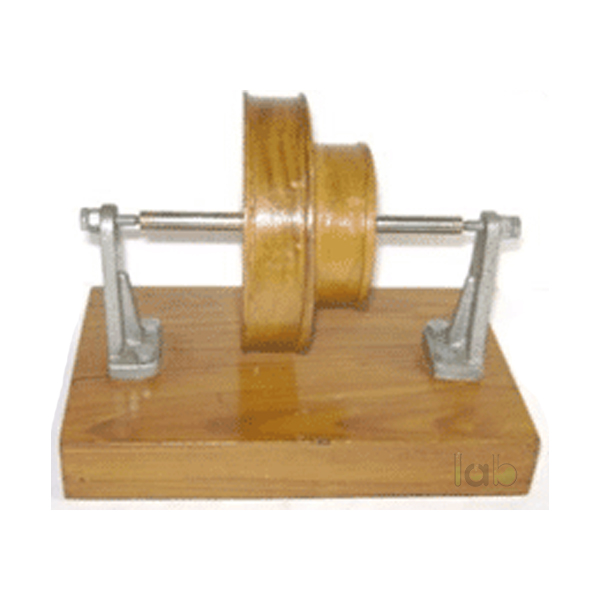
Fletcher Trolley

Product Code : EL-AM-10331
The Fletcher trolley is an all-metal apparatus for the laws of motion. A metal trolley with removable cylindrical weights runs on a track of two 150 cm steel rods. A load in a scale pan pulls it through a cord over a frictionless pulley, while a steel vibrator with brush and ink records the motion.
Specifications of the Fletcher trolley
| Component | Specification |
|---|---|
| Trolley | Metal, with low-friction wheels and removable cylindrical weights |
| Track | Two steel rods, 150 cm long |
| Frame | Heavy clamps on two vertical rods, on cast iron feet |
| Vibrator | Steel, fitted to one vertical rod |
| Pulley | Frictionless, fitted to the other vertical rod |
| Supplied with | Cord, scale pan, brush and ink |
| Construction | All metal; assembles and dismantles easily |
| House code | EL-AM-10331 |
| Manufacturer | Lab Exports, Delhi |
Laws of motion experiments with the Fletcher trolley
A load of mass m in the scale pan pulls the trolley, of mass M, along the rods. With friction small, the acceleration is a = mg/(M + m), where g is the acceleration due to gravity. The swinging vibrator brushes a wavy ink trace on a paper strip fixed to the moving trolley. Each wave takes one period T of the vibrator, so successive wave lengths differ by a T2.
- Acceleration and force at constant mass. Find the masses of the trolley and its cylindrical weights on a physical balance. Move the weights one at a time from the trolley to the scale pan. The total moving mass M + m stays the same while the pulling force mg rises. With friction allowed for, a graph of a against mg is a straight line through the origin.
- Acceleration and mass at constant force. Keep the pan load fixed and take cylindrical weights off the trolley. As the total mass falls the acceleration rises, and the product a(M + m) stays nearly constant.
- Period of the vibrator. Set the vibrator swinging and time a counted number of swings, n, with an analog stop clock. The period T is the time divided by n. It is needed to turn wave lengths on the trace into an acceleration.
- Value of g. Rearranging a = mg/(M + m) gives g = a(M + m)/m. Use the acceleration from the trace and the masses from the balance.
Reading the brush trace
- Assemble the track on its vertical rods and cast iron feet, and level it so that the unloaded trolley stays at rest.
- Fix a paper strip on the trolley, ink the brush and set it to touch the paper lightly.
- Pass the cord over the pulley to the scale pan, add a load, start the vibrator and release the trolley.
- Skip the first wave or two, measure several successive wave lengths along the strip and find their differences.
- Equal differences show uniform acceleration. Divide the mean difference by T2 to get a.
Frequently Asked Questions
How is friction in the trolley allowed for?
Tilt the track very slightly, instead of setting it exactly level, before loading the pan. With the cord unhooked, raise the end away from the pulley until the trolley runs at a steady speed after a gentle push. Part of its weight then balances friction, and the pan load alone gives the net accelerating force.
Why are weights moved from the trolley to the pan instead of adding new ones?
Moving them keeps the total moving mass M + m the same. Only the pulling force changes, so any change in acceleration comes from the force alone. Adding fresh masses to the pan would raise the force and the mass together.
Why are differences between waves used rather than timing from the start?
The trolley can get a small jerk as it is released, so it may not start cleanly from rest. Successive wave lengths each cover one period T, and their difference equals a T2 whatever the starting speed. The result then does not depend on how the run began.
How does the experiment show the second law of motion?
The acceleration is found to be proportional to the net force at fixed mass, and inversely proportional to the total mass at fixed force. Together these give a = F/m, which is the second law written as F = m a.
Can the Fletcher trolley be used to find g?
Yes. Measure the acceleration from the trace and the masses on a balance, then g = a(M + m)/m. Friction that is not balanced makes the value come out low, so allow for friction first and repeat with several pan loads.
Other apparatus for laws of motion practicals
More apparatus is in the Applied Mechanics section of the Physics Lab range.
To enquire, email [email protected] with the house code EL-AM-10331 and the quantity, or use the Add To Cart button on this page.
Last updated: 19 November 2026